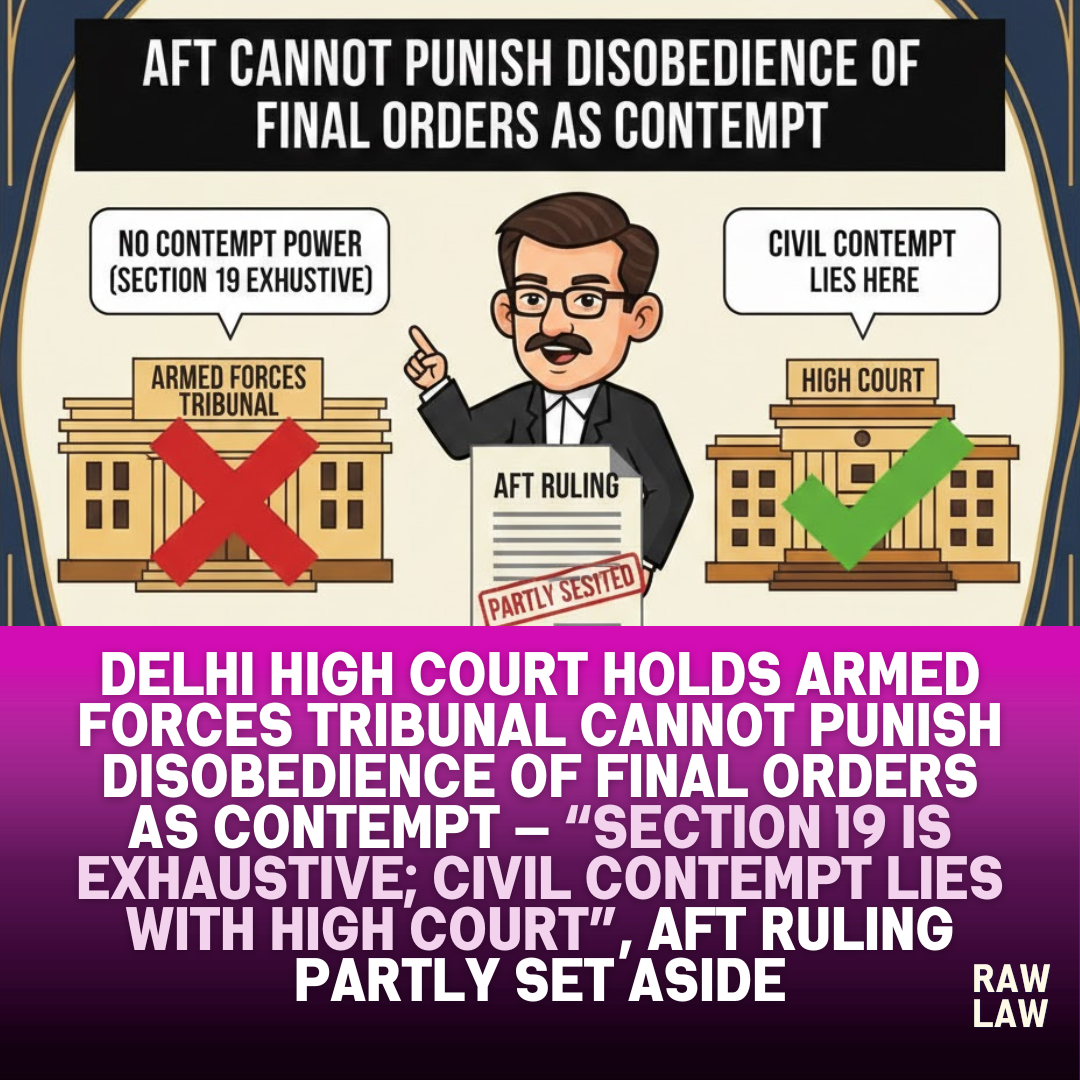
Delhi High Court holds Armed Forces Tribunal cannot punish disobedience of final orders as contempt — “Section 19 is exhaustive; civil contempt lies with High Court”, AFT ruling partly set aside

Court’s decision
The Delhi High Court allowed the writ petition filed by the Union of India and partly set aside the Full Bench decision of the Armed Forces Tribunal which had held that non-implementation of its final orders amounted to contempt under Section 19 of the Armed Forces Tribunal Act, 2007.
The High Court ruled that Section 19 exhaustively defines the Tribunal’s contempt powers and does not extend to civil contempt for disobedience of final orders. While clarifying that interlocutory disobedience disrupting ongoing proceedings may attract Section 19, the Court held that enforcement of final orders lies within the High Court’s jurisdiction under Section 10 of the Contempt of Courts Act, 1971.
Facts
The matter arose from a detailed Full Bench judgment of the Armed Forces Tribunal delivered on 31 July 2024. The Tribunal examined the alarming statistic that 5612 of its orders remained unimplemented. Concerned about systemic non-compliance, the Tribunal framed two legal questions relating to the scope of its contempt powers under Section 19 of the AFT Act and its authority under Section 29 read with Rule 25 of the AFT (Procedure) Rules, 2008.
The Tribunal concluded that persistent non-compliance of its orders could amount to contempt and that it possessed powers akin to a court of record. It invoked Rule 25 to assert inherent authority to enforce its decisions.
The Union of India challenged this interpretation before the Delhi High Court, contending that the Tribunal had exceeded its statutory limits.
Issues
The High Court framed the controversy around three principal legal questions:
- Whether Section 19 of the AFT Act empowers the Tribunal to punish disobedience of its final orders as civil contempt.
- Whether the Tribunal can derive such power from Rule 25 of the 2008 Rules.
- Whether, in absence of such power, the High Court’s jurisdiction under Section 10 of the Contempt of Courts Act applies.
Petitioner’s arguments
The Union of India contended that contempt jurisdiction must be expressly conferred by statute and cannot be implied. Section 19 narrowly defines contempt as using insulting or threatening language or causing interruption or disturbance in the Tribunal’s proceedings. It does not mention civil contempt or wilful disobedience of final orders.
The petitioner emphasised that a 2012 Amendment Bill proposing to confer broader contempt powers on the Tribunal was withdrawn, demonstrating legislative intent not to vest civil contempt powers in the AFT.
It was further argued that Rule 25 cannot enlarge statutory powers and that the Tribunal is not a court of record under Article 215 of the Constitution.
Respondent’s arguments
The respondent officer argued that unless the Tribunal could punish non-compliance, its orders would become ineffective. He contended that Rule 25 preserved inherent powers necessary to secure the ends of justice and to give effect to its orders.
It was submitted that failure to implement orders amounted to obstruction of justice and should fall within the ambit of Section 19. The respondent further argued that Section 10 of the Contempt of Courts Act would not apply as the Tribunal is not subordinate to the High Court in the conventional sense.
Analysis of the law
The Court held that the AFT Act constitutes a self-contained code. Being a statutory tribunal, the AFT cannot assume powers beyond those expressly conferred. Section 19 is exhaustive of its contempt jurisdiction.
Interpreting Section 19, the Court clarified that “interruption or disturbance in the proceedings” refers to acts affecting ongoing proceedings. Once a final order is passed, proceedings conclude. Subsequent non-compliance does not disturb pending proceedings and therefore cannot fall within Section 19.
The Court rejected the Tribunal’s reasoning that it possessed powers of a court of record. Relying on precedent, it held that tribunals are not courts of record unless expressly declared so.
Precedent analysis
The Court relied on T. Sudhakar Prasad v. Government of Andhra Pradesh, which held that contempt jurisdiction must be statutorily conferred and tribunals are not courts of record.
It also referred to Union of India v. Air Commodore N.K. Sharma, emphasising limits on tribunal powers, and discussed jurisprudence on purposive interpretation of beneficial statutes while cautioning against judicial legislation.
The Court respectfully disagreed with the Kerala High Court decision in A. Shihabudeen v. Principal Controller of Defence, holding that equating non-implementation of final orders with disturbance of proceedings impermissibly stretches statutory language.
Court’s reasoning
The Court acknowledged the seriousness of 5612 unimplemented orders and appreciated the Tribunal’s concern. However, it held that judicial sympathy cannot override statutory limits.
It ruled that disobedience of interlocutory orders that disrupt ongoing proceedings may attract Section 19. But disobedience of final orders does not constitute disturbance of proceedings.
Importantly, the Court interpreted Section 10 of the Contempt of Courts Act purposively. To prevent orders of tribunals from becoming unenforceable, the High Court can exercise contempt jurisdiction over non-compliance with AFT orders.
Rule 25, the Court clarified, recognises inherent powers to issue directions for enforcement but does not authorise incarceration absent statutory backing.
Conclusion
The Delhi High Court held that the Armed Forces Tribunal cannot punish wilful disobedience of its final orders as contempt under Section 19. The Tribunal’s contempt power is limited to acts disrupting ongoing proceedings.
Enforcement of final orders lies with the High Court under Section 10 of the Contempt of Courts Act. Rule 25 empowers the Tribunal to issue necessary enforcement directions short of imprisonment but does not expand contempt jurisdiction.
Accordingly, the impugned Full Bench decision was set aside to the extent it held otherwise.
Implications
This ruling significantly clarifies the scope of contempt jurisdiction under the Armed Forces Tribunal Act. It prevents judicial overreach while safeguarding enforceability of tribunal orders.
The decision underscores that statutory tribunals cannot assume powers not conferred by Parliament. At the same time, it ensures that members of the Armed Forces are not left remediless, as High Courts retain contempt jurisdiction to enforce AFT orders.
The judgment balances separation of powers, statutory interpretation, and institutional authority within India’s judicial framework.
Case Law References
- T. Sudhakar Prasad v. Government of Andhra Pradesh (2001) 1 SCC 516 – Tribunals are not courts of record; contempt powers must be statutory.
- Union of India v. Air Commodore N.K. Sharma (2023 SCC OnLine SC 1673) – Limits on tribunal authority.
- State of U.P. v. Roshan Singh (2008) – Interpretation of statutory powers.
- Niaz Mohammad v. State of Haryana (1994) – Contempt jurisdiction principles.
- A. Shihabudeen v. Principal Controller of Defence (Kerala High Court) – Distinguished and not followed.
FAQs
1. Can the Armed Forces Tribunal punish non-compliance of its final orders as contempt?
No. The Delhi High Court has held that Section 19 of the AFT Act does not cover civil contempt for disobedience of final orders.
2. Who enforces final orders of the Armed Forces Tribunal?
The High Court can exercise contempt jurisdiction under Section 10 of the Contempt of Courts Act to ensure compliance.
3. Does Rule 25 give the AFT unlimited enforcement powers?
No. Rule 25 recognises inherent powers to issue directions for implementation but does not authorise imprisonment absent statutory sanction.