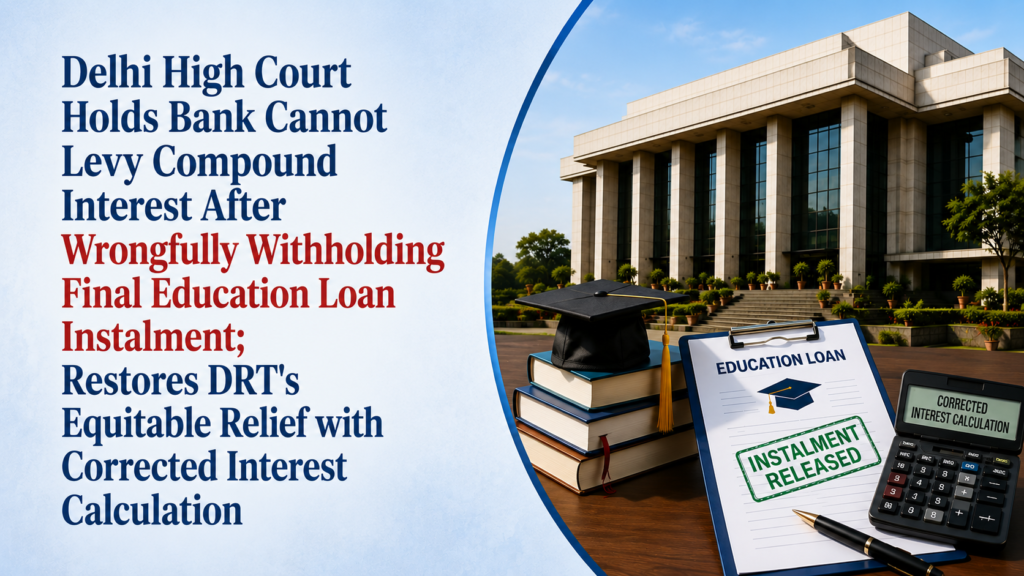
Delhi High Court Holds Bank Cannot Levy Compound Interest After Wrongfully Withholding Final Education Loan Instalment; Restores DRT’s Equitable Relief with Corrected Interest Calculation

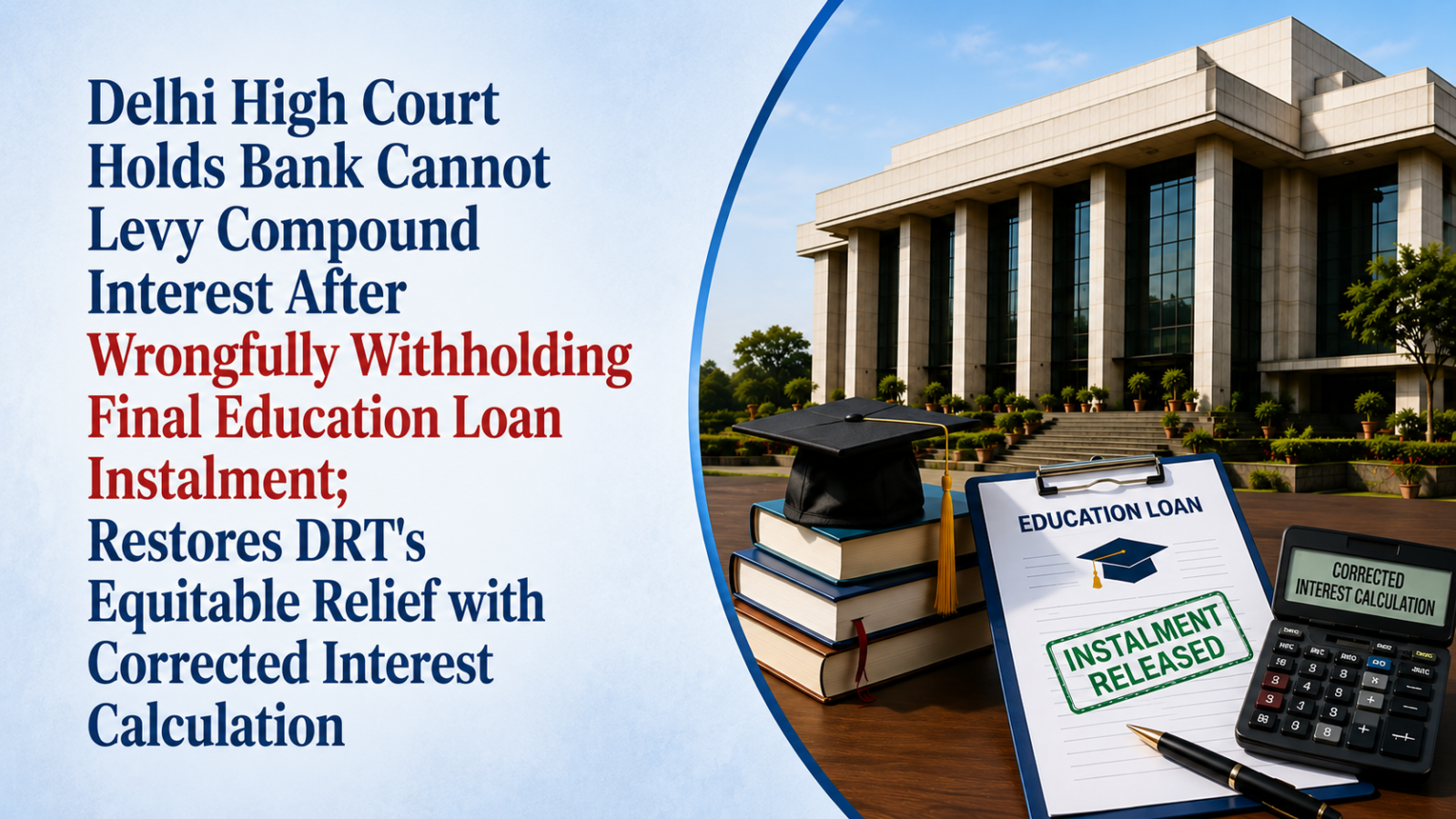
Delhi High Court Holds Bank Cannot Charge Compound Interest After Wrongfully Withholding Final Education Loan Instalment; Orders Fresh Recalculation
Facts
The petitioners obtained an education loan of ₹15 lakh from the Central Bank of India to finance the overseas undergraduate education of Petitioner’s son in the United States. Although the bank sanctioned the entire loan, it disbursed only three instalments totaling ₹11.25 lakh and withheld the fourth and final instalment of ₹3.75 lakh, insisting upon additional collateral security despite no such requirement in the sanction terms.
The petitioners alleged that withholding the final instalment prevented completion of the student’s education and breached the loan agreement. Meanwhile, the bank initiated recovery proceedings before the Debt Recovery Tribunal (DRT) claiming default. During those proceedings, Fixed Deposit Receipts (FDRs) worth ₹35.11 lakh were furnished by the petitioners and later appropriated by the bank. Earlier proceedings culminated in a remand by the Delhi High Court directing fresh computation after production of proper statements of account. Upon remand, the DRT granted equitable relief by directing computation on simple interest alone. However, the DRAT modified that relief by restoring compound and penal interest, leading to the present writ petition.
Issues
- Whether a bank that wrongfully withholds the final sanctioned education loan instalment can still recover compound and penal interest.
- Whether the DRAT was justified in interfering with the DRT’s discretionary equitable relief.
- Whether the DRT correctly computed the petitioners’ liability by treating all disbursements as one lump sum.
- Whether liability should instead be calculated separately from the date of each instalment.
Petitioners’ Arguments
The petitioners contended that:
- The bank itself breached the loan agreement by withholding the final sanctioned instalment.
- The sanction letter never required additional collateral security.
- The bank’s conduct frustrated the very purpose of the educational loan and adversely affected the student’s education.
- Despite earlier judicial directions, the bank failed to produce complete statements of account.
- The DRAT, though formally allowing their appeal, effectively denied meaningful relief by restoring compound and penal interest.
Respondent’s Arguments
The bank argued that:
- Earlier account records became unavailable due to migration from its standalone banking system to the Core Banking System.
- During the moratorium period only simple interest was chargeable, so missing records caused no prejudice.
- Compound and penal interest became contractually payable after expiry of the moratorium.
- The petitioners had acknowledged receipt of only three instalments through their own correspondence.
Analysis of the Law
The Court emphasized that educational loans are granted to facilitate education and that withholding a sanctioned instalment during the course defeats the very object of such financing.
The Court further held that an appellate tribunal cannot substitute its own discretion merely because it would have reached a different conclusion. Interference is permissible only where the original exercise of discretion is arbitrary, capricious, perverse, or contrary to settled legal principles.
The Court also held that interest computation must reflect the actual dates on which each instalment was disbursed and cannot be based on an artificial assumption that the entire amount was released on one date.
Precedent Analysis
The Court relied upon:
- Wander Ltd. v. Antox India (P) Ltd. – appellate courts should not interfere with discretionary orders unless shown to be arbitrary, capricious, perverse, or contrary to settled principles.
- Mohd. Mehtab Khan v. Khushnuma Ibrahim Khan – reaffirmed the limited scope of appellate interference with discretionary orders.
- Ramdev Food Products (P) Ltd. v. Arvindbhai Rambhai Patel – reiterated that appellate substitution of discretion is impermissible absent perversity or arbitrariness.
Court’s Reasoning
The Court observed that:
- The bank had accepted the collateral at the time of sanction and released three instalments on that basis.
- There was no justification for withholding only the final instalment after the student had already commenced the course.
- Such conduct defeated the purpose of the education loan and caused hardship to the student.
- The DRT had appropriately balanced equities by directing repayment of the amount actually disbursed with simple interest while denying compound and penal interest to the defaulting bank.
- The DRAT accepted the factual findings against the bank but nevertheless altered the discretionary relief without finding the DRT’s decision arbitrary, perverse, or illegal, contrary to the principles laid down in Wander Ltd.
- However, the DRT committed a computational error by calculating interest as though ₹11.25 lakh had been disbursed on a single date instead of three separate instalments. That limited correction was necessary.
Conclusion
The Delhi High Court allowed the writ petition.
The Court set aside the DRAT’s order, restored the DRT’s equitable direction to apply simple interest throughout, but modified the computation by directing that interest be calculated separately from the actual dates of each disbursement. The bank was directed to recompute the liability within four weeks, furnish a detailed statement of calculations, and refund any excess amount recovered along with simple interest at 7% per annum from 11 March 2014. Conversely, if any amount remained payable after recalculation, the petitioners would be liable to pay the same.
Case Details
Case: Yogesh Jain & Another v. Central Bank of India
Court: Delhi High Court
Case Number: W.P.(C) 1205/2026
Judge: Hon’ble Mr. Justice Vivek Chaudhary and Hon’ble Ms. Justice Renu Bhatnagar
Date: 30 July 2026
Result: Writ petition allowed. DRAT’s order set aside. DRT’s direction applying simple interest restored, subject to recalculation based on the actual dates of each loan disbursement. Bank directed to recompute liability and refund any excess amount with 7% simple interest, if applicable.