
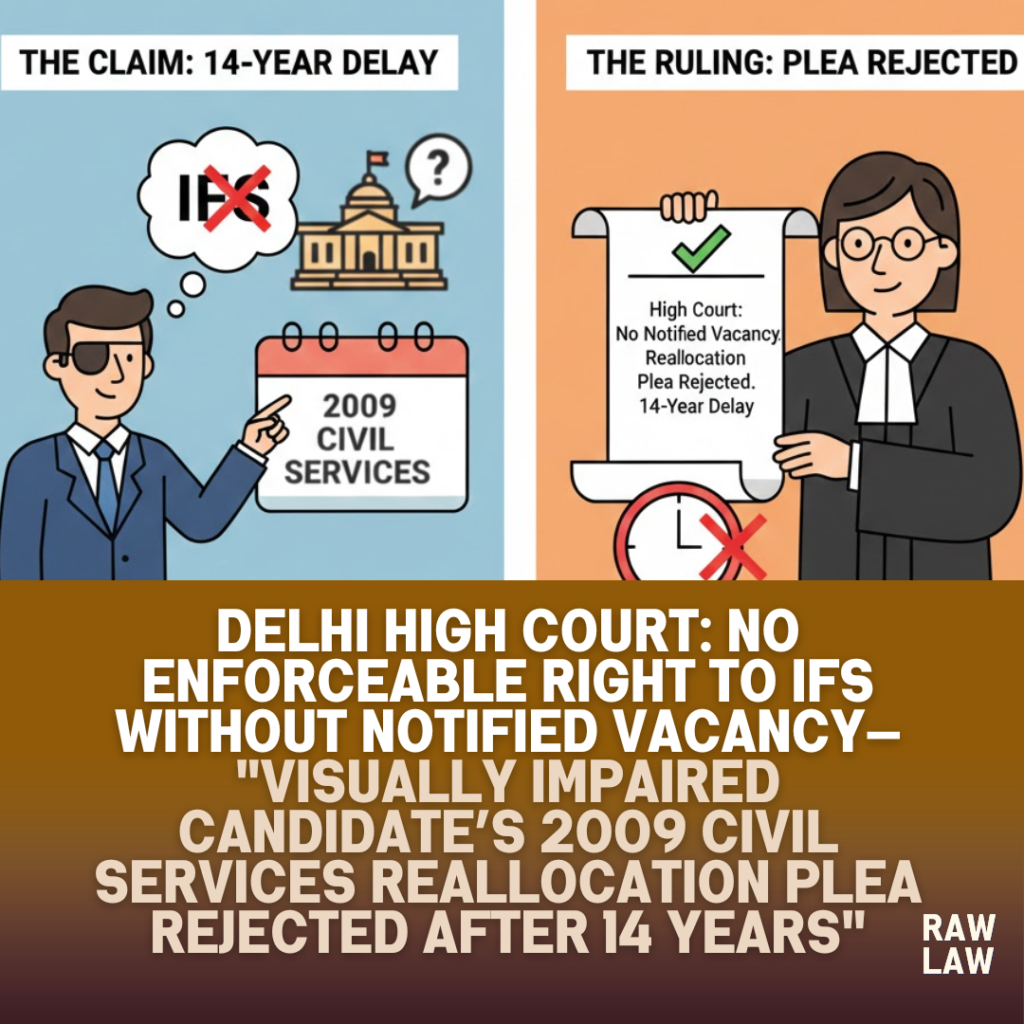

Court’s decision
The Delhi High Court dismissed a writ petition challenging the Central Administrative Tribunal’s refusal to direct reallocation of a Civil Services Examination, 2009 candidate to the Indian Foreign Service under the visually impaired category.
The Court held that no vacancy was earmarked for the visually impaired sub-category in the Indian Foreign Service for CSE-2009 and that the blocked vacancy relied upon by the petitioner was neither reserved nor available. Observing long acquiescence and absence of a demonstrable reserved vacancy, the Court declined to exercise discretionary jurisdiction under Article 226.
Facts
The petitioner appeared in the Union Public Service Commission Civil Services Examination, 2009, secured Rank 860 in the general merit list and Rank 5 in the visually impaired category. He was initially allocated to the Armed Forces Headquarters Service.
Relying on Government of India v. Ravi Prakash Gupta, he sought allocation to a higher-preference service against alleged backlog vacancies for persons with disabilities.
Pursuant to earlier proceedings, he was reallocated to the Indian Postal Service in January 2012 and joined without protest. Nearly a year later, he filed a second Original Application claiming appointment against 1% visually impaired backlog vacancies in the Indian Administrative Service or Indian Foreign Service. The Tribunal dismissed the application in May 2016.
Issues
The High Court considered:
- Whether any vacancy in the visually impaired sub-category existed in the Indian Foreign Service for CSE-2009.
- Whether a vacancy blocked due to another candidate’s ineligibility could be claimed by the petitioner.
- Whether long acquiescence and passage of time barred equitable relief under Article 226.
Petitioner’s arguments
The petitioner contended that a vacancy in the Indian Foreign Service had remained blocked due to another candidate, Yashwant G.V., who was later found ineligible to be treated as visually impaired.
It was argued that once that candidate was accommodated in the Indian Administrative Service through creation of a supernumerary post, the Indian Foreign Service vacancy ought to have been offered to him.
He claimed denial of such allocation defeated the statutory reservation scheme for persons with disabilities and was arbitrary.
Respondents’ arguments
The Union of India submitted that no vacancy was earmarked for the visually impaired sub-category in the Indian Foreign Service for CSE-2009.
It was clarified that the candidate relied upon by the petitioner was declared to have only 30% visual disability and thus not eligible as a visually impaired candidate. His candidature was cancelled and later accommodated in the Indian Administrative Service through a supernumerary post pursuant to judicial orders.
The general vacancy that had remained blocked was subsequently carried forward and filled in CSE-2011. Therefore, no vacancy for CSE-2009 remained available.
Analysis of the law
The Court examined the principle laid down in Government of India v. Ravi Prakash Gupta (2010) 7 SCC 626, which clarified that reservation for persons with disabilities is not dependent upon prior identification of posts and that backlog vacancies must be computed from enforcement of the Disabilities Act, 1995.
However, the Court noted that reservation operates within the framework of notified vacancies. The carry-forward of backlog vacancies cannot be invoked abstractly in the absence of a demonstrable reserved vacancy in the concerned service and recruitment year.
The Court also reiterated that writ jurisdiction under Article 226 is discretionary and governed by equitable considerations.
Precedent analysis
In Government of India v. Ravi Prakash Gupta, the Supreme Court held that reservation for persons with disabilities cannot be denied merely because posts were not identified and that backlog vacancies must be filled.
The High Court distinguished the present case, holding that the petitioner failed to establish the existence of a reserved vacancy in the Indian Foreign Service for CSE-2009.
The Court emphasised that judicial directions cannot create a vacancy where none exists in the notified cadre position.
Court’s reasoning
The Court found that no vacancy in the visually impaired sub-category had been earmarked in the Indian Foreign Service for CSE-2009.
The vacancy blocked on account of Yashwant G.V. was not a reserved visually impaired vacancy and had already been carried forward and filled in CSE-2011.
The petitioner had accepted allocation to the Indian Postal Service in 2012 and served for over fourteen years. Granting reallocation at this stage would unsettle settled service positions and affect third parties who were not impleaded.
The Court held that long-standing acquiescence, absence of vacancy, and advanced stage of service militated against discretionary relief.
No jurisdictional error or patent illegality was found in the Tribunal’s order.
Conclusion
The Delhi High Court dismissed the writ petition and upheld the Tribunal’s order refusing reallocation to the Indian Foreign Service.
The Court held that in the absence of a notified reserved vacancy for CSE-2009 and considering long delay and acquiescence, no enforceable right to reallocation arose.
Implications
This ruling clarifies:
- Reservation benefits must operate within the notified vacancy framework.
- Carry-forward of backlog vacancies cannot be invoked without proof of an existing reserved vacancy.
- Acceptance of service allocation and long acquiescence can defeat belated reallocation claims.
- Article 226 relief is discretionary and equity-based.
The judgment underscores judicial restraint in disturbing long-settled civil service allocations.
Case law references
Government of India v. Ravi Prakash Gupta (2010) 7 SCC 626
Held that disability reservation is not dependent on prior identification of posts and backlog vacancies must be computed from enforcement of the Disabilities Act.
FAQs
1. Can a Civil Services candidate claim reallocation years after joining a service?
Generally no. Courts are reluctant to disturb long-settled allocations, especially after prolonged acquiescence.
2. Does the carry-forward rule guarantee allocation without a notified vacancy?
No. Reservation and carry-forward operate within the framework of notified vacancies for a recruitment year.
3. Can courts create vacancies through judicial directions?
Courts cannot direct allocation in the absence of an existing or demonstrable vacancy in the relevant category.


