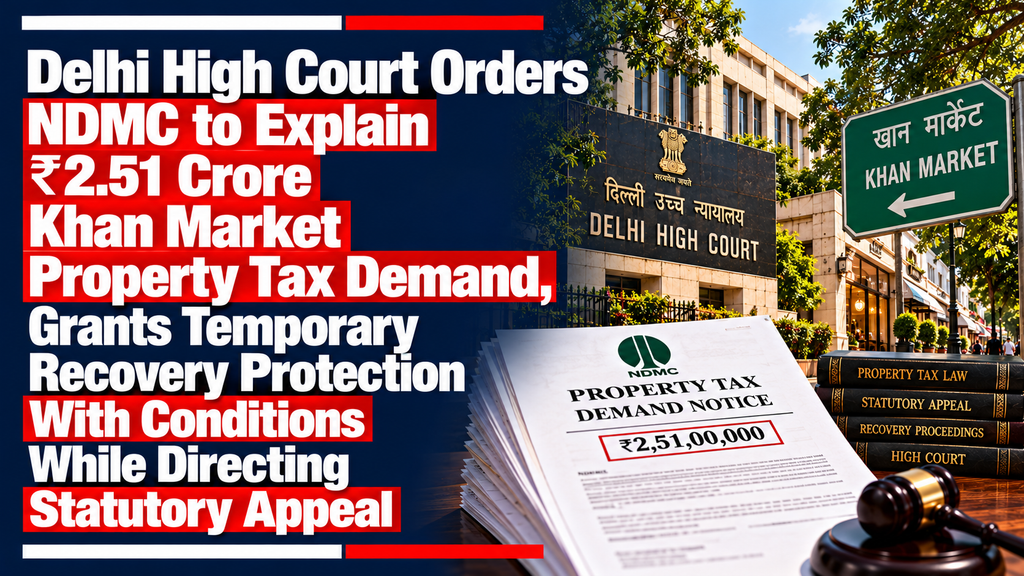
Delhi High Court Orders NDMC to Explain ₹2.51 Crore Khan Market Property Tax Demand, Grants Temporary Recovery Protection With Conditions While Directing Statutory Appeal


Delhi High Court Rejects Immediate Writ Challenge to Khan Market Property Tax Assessment, Directs Detailed ₹2.51 Crore Computation and Protects Appeal Period Subject to Conditions
Facts
Gurvinder Saluja challenged NDMC’s assessment of Shop No. 61, Khan Market. A notice of 26 September 2023 proposed increasing annual rateable value from ₹1,62,400 to ₹1,42,91,100 with effect from 1 April 2023. NDMC’s order of 20 December 2023 additionally fixed historical values from July 2012, leading to a bill for ₹2,66,27,563, including an additional demand of ₹2,51,86,094. An earlier assessment dated 26 May 2022 purported to operate from April 2012, while September 2022 municipal portal entries reflected differing values. An interim order had restrained coercive recovery upon deposit of ₹19,79,170, which the petitioner said he paid.
Issues
Whether the September 2023 notice could lawfully generate retrospective property-tax increases under the proviso to Section 72 of the NDMC Act, 1994; whether earlier assessments independently supported the demands; whether the calculations and rental comparators were sustainable; and whether these disputed questions warranted writ interference despite the Section 115 appeal remedy.
Petitioner’s Arguments
The petitioner submitted that Section 72 barred increased tax for periods preceding the financial year of the 2023 notice; the order nevertheless backdated rateable values to 2012. He disputed the comparison with Shop No. 19-B, asserted that occupation through a company in which he was director should be treated as self-occupation, questioned the hearing and lack of period-wise computation, and contested the operation of the May 2022 assessment. He also reserved relief under Section 64H(3), inserted by the 2026 amendment.
Respondent’s Arguments
NDMC asserted that the petitioner should pursue the comprehensive statutory appeal before the District Judge under Section 115. It defended expected annual rental value as the valuation basis, treated occupation by a company as distinct from the owner’s occupation, and relied on hearing opportunities and written objections considered during assessment. The Council invoked its May 2022 order to justify historical liabilities and disputed the petitioner’s standing while municipal records continued in his father’s name.
Analysis of the Law
The proviso to Section 72(1) prohibits making a person liable to increased tax for a period before commencement of the financial year in which the amendment notice is issued, insofar as the increase arises by reason of that amendment. A pre-existing, independently operative assessment may require separate examination. Sections 115–117 provide a property-tax appeal, associated deposit obligations and delay condonation. Article 226 remains available in exceptional cases, but fact-intensive questions concerning historical assessments, rates and payments ordinarily belong before the appellate forum.
Precedent Analysis
Radha Krishan Industries v. State of Himachal Pradesh, (2021) 6 SCC 771, recognises that alternative remedies do not extinguish writ jurisdiction but ordinarily warrant judicial restraint, subject to exceptions such as jurisdictional error or denial of natural justice. The petitioner relied on NDMC v. Association of Concerned Citizens of New Delhi, (2019) 15 SCC 303, regarding protections associated with earlier assessments; its application was left open. Ved Marwah v. NDMC, 2018:DHC:2055-DB, was cited regarding statutory appeal-deposit requirements, which were not waived.
Court’s Reasoning
The Court held that the 2023 notice’s date and the retrospective entries in the resulting assessment made the Section 72 objection substantial, not merely a valuation dispute. Nevertheless, the May 2022 assessment and September 2022 portal entries required record-based reconciliation to identify whether historical components arose from the 2023 amendment or an earlier operative order. NDMC had not supplied a period-wise derivation of the additional ₹2,51,86,094, nor identified supporting orders and payment credits. These intertwined facts should be examined on appeal, but full disclosure was necessary to make that remedy effective.
Conclusion
The writ petition was disposed of without approving or quashing the disputed assessments. Within 15 days of receipt of the judgment NDMC must provide a period-wise computation, underlying orders/notices and credit reconciliation. An appeal filed within four weeks of service of those materials cannot be rejected as time-barred for the pendency of this writ or that subsequent four-week interval; earlier delay remains examinable. Conditional protection against coercive recovery continues during that interval and, if a timely appeal with interim application is filed, until its interim decision or appeal disposal. Statutory deposit requirements and all merits remain open.
Case: Gurvinder Saluja v. New Delhi Municipal Council
Court: High Court of Delhi at New Delhi, Writ Jurisdiction
Case Number: W.P.(C) 4427/2024; CM APPL. 18071/2024 and 26446/2025
Judge: Justices Anil Kshetrapal and Bharat Parashar (judgment by Anil Kshetrapal, J.)
Date: 28 October 2026
Result: Writ disposed of; statutory appeal preserved; detailed computation and records ordered; conditional recovery protection granted; merits left open.