Delhi High Court Orders Premature Release of Two Life Convicts; Holds Repeated SRB Rejections Based on Crime Gravity Ignore Reformation and Violate Article 21

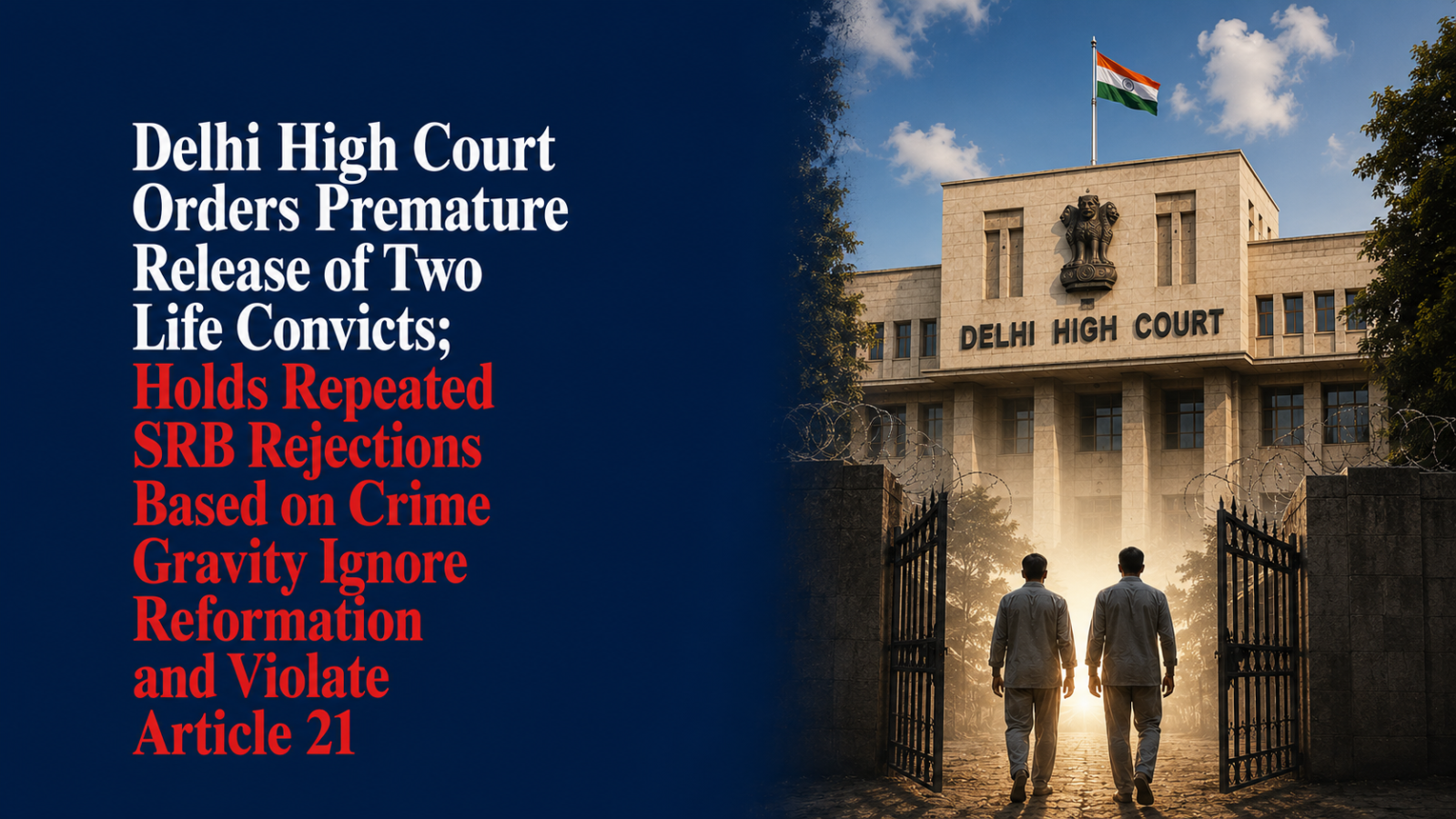
Delhi High Court Orders Premature Release of Two Life Convicts; Holds Repeated SRB Rejections Based on Crime Gravity Ignore Reformation and Violate Article 21
Facts
The Delhi High Court decided two writ petitions filed by Ramesh and Tasleem, both life convicts, challenging the rejection of their requests for premature release by the Sentence Review Board (“SRB”) and the consequential order of the Government of NCT of Delhi dated 4 December 2024. They sought premature release/permanent remission of their life sentences.
Ramesh was serving life imprisonment for offences under Sections 304-II, 376, 377 and 34 IPC arising from FIR No.198/1992, P.S. Anand Parbat. As of 3 January 2026, he had undergone more than 31 years of actual imprisonment, excluding remission, and his total custody including remission exceeded 40 years.
Tasleem was serving life imprisonment for an offence under Section 376(2)(g) IPC. As of 6 October 2025, he had undergone more than 15 years of actual imprisonment and over 19 years including remission.
The Court appointed Senior Advocate Rebecca M. John as Amicus Curiae to assist it on the proper interpretation and application of Delhi’s remission and premature-release policy in light of the governing judicial precedents.
The controversy therefore went beyond the individual petitioners and required the Court to examine the principles governing how the SRB must assess applications for premature release.
Issues
The principal questions before the Court were whether the SRB could repeatedly reject premature release principally by referring to the gravity or heinous nature of the original offence, despite substantial periods of incarceration and material demonstrating reformation.
The Court also considered whether the SRB was required to give meaningful weight to the convict’s post-conviction conduct, rehabilitation, successful parole/furlough, socio-economic circumstances, institutional reports and present propensity to commit crime.
A further issue was the scope of judicial review under Article 226: whether the High Court could only remit an illegally rejected application to the SRB for reconsideration, or whether, in an appropriate case of repeated arbitrary rejection, it could direct premature release itself.
Petitioners’ Arguments
The petitioners contended that premature release is founded upon a reformative rather than retributive philosophy. Once the minimum eligibility period prescribed under the applicable policy is completed, the decision must focus primarily upon the convict’s present condition, reformation, rehabilitation and future risk.
It was argued that the SRB repeatedly relied upon static considerations such as the seriousness of the original offence, its effect upon society and the supposed “wrong message” that release would send, instead of undertaking an individualised assessment.
The petitioners relied heavily upon their jail conduct, institutional reports and successful periods outside prison on parole, furlough or interim bail.
In Tasleem’s case specifically, it was argued that the SRB itself recorded his satisfactory conduct, zero punishment record and successful temporary releases, yet paradoxically stated that jail conduct was “not necessarily a barometer” of what he might do outside prison. The petitioner argued that no objective material was identified to support such an adverse prediction.
State’s Arguments
The State emphasised the limited scope of judicial review in matters of remission. It contended that the constitutional and statutory power to grant remission belongs to the executive and that courts ordinarily cannot substitute their own assessment for that of the SRB.
The State also argued that considerations such as societal acceptance, deterrence and victim impact could legitimately form part of the SRB’s assessment.
At the same time, the precedents relied upon by the State recognised that judicial review remains available where the SRB’s exercise of discretion suffers from procedural unfairness, arbitrariness, non-application of mind, patent illegality or constitutional infirmity.
Analysis of the Law
1. No Fundamental Right to Remission, But a Legal Right to Fair Consideration
The Court examined Section 432 CrPC, corresponding to Section 473 BNSS, which empowers the appropriate Government to suspend or remit a sentence. The judgment distinguished remission from appellate alteration of a sentence: remission affects the execution of the sentence, not the conviction itself.
A convict therefore does not possess an indefeasible fundamental right to remission. However, once a statutory or policy framework governing remission exists, an eligible prisoner has a legal right to have his case fairly, meaningfully and non-arbitrarily considered.
2. Reformation Is Central to Premature Release
Rule 1244 of the Delhi Prison Rules identifies the primary objective of premature release as the reformation, rehabilitation and reintegration of offenders into society, consistently with protecting society from criminal activity. Prison conduct is relevant because it indicates rehabilitative potential and whether the prisoner has become harmless and capable of functioning as a useful member of society.
The inquiry therefore cannot remain permanently anchored to the crime committed many years earlier.
3. Gravity of Original Crime Cannot Be the Sole Determinative Factor
The Court held that the gravity of the original offence and length of sentence are essentially static historical facts. If those factors were treated as determinative forever, a life convict could effectively never qualify for premature release.
Once the eligibility threshold has been crossed, the assessment must become forward-looking and examine matters such as:
- present propensity to commit crime;
- post-conviction conduct;
- demonstrable reformation;
- prospects of rehabilitation and reintegration;
- conduct during parole, furlough and other temporary releases;
- whether continued incarceration serves any legitimate penological purpose; and
- socio-economic circumstances of the convict and his family.
The SRB cannot convert remission proceedings into a fresh exercise in punishment for the original crime.
4. Police Opposition Is Not Conclusive
The applicable guidelines expressly provide that premature release should not ordinarily be rejected merely because the police oppose it.
The SRB must independently evaluate the relevant material, including reports from the Prison Authorities, Probation Officer, Social Welfare Department and police.
5. SRB Must Give Individualised and Reasoned Decisions
The judgment strongly disapproved of stereotyped or formulaic reasons.
The SRB must conduct an individualised assessment of each convict and meaningfully engage with favourable as well as adverse material. Repeated reliance upon generic expressions such as the crime being “heinous”, “shaking the confidence of society” or release sending a “wrong message” cannot replace the criteria prescribed by law.
The applicable Delhi Prison Rules further require decisions on premature release to be made through a speaking order in writing.
Precedent Analysis
State of Haryana v. Mahender Singh
The Supreme Court recognised that although a convict has no constitutional right to obtain remission, he possesses a legal right to be considered for remission in accordance with the applicable statutory and policy framework and the protections of Articles 20 and 21.
Laxman Naskar v. Union of India
The judgment treated the following considerations as important: whether the offence was an individual crime affecting society at large; likelihood of recurrence; whether the prisoner had lost his criminal potential; whether any useful purpose remained in continued imprisonment; and the socio-economic condition of his family.
The Supreme Court had interfered where the authorities failed to adequately consider jail conduct, loss of criminal potential, usefulness of continued confinement and family circumstances.
Satish alias Sabbe v. State of Uttar Pradesh
The Supreme Court held that the length of sentence or gravity of the original offence cannot by itself justify refusal of premature release. Assessment of future criminal propensity must be based on objective matters such as antecedents and conduct during incarceration, rather than vague apprehensions.
Joseph v. State of Kerala
The Court relied upon the Supreme Court’s warning against rigidly typecasting prisoners solely by reference to crimes committed in the distant past.
The reformative object of prison law requires authorities to consider whether a prisoner has fundamentally changed over years of incarceration. An inflexible approach that disregards reformation and good conduct can result in an arbitrary denial of liberty contrary to Article 14.
Bilkis Yakub Rasool v. Union of India
The judgment reiterated the distinction between remission and alteration of conviction or sentence. Remission affects only execution of the sentence; it neither wipes out the offence nor extinguishes the conviction.
Court’s Reasoning
Ramesh
The High Court found a particularly serious defect in the SRB’s treatment of Ramesh.
His conviction under Section 302 IPC had been altered by the Supreme Court to Section 304 Part II IPC, though his convictions under Sections 376, 377 and 34 IPC remained. He therefore fell within the category of other life convicts eligible for consideration after 10 years’ actual imprisonment and 14 years including remission.
Yet the SRB repeatedly treated him as a Section 302 murder convict and applied the more onerous threshold applicable to prisoners governed by Section 433A CrPC. The High Court held that this fundamental legal error had infected the SRB’s consideration.
More significantly, Ramesh’s application had been rejected 18 times, substantially on repetitive grounds. Even after the High Court had previously set aside an SRB decision and ordered reconsideration according to Supreme Court principles, the Board again substantially repeated its earlier reasoning.
The Court found that the SRB had failed to meaningfully consider his family circumstances, rehabilitation prospects and favourable institutional material, while repeatedly relying upon expressions such as “desperation crime”, “shakes the confidence of society” and release not being “in the interest of society at large”.
Having undergone more than 31 years of actual imprisonment and over 40 years including remission, Ramesh’s continued confinement was held to serve no legitimate penological purpose.
The Court characterised the repeated rejection as manifestly arbitrary, contrary to the State’s own policy, a failure to discharge statutory obligations and a violation of Article 21. It therefore held that another remand to the SRB would serve no purpose and ordered his immediate release.
Tasleem
Tasleem had undergone more than 15 years of actual imprisonment, besides more than three years of remission, and had therefore crossed the applicable eligibility threshold.
The Court held that once that threshold was crossed, the inquiry had to shift from the historical crime towards his present reformation, future risk and whether continued incarceration served any genuine purpose.
The evidence strongly favoured Tasleem. Reports from the Social Welfare Department and Prison Authorities supported release. There was no adverse report from his native police station. He had repeatedly been released on interim bail, parole, emergency parole and furlough without a single adverse incident. He also had a zero punishment record.
Nevertheless, his case had been rejected repeatedly on substantially identical grounds.
The High Court held that the SRB improperly relied upon the gravity of the original offence, the supposed “wrong message” to society and abstract concerns regarding public confidence, while disregarding post-conviction conduct, favourable institutional material, successful temporary releases and family hardship. The resulting decisions were arbitrary and violative of Article 21.
Conclusion
The Delhi High Court held that premature release is fundamentally a forward-looking, reformative exercise rather than an extension of retributive punishment.
The gravity of the original crime remains relevant background, but it cannot become the sole or perpetual ground for denying release after the prisoner has crossed the applicable eligibility threshold. The SRB must meaningfully evaluate present-day reformation, rehabilitation, prison conduct, successful temporary releases, future criminal propensity, family circumstances and the legitimate penological purpose—if any—served by continued imprisonment.
Where the SRB repeatedly ignores these requirements and mechanically rejects applications on stereotyped grounds, its decision becomes susceptible to judicial review under Article 226. In an appropriate case, particularly after repeated arbitrary reconsiderations, the High Court is not compelled to remit the matter yet again to the SRB and may itself direct release.
Accordingly, the Court set aside the impugned SRB decisions and Government order concerning Ramesh and directed his release forthwith.
It likewise held Tasleem entitled to premature release and directed that he be released from custody forthwith. Both writ petitions were accordingly disposed of.
Case Details
Case: Ramesh v. State (NCT of Delhi) & Anr. with Tasleem v. State of NCT of Delhi
Court: High Court of Delhi at New Delhi
Case Numbers: W.P.(CRL) 2875/2025 & W.P.(CRL) 578/2025
Judge: Justice A. J. Bhambhani
Date: 10 August 2026
Result: Petitions allowed; impugned rejection of premature release set aside and both Ramesh and Tasleem directed to be released from custody forthwith.