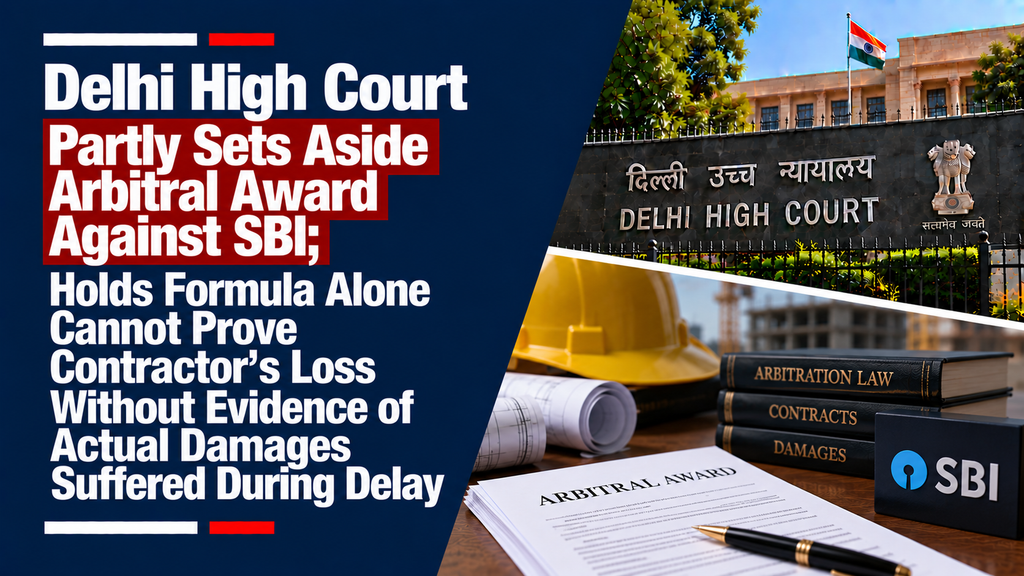
Delhi High Court Partly Sets Aside Arbitral Award Against SBI; Holds Formula Alone Cannot Prove Contractor’s Loss Without Evidence of Actual Damages Suffered During Delay

No Evidence of Actual Loss, No Formula-Based Damages: Delhi High Court Interferes With Arbitral Award Against SBI
Facts
The dispute arose from a construction contract awarded by State Bank of India (SBI) to M/s K.R. Anand for construction of 76 residential flats for SBI officers at Sector 62, Noida, along with civil, water supply, sanitation and external development works.
The contract was awarded on 22 December 2012 and the parties executed an agreement on 16 January 2013 for approximately ₹19.81 crore. The stipulated completion period was 24 months, ending on 15 January 2015.
The project was delayed. Three extensions were granted: the first for 85 days with Price Variation Adjustment (PVA), the second for 145 days with PVA, and the third for 150 days without PVA. The work was ultimately completed on 23 January 2016.
The contractor attributed the delay to SBI’s failure to timely provide drawings and approvals, whereas SBI disputed that position.
Arbitration was invoked in January 2019. The contractor raised 14 claims aggregating approximately ₹4.92 crore, and the arbitrator eventually awarded ₹1,42,95,725 in its favour.
SBI challenged the award under Section 34 of the Arbitration and Conciliation Act, 1996, but confined its challenge to Claims 1, 3, 7 and 10 and consequential interest.
Issues
The principal questions before the Delhi High Court were whether:
- overhead/prolongation damages could be awarded merely by applying the Emden Formula without proof of actual loss;
- PVA could be awarded for the third extension despite documentary material stating that the extension was without PVA;
- interest could be awarded for delayed payment of running and final bills;
- interest could be awarded for delayed refund of the security deposit; and
- the invalid portions of an arbitral award could be severed while preserving the valid portions.
Petitioner’s Arguments
SBI argued that the arbitrator had found 205 days of delay attributable to the contractor and 175 days attributable to SBI, yet awarded ₹30,27,231 towards overhead expenditure without adequate proof that the contractor actually suffered such loss.
It contended that the Emden Formula was merely a method of quantification and could not substitute the contractor’s fundamental obligation to first prove that loss had actually been suffered. SBI relied particularly upon Unibros v. All India Radio and Batliboi Environmental Engineers Ltd. v. HPCL.
On PVA, SBI stressed that the third extension was expressly granted without PVA, and that the architect’s written recommendation dated 11 November 2015 also contemplated an extension without monetary benefit or PVA.
SBI further challenged interest on delayed running bills and the security deposit, relying particularly upon contractual provisions governing payments and Clause 6.2, which provided that no interest would be paid on amounts retained as security deposit.
Respondent’s Arguments
The contractor emphasised the narrow scope of judicial interference under Section 34 and argued that the arbitrator had adopted a plausible view based upon the material before him.
Regarding overheads, it contended that bills showing expenditure during the prolonged contractual period had been produced and that use of the Emden Formula together with the CPWD Manual was justified.
For PVA, the contractor argued that SBI itself was responsible for the delay necessitating the third extension and that the architect’s cross-examination supported its entitlement.
It further defended interest on running and final bills because Clause 37 required payment within 14 working days of the architect’s certificate, whereas substantial delays had occurred.
Analysis of the Law
Formula Cannot Substitute Proof of Loss
This is the judgment’s most significant proposition.
The Court held that damages under Section 73 of the Contract Act require two foundational elements: breach of contract and actual loss or damage—or proof that actual damage is incapable or extremely difficult of being established.
Here, the arbitrator had proceeded directly to the Emden Formula to calculate ₹30,27,231 as overhead expenditure for the 175 days attributed to SBI.
The High Court found this legally unsustainable.
Relying upon Unibros v. All India Radio, the Court held that a mathematical formula is a method for assessing loss; it does not itself prove that loss occurred.
The contractor must first establish through credible evidence that it actually suffered loss because of prolongation. Only thereafter can a formula assist in quantification.
The Court therefore held that damages awarded solely through the Emden Formula without evidence proving actual loss were contrary to settled law.
Reasoned Award Is Mandatory
The Court separately invoked Section 31(3) of the Arbitration Act, which requires reasons in an arbitral award.
While an arbitrator need not write a judgment comparable to a court decision, the reasoning must still be intelligible and adequate.
Here, even after reading the award as a whole, the High Court found no reason explaining why the Emden calculation had been accepted despite the absence of evidence proving actual loss or showing that such loss was difficult or impossible to prove.
Accordingly, Claim No. 1 suffered from patent illegality.
PVA for Third Extension
The Court also found serious difficulty with the PVA awarded for the third extension.
The architect’s written recommendation expressly stated that the extension up to 28 January 2016 should be granted:
“without any monetary benefit and without PVA to the contractor.”
The arbitrator nevertheless relied upon an alleged admission made by the architect during cross-examination.
The High Court held that the architect’s answer could not reasonably be construed as an admission that PVA was payable for the third extension. More importantly, the arbitrator could not ignore relevant documentary evidence in favour of a supposed admission that did not actually establish the proposition.
The Court further found that the arbitrator had attributed the overall 380-day delay as 175 days to SBI and 205 days to the contractor, but had not identified which particular period corresponded to each party.
Therefore, the conclusion that SBI was responsible for the entire third-extension period was found to be without basis and perverse.
However, Claim No. 3 contained two distinct components. The ₹56,84,292 PVA concerning the first two extensions was not challenged, whereas ₹43,81,068 related to the third extension. The Court held that these portions were severable and set aside only the latter.
Interest on Delayed Running and Final Bills
Here, SBI’s challenge failed.
Clause 37 required payment to the contractor within 14 working days from the architect’s certificate.
The payments had admittedly been delayed, and the arbitrator awarded ₹4,21,385 as interest.
The High Court held that this was a plausible interpretation of the contract and therefore did not warrant interference under Section 34.
The Court also rejected SBI’s contention that running bills were merely advance payments. Unlike the contractual provision considered in the precedent relied upon by SBI, this agreement contained no clause characterising the payments in that manner.
Interest on Delayed Security Deposit
The contractor’s security deposit was to be released in two stages.
The first 50% was released after a delay of 321 days, while the remaining 50% was released after a delay of 424 days.
SBI sought to rely upon Clause 6.2, which stated that no interest would be paid on security deposits.
The Court rejected the challenge for two reasons.
First, SBI had not raised the Clause 6.2 defence before the arbitrator, and could not introduce it for the first time in Section 34 proceedings.
Second, Clause 6.2 could not be read in isolation. The contractual prohibition concerned security deposits legitimately retained by the bank. Once the period prescribed for retention under Clause 6.1 expired, Clause 6.2 did not protect SBI from interest arising from delayed refund.
Thus, the interest awarded under Claim No. 10 was upheld.
Precedent Analysis
The Court drew significantly upon Kailash Nath Associates v. DDA for the proposition that actual loss remains fundamental to contractual damages where such loss is capable of proof.
It relied upon State of Rajasthan v. Ferro Concrete Construction (P) Ltd. to emphasise that although the quantum and sufficiency of evidence ordinarily fall within the arbitrator’s domain, an award made without any supporting evidence may be legally unsustainable.
Unibros v. All India Radio was central to the treatment of the Emden Formula: formulae can assist in quantifying established losses but cannot themselves establish that the contractor suffered the claimed loss.
For the requirement of reasons, the Court relied upon Dyna Technologies Pvt. Ltd. v. Crompton Greaves Ltd., holding that Section 31(3) requires intelligible and adequate reasoning.
Finally, Gayatri Balasamy v. ISG Novasoft Technologies Ltd. was applied to distinguish impermissible modification of an award from permissible severance of an invalid portion from valid and independently sustainable portions.
Court’s Reasoning
The judgment draws an important distinction between reappreciating an arbitrator’s factual assessment and intervening where the award crosses into patent illegality.
The Court did not reopen every factual determination. It upheld those portions where the arbitrator had taken a plausible contractual view, particularly regarding delayed payments.
It interfered where the defect was more fundamental: damages awarded without proof of loss, absence of adequate reasons, disregard of material documentary evidence, and conclusions unsupported by the record.
Equally importantly, the Court did not set aside the entire award merely because some claims were defective.
Applying the doctrine of severability recognised by the Supreme Court, it preserved the valid portions while removing only the independently severable invalid components.
Conclusion
The Delhi High Court partly allowed SBI’s Section 34 petition.
It set aside:
Claim No. 1 — ₹30,27,231 awarded towards overhead/prolongation expenditure; and
part of Claim No. 3 — ₹43,81,068 awarded as PVA for the third extension.
At the same time, it upheld Claim No. 7, concerning interest for delayed running/final bill payments, and Claim No. 10, concerning interest for delayed release of the security deposit. The unchallenged PVA relating to the first two extensions was also preserved.
The Court therefore severed the legally unsustainable portions rather than setting aside the arbitral award in its entirety.
Case Details
Case: State Bank of India v. K R Anand
Court: Delhi High Court
Case No.: O.M.P. (COMM) 69/2024 & I.A. 2596/2024
CNR: DLHC010035702024
Judge: Justice Avneesh Jhingan
Reserved: 7 September 2026
Pronounced: 15 September 2026
Provision: Section 34, Arbitration and Conciliation Act, 1996
Result: Petition partly allowed; overhead damages and PVA for third extension set aside; awards for delayed-payment and security-deposit interest upheld.