Delhi High Court: “No Legally Enforceable Liability Survives Once Payment Made” — Cheque Bounce Case Quashed as Cheque Amount Had Already Been Transferred Through RTGS Before Prosecution

Court’s decision
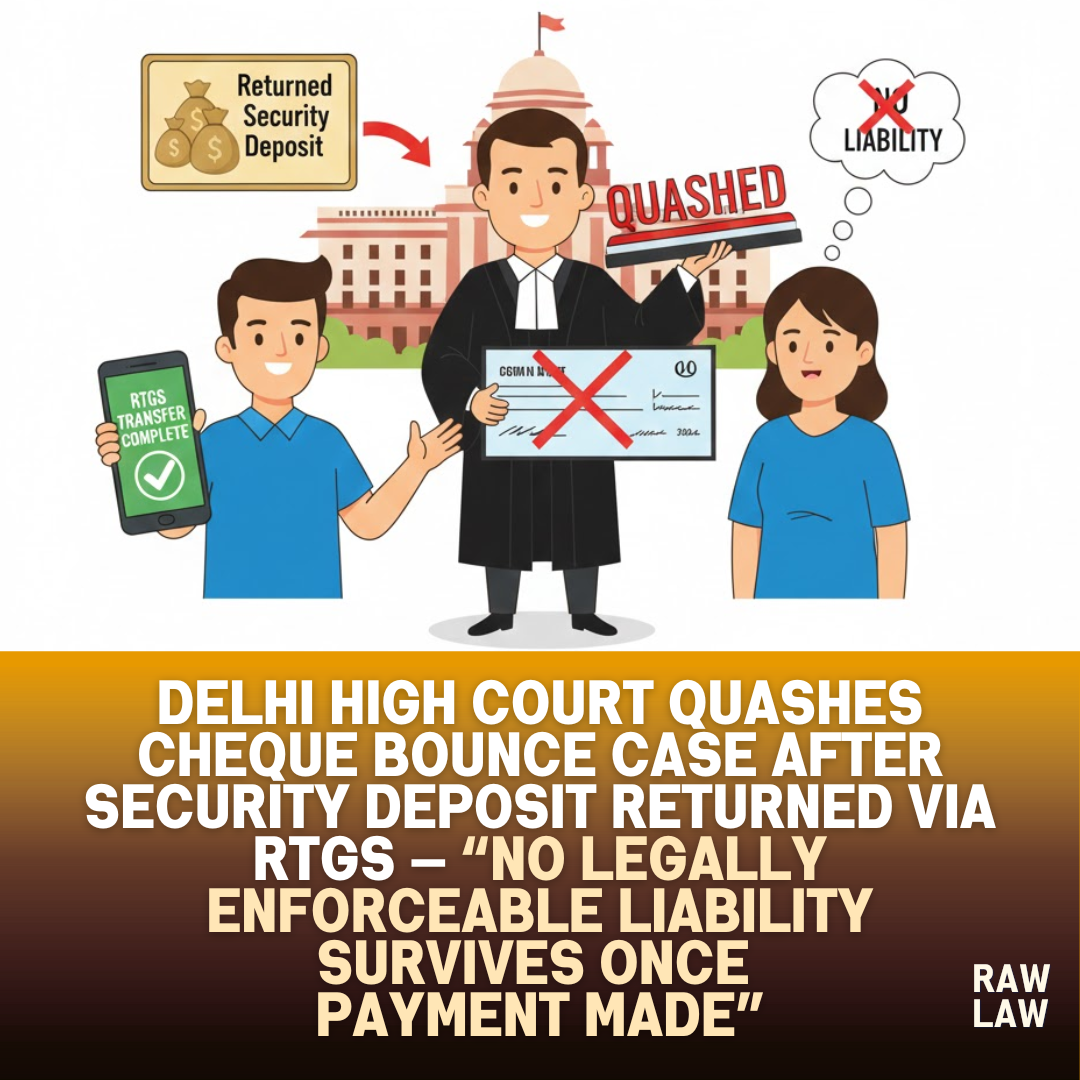
The Delhi High Court quashed a criminal complaint under Section 138 of the Negotiable Instruments Act, holding that once the cheque amount of ₹15 lakhs had already been returned through RTGS, no legally enforceable liability survived to sustain prosecution for cheque dishonour. The Court ruled that presenting a cheque after receipt of the underlying amount cannot create criminal liability. Consequently, the complaint and the summoning order were set aside.
Facts
The dispute arose from a Lease Agreement dated 27 March 2023, under which commercial premises in Noida were leased for nine years with a lock-in period of 36 months. The complainant company paid ₹15 lakhs as security deposit at the time of execution of the agreement. Possession was handed over, and the tenant commenced renovation during the rent-free fit-out period.
Within two months, the landlord terminated the agreement and sought immediate vacation. The complainant alleged forced eviction and substantial losses exceeding ₹1 crore on renovation and vendor advances. A cheque dated 18 May 2023 for ₹15 lakhs was issued by the landlord towards return of the security deposit.
The cheque was dishonoured with the remark “Payment stopped by Drawer.” A legal notice was issued, and subsequently a complaint under Section 138 of the Negotiable Instruments Act was filed. The Magistrate summoned the accused company and its director.
The accused approached the High Court under Section 528 of the Bharatiya Nagarik Suraksha Sanhita seeking quashing of the complaint and summoning order.
Issues
The principal issue before the High Court was whether a complaint under Section 138 of the Negotiable Instruments Act could be sustained when the cheque amount had already been transferred through RTGS before prosecution.
A secondary issue concerned whether a discrepancy in the complainant’s name—between “Limited” and “Private Limited”—affected locus standi and maintainability.
The central legal question was whether any legally enforceable liability existed on the date of presentation of the cheque.
Petitioner’s arguments
The petitioner contended that the ₹15 lakh security deposit had already been returned through RTGS on 6 June 2023. Since the underlying liability stood discharged, presentation of the cheque thereafter could not create a cause of action under Section 138.
It was argued that the payment through RTGS had been recorded in civil proceedings and acknowledged in judicial orders of the Allahabad High Court and the Civil Judge at Gautam Buddha Nagar. The petitioner further asserted that the cheque payment was stopped only because the amount had already been transferred electronically.
Additionally, the petitioner challenged the complaint on grounds of misdescription of the complainant entity, submitting that the lease agreement and related documents referred to a differently named company.
Respondent’s arguments
The respondent argued that the RTGS transfer was not towards return of the security deposit but constituted partial compensation for fit-out expenses incurred during renovation. It was contended that the cheque represented an independent legally enforceable liability.
The respondent maintained that the complaint was valid and that disputed questions regarding adjustment of payments could only be examined during trial. It was submitted that the petition for quashing was premature.
Analysis of the law
The Court examined the essential ingredients of Section 138 of the Negotiable Instruments Act, namely: existence of a legally enforceable debt or liability, issuance of cheque in discharge thereof, dishonour of cheque, and failure to pay within statutory notice period.
The High Court emphasized that a cheque must represent a subsisting and legally enforceable liability on the date of presentation. If the underlying debt stands discharged prior to presentation, criminal liability does not arise.
The Court noted that the respondent had admitted receipt of ₹15 lakhs through RTGS. Judicial records in related civil proceedings also acknowledged this payment. The defence that RTGS represented damages or compensation did not find support in the contemporaneous legal notice.
The Court held that criminal prosecution cannot be sustained in absence of a legally enforceable liability.
Precedent analysis
While the judgment primarily turned on statutory interpretation of Section 138, it reinforced settled principles that:
- Dishonour alone is insufficient; the cheque must represent enforceable liability.
- Courts can exercise inherent powers to quash complaints when foundational ingredients of the offence are absent.
- Criminal proceedings should not be used as pressure tactics in civil disputes.
The Court applied these principles to conclude that continuation of proceedings would amount to abuse of process.
Court’s reasoning
The High Court found that the cheque dated 18 May 2023 was issued towards return of the security deposit. It was undisputed that ₹15 lakhs had been credited to the complainant’s account via RTGS on 6 June 2023.
The Court rejected the respondent’s claim that the RTGS payment represented compensation for damages, observing that such assertion was absent in the legal notice and appeared for the first time in the complaint.
Since the liability underlying the cheque stood discharged, there was no legally enforceable debt subsisting on the date of presentation. Accordingly, the basic ingredient of Section 138 was not satisfied.
The Court also held that the discrepancy in the company’s name appeared to be a misdescription and not fatal at this stage. However, that issue became academic in view of the absence of enforceable liability.
Conclusion
The Delhi High Court quashed the criminal complaint and the summoning order, holding that prosecution under Section 138 of the Negotiable Instruments Act cannot continue when the cheque amount has already been paid through RTGS.
The ruling underscores that cheque bounce proceedings require a subsisting legal liability and cannot be sustained once payment has been made.
Implications
This judgment strengthens jurisprudence on cheque bounce litigation and legally enforceable debt requirements. It clarifies that electronic transfer discharging the liability negates criminal prosecution under Section 138.
The ruling also discourages misuse of criminal proceedings in commercial lease disputes. For businesses, it highlights the importance of documenting adjustments and payments clearly to avoid parallel civil and criminal litigation.
The decision will likely guide courts in future cheque bounce cases involving prior electronic settlements and disputed adjustments.
Case law references
- Principles governing Section 138 of the Negotiable Instruments Act — legally enforceable liability must subsist on date of presentation.
- Inherent powers under Section 528 of the Bharatiya Nagarik Suraksha Sanhita (formerly Section 482 CrPC) — can be invoked to prevent abuse of process when essential ingredients of offence are absent.
FAQs
1. Can a cheque bounce case continue if the amount is already paid through RTGS?
No. If the underlying debt has been discharged before presentation of the cheque, there is no legally enforceable liability and Section 138 prosecution cannot continue.
2. Does “payment stopped by drawer” automatically attract Section 138?
Not necessarily. The cheque must represent a subsisting legal liability. If payment was already made, criminal liability may not arise.
3. Can High Courts quash cheque bounce complaints at the summoning stage?
Yes. If foundational ingredients of the offence are missing on admitted facts, High Courts may quash proceedings to prevent abuse of process.