Delhi High Court Reduces Wife’s Interim Maintenance From ₹30,000 to ₹25,000; Considers Her Qualifications, Independent Income, Free Housing and Husband’s Child Expenses

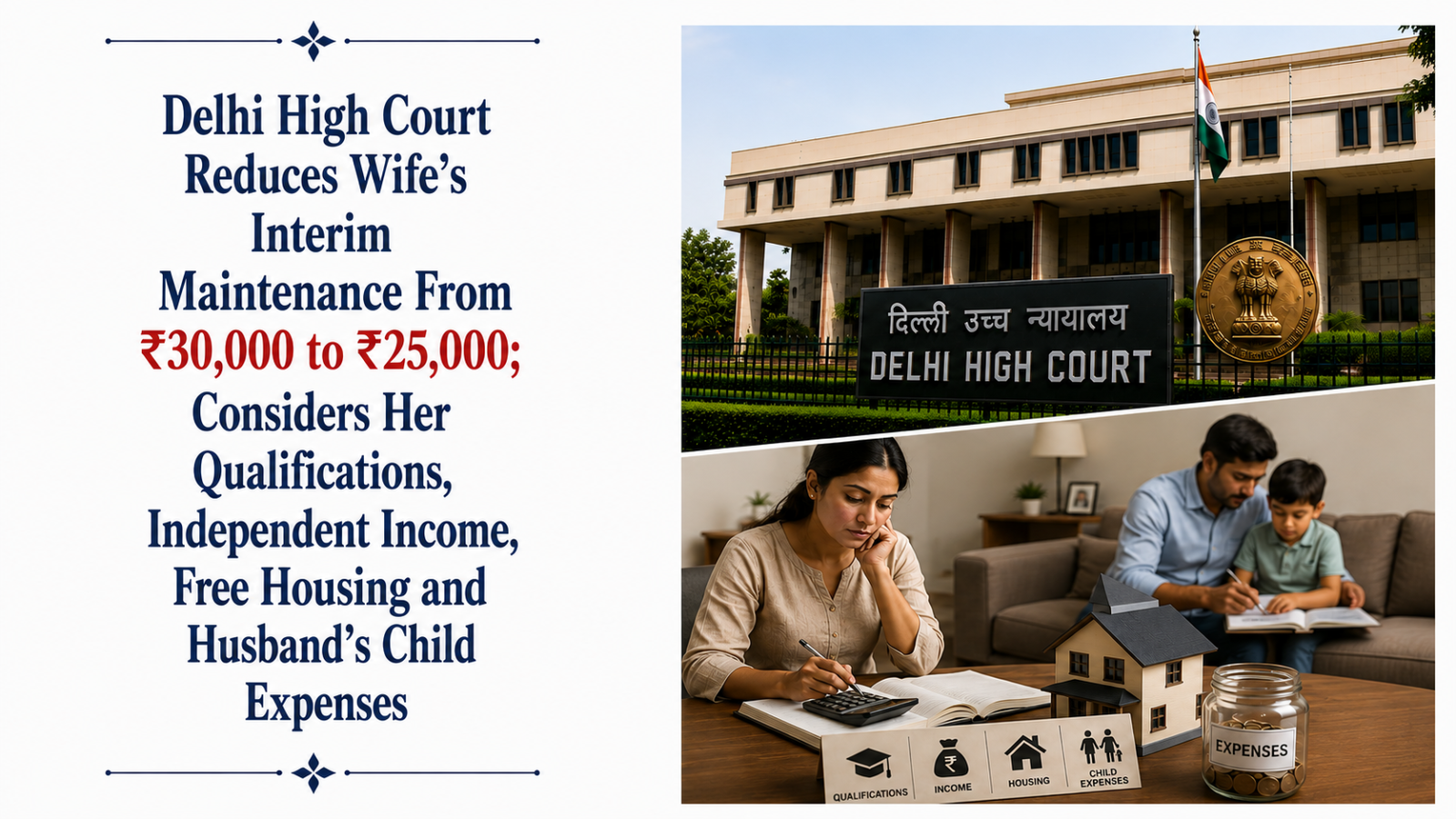
Husband Supports Both Children While Wife Has Independent Income and Free Housing; Delhi High Court Reduces Interim Maintenance to ₹25,000
Facts
Ashutosh Rai Asthana and Yamita Rai Asthana were married on 2 November 1995 and had two children. Following matrimonial differences, the wife instituted maintenance proceedings on 9 April 2021.
The Family Court initially awarded the wife ad-interim maintenance of ₹25,000 per month by an order dated 15 January 2022. Subsequently, by the impugned order dated 5 June 2024, the Family Court enhanced the amount and granted her interim maintenance of ₹30,000 per month from the date of filing of the maintenance application.
The husband challenged the ₹30,000 award before the Delhi High Court in revision.
The material before the Court showed that both children were residing with the husband and that he was solely meeting their educational and financial requirements. The elder daughter was pursuing an MBBS course.
The wife was residing alone in a three-bedroom residential property purchased by/belonging to the husband. She held an MBA in Finance as well as degrees and diplomas in Astrology. She was also receiving ₹10,450 per month as rental income and approximately ₹4,400 per month as interest on fixed deposits.
Issues
The principal issues before the High Court were:
- Whether the Family Court was justified in awarding ₹30,000 per month as interim maintenance primarily on the basis of the husband’s income.
- Whether the wife’s educational qualifications and earning capacity were relevant while determining interim maintenance.
- Whether her independent rental income, FD interest and availability of residential accommodation should be considered.
- Whether the husband’s responsibility for maintaining both children, including the expenses of his daughter’s MBBS education, should affect the quantum.
- Whether the Family Court had appropriately balanced the rights, resources and liabilities of both spouses in accordance with the governing principles for maintenance.
Petitioner’s Arguments
The husband argued that the Family Court had failed to properly appreciate the financial and personal circumstances of both parties.
He emphasised that he was responsible for the financial needs of both children, particularly the elder daughter, who was pursuing the comparatively expensive MBBS course.
He further contended that the wife was highly educated, holding an MBA in Finance, and was therefore capable of earning and maintaining herself.
The husband also relied upon the wife’s rental income and interest income from fixed deposits. Additionally, she was residing in a house purchased by him, thereby substantially reducing her housing expenditure.
He also referred to various loans and financial liabilities that he was required to repay.
Reliance was placed upon Bhagwan Dutt v. Kamla Devi and Bharat Hedge v. Shrimati Saroj to contend that maintenance must be determined after considering the status of the parties, claimant’s reasonable needs, independent income, liabilities, number of dependants and the paying spouse’s financial capacity.
Respondent’s Arguments
The wife defended the Family Court’s order.
She relied upon the husband’s income affidavit and particularly his Income Tax Return for Assessment Year 2022–23, which reflected an annual income exceeding ₹63 lakh. She also pointed out that the husband was engaged in the cargo business.
According to her, the Family Court had considered the relevant documents, submissions and circumstances before fixing interim maintenance at ₹30,000 per month.
She therefore contended that there was no infirmity warranting revisional interference and characterised the husband’s challenge as an abuse of the process of law.
Analysis of the Law
The High Court reiterated that maintenance cannot be determined through a mechanical formula based exclusively upon the paying spouse’s income.
Relying upon the principles recognised in Rajnesh v. Neha, the Court noted that determination of maintenance requires consideration of several interrelated factors, including:
- status of the parties;
- reasonable requirements of the claimant;
- claimant’s independent income and property;
- number of persons the non-applicant must maintain;
- standard of living enjoyed in the matrimonial home;
- liabilities of the non-applicant;
- food, clothing, shelter, education and medical requirements; and
- paying spouse’s financial capacity.
The Court emphasised that the object of interim maintenance is to prevent vagrancy and destitution of a person unable to support herself. The appropriate quantum necessarily depends upon the particular facts and financial circumstances of the parties.
Accordingly, the husband’s substantial income was relevant but could not be viewed in isolation from the wife’s resources, accommodation, qualifications and the husband’s other financial responsibilities.
Precedent Analysis
The Court considered Rajnesh v. Neha, (2021) 2 SCC 324, which incorporated the factors earlier identified by the Delhi High Court in Bharat Hedge v. Smt. Saroj Hegde for determining maintenance. These factors require a holistic assessment of the financial position and needs of both sides.
The Court also relied upon Chaturbhuj v. Sita Bai, (2008) 2 SCC 316, which explains that maintenance proceedings are not intended to punish a spouse for past neglect but to prevent vagrancy by compelling a person with sufficient means to support those unable to maintain themselves. Section 125 CrPC operates as a measure of social justice intended particularly to protect women and children.
The petitioner additionally relied upon Bhagwan Dutt v. Kamla Devi, (1975) 2 SCC 386, and Bharat Hedge v. Shrimati Saroj, 2007 SCC OnLine Del 622, in support of the proposition that the claimant’s independent income, reasonable requirements, parties’ status and the respondent’s liabilities must all be considered while fixing maintenance.
Court’s Reasoning
The High Court identified several uncontroverted circumstances which materially affected the maintenance assessment.
First, both children were residing with the husband, who was solely bearing their educational and financial expenses. One daughter was pursuing an MBBS course.
Second, the wife had exclusive use of a large three-bedroom residential accommodation purchased by/belonging to the husband.
Third, she was an MBA Finance graduate and also possessed qualifications in Astrology. The Court regarded her as a well-qualified woman possessing qualifications sufficient to enable her to earn for herself.
Fourth, she was not completely without independent resources. She received ₹10,450 per month as rent and ₹4,400 per month as FD interest.
Fifth, even before the formal award of ad-interim maintenance, the husband had voluntarily been paying her ₹20,000 per month.
The Court found that although the Family Court had noticed these circumstances, it had not given them due weight and had instead tilted the assessment primarily towards the husband’s income while fixing maintenance at ₹30,000 per month.
The High Court acknowledged that the husband was a “man of means”, but held that this fact could not make the other relevant variables irrelevant.
A balance had to be maintained between the rights and liabilities of both parties while preserving the social purpose underlying Section 125 CrPC.
Conclusion
The Delhi High Court found revisional interference justified and reduced the wife’s interim maintenance from ₹30,000 to ₹25,000 per month.
The Court held that the Family Court had failed to give sufficient weight to the cumulative circumstances, particularly the wife’s qualifications and earning capacity, her independent rental and interest income, her exclusive residential accommodation, and the husband’s responsibility for maintaining both children.
The reduced amount of ₹25,000 per month was made payable with effect from 12 April 2021, the date of filing of the maintenance application.
Case Details
Case: Ashutosh Rai Asthana v. Yamita Rai Asthana
Court: High Court of Delhi at New Delhi
Case Number: CRL.REV.P.(MAT.) 122/2024 & CRL.M.A. 35886/2024
Judge: Hon’ble Mr. Justice Saurabh Banerjee
Date: 11 August 2026
Result: Revision disposed of; interim maintenance reduced from ₹30,000 to ₹25,000 per month with effect from 12 April 2021.