Delhi High Court Sets Aside Discharge in Assault and Molestation Case; Holds CCTV Timing Alone Cannot Override Victim Statements, MLC and Torn Clothes

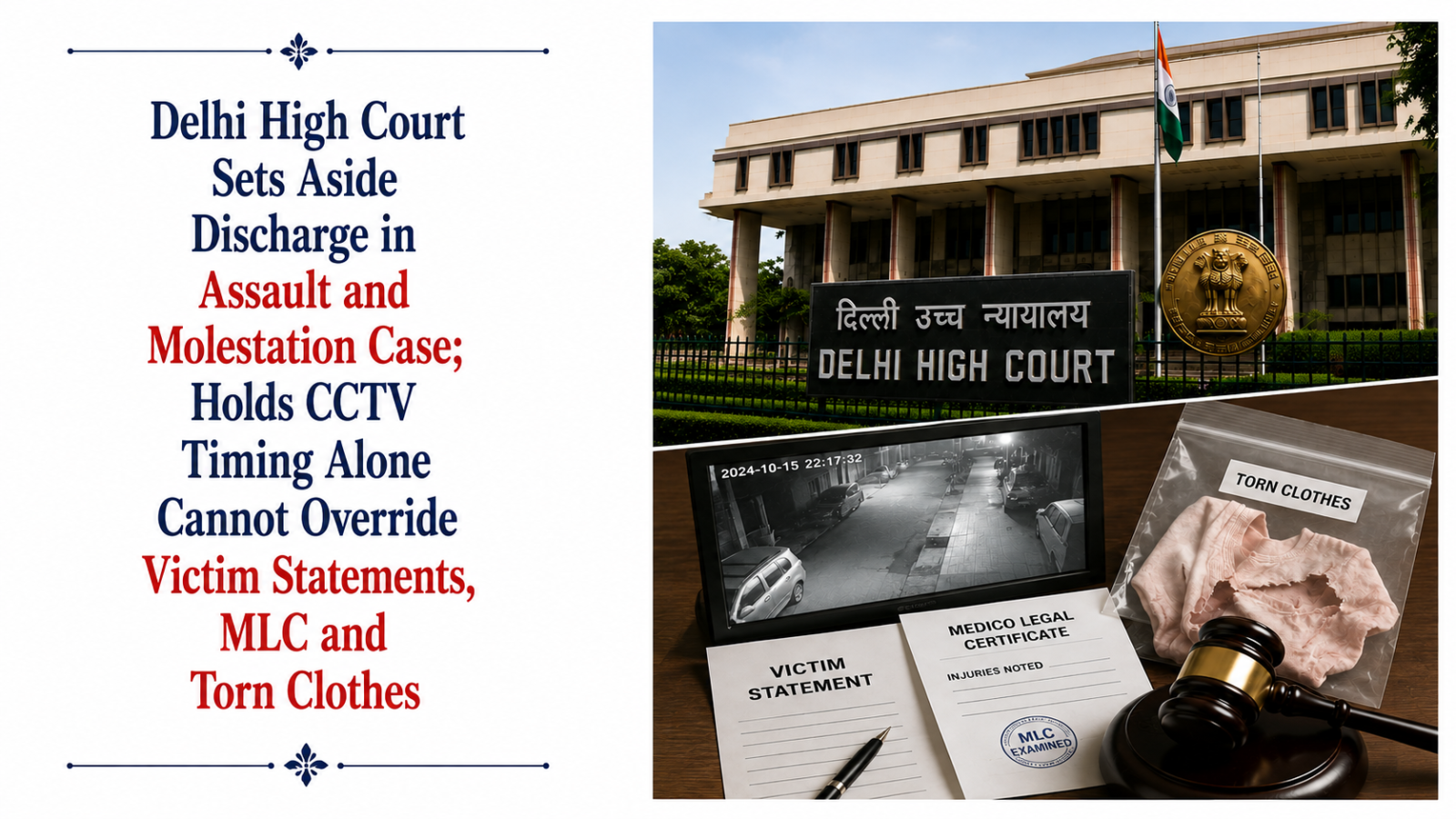
State’s Revision Allowed in Assault Case; Delhi High Court Sets Aside Discharge After Finding Trial Court Ignored Material Prima Facie Evidence
Facts
The case arose from FIR No. 204/2017 registered at Police Station Vasant Kunj South for offences under Sections 308, 354, 451, 509, 506 and 34 IPC. The State filed a criminal revision challenging the Sessions Court’s order dated 21 August 2018 discharging all the accused.
According to the prosecution, on receiving information on 4 May 2017, the Investigating Officer went to Fortis Hospital, where the complainant was initially unable to make a statement. In her statement recorded the following day, she alleged that while she was raising the level of the gate of her premises, the respondents entered the property and assaulted her. During the altercation, she was struck on the head and became unconscious. Her daughter-in-law called the police, but the accused allegedly fled before the police arrived.
In her statement under Section 164 CrPC, the complainant gave more specific allegations. She alleged that Chandgi Ram abused her and subsequently returned with Dharampal, Ant Ram and Kalpana. Chandgi Ram allegedly tore her clothes and touched her breast; Kalpana allegedly struck her on the head; Dharampal held her daughter-in-law; and Ant Ram assaulted her son.
There was admittedly pre-existing civil litigation and a property dispute between the complainant’s family and the accused.
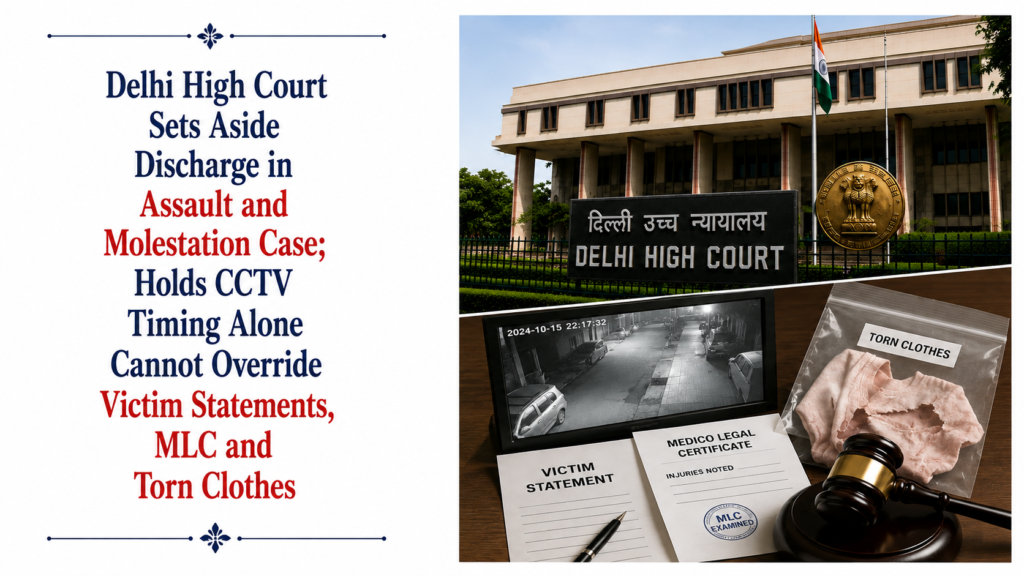
The Trial Court discharged all the accused primarily after considering a timing discrepancy. The PCR call was made at around 2:40 PM, while CCTV footage showed Chandgi Ram at the billing counter of Big Bazaar, Vasant Square Mall, at 2:48:30 PM. Considering the mall to be approximately 7–9 kilometres from the alleged place of occurrence, the Trial Court concluded that it would have been impossible for him to commit the incident and reach the billing counter within that period.
The State challenged the discharge order before the Delhi High Court.
Issues
The principal issues before the High Court were:
- Whether the Trial Court was justified in discharging the accused primarily on the basis of the CCTV footage and discrepancy in the timeline.
- Whether the complainant’s statements, witness accounts, MLC and torn clothes cumulatively raised sufficient prima facie suspicion to require a trial.
- Whether questions concerning the precise time of occurrence, travel time, distance and the accused’s presence at the mall could appropriately be conclusively determined at the stage of framing charge.
- What degree of scrutiny of prosecution evidence is permissible while considering discharge under Sections 227 and 228 CrPC.
- Whether the Trial Court’s failure to consider the prosecution material cumulatively warranted interference in revisional jurisdiction.
Petitioner’s Arguments
The State argued that the Trial Court had given disproportionate importance to a minor discrepancy regarding the precise time of the occurrence.
The complainant was a 55-year-old illiterate woman, and a slight discrepancy regarding timing could not, according to the prosecution, demolish the case at the threshold.
The State emphasised that the complainant’s MLC supported the allegation of assault, while her torn clothes had also been seized during investigation. These circumstances, together with the witness statements, constituted sufficient prima facie material to proceed against the accused.
The prosecution further argued that the admitted property dispute between the parties provided the background in which the alleged incident had occurred and could not itself justify disbelief of the prosecution case without a full trial.
It was also contended that the witnesses placed the incident at around 2:00 PM, whereas the CCTV showed Chandgi Ram at the mall at 2:48 PM. Whether he could have travelled between the two locations was a factual matter requiring evidence at trial.
Respondents’ Arguments
The accused supported the Trial Court’s discharge order and argued that it had properly considered the material available on record.
They contended that the High Court’s revisional jurisdiction was narrow and interference was justified only where the Trial Court’s view was manifestly perverse or so inherently improbable that no reasonable person could have arrived at it.
Accordingly, they argued that the State had failed to establish any basis for revisional interference.
Analysis of the Law
The High Court examined the standard applicable at the stage of framing charges under Sections 227 and 228 CrPC.
At this stage, the Court is not required to conduct a meticulous evaluation of the prosecution evidence or finally determine its truthfulness, reliability or probative value. The relevant inquiry is whether the material, viewed collectively, gives rise to a sufficiently strong or plausible prima facie case warranting trial.
The High Court held that the Trial Court had effectively treated the timing discrepancy and CCTV footage as determinative, while failing to give adequate weight to other material circumstances.
The witnesses placed the alleged incident at around 2:00 PM. The MLC indicated assault, and the complainant’s torn clothes were also part of the investigative material. These were prima facie relevant circumstances that could not simply be disregarded because the PCR call was made later at 2:40 PM and one accused appeared on CCTV at the mall at 2:48 PM.
Questions concerning the exact time of occurrence, distance between the locations, travel time, neighbourhood geography, past hostility and the explanation for delay in the PCR call were matters requiring evidentiary examination at trial.
Precedent Analysis
The High Court relied upon the Supreme Court’s decision in Manendra Prasad Tiwari v. Amit Kumar Tiwari, (2022) 20 SCC 757.
The Supreme Court had held that while considering whether charges should be framed, the court must consider the prosecution material as a whole without meticulously sifting the evidence or entering into its ultimate probative value.
Where the material creates a high probability that the accused has prima facie committed the offence, the matter should proceed to trial. Questions regarding the truthfulness, acceptability and sufficiency of the prosecution evidence are properly tested during trial.
Applying this principle, the Delhi High Court held that the material against the respondents crossed the threshold of mere suspicion and disclosed a plausible case requiring trial.
Court’s Reasoning
The High Court found that the Trial Court had treated the CCTV footage as virtually conclusive proof that Chandgi Ram could not have participated in the alleged incident.
However, the Trial Court’s reasoning proceeded largely from the assumption that the incident occurred at approximately 2:40 PM because that was when the PCR call was made.
The prosecution witnesses, on the other hand, placed the incident at around 2:00 PM. If that version were accepted for the limited purpose of assessing a prima facie case, the accused being present at the mall at 2:48 PM would not necessarily make the prosecution version impossible.
The Court held that determining the precise sequence required examination of multiple factors: the actual time of occurrence, timing of the PCR call, CCTV footage, distance between the locations, possible travel time, local routes, surrounding circumstances and the admitted history of hostility between the parties.
These matters could not appropriately be resolved conclusively at the charge stage. They required a full-fledged trial.
The Court further found that the MLC, torn clothes and witness statements constituted material prima facie evidence which the Trial Court had failed to adequately consider.
The discharge order therefore suffered from an inherent error and non-consideration of relevant prima facie material, warranting interference under the High Court’s revisional jurisdiction.
Conclusion
The Delhi High Court allowed the State’s criminal revision and set aside the Trial Court’s order dated 21 August 2018 discharging all the respondents.
The Court held that the accused could not have been discharged merely on the basis of the timing discrepancy and CCTV footage when other material—including witness statements, the complainant’s MLC and her torn clothes—prima facie supported the prosecution case.
The High Court clarified that the factual discrepancies regarding timing, distance and the accused’s presence at the mall were matters to be tested through evidence at trial rather than conclusively determined at the charge stage.
The Trial Court was consequently directed to frame charges afresh against the respondents within three months, after considering all material available on record and following due process of law.
Case Details
Case: State v. Chandgi Ram & Ors.
Court: High Court of Delhi at New Delhi
Case Number: CRL.REV.P. 1087/2018 & CRL.M.A. 36132/2019
Judge: Hon’ble Mr. Justice Saurabh Banerjee
Date: 11 August 2026
FIR: FIR No. 204/2017, P.S. Vasant Kunj South
Offences: Sections 308, 354, 451, 509, 506 and 34 IPC
Result: State’s revision allowed; discharge order set aside and Trial Court directed to frame charges afresh within three months.