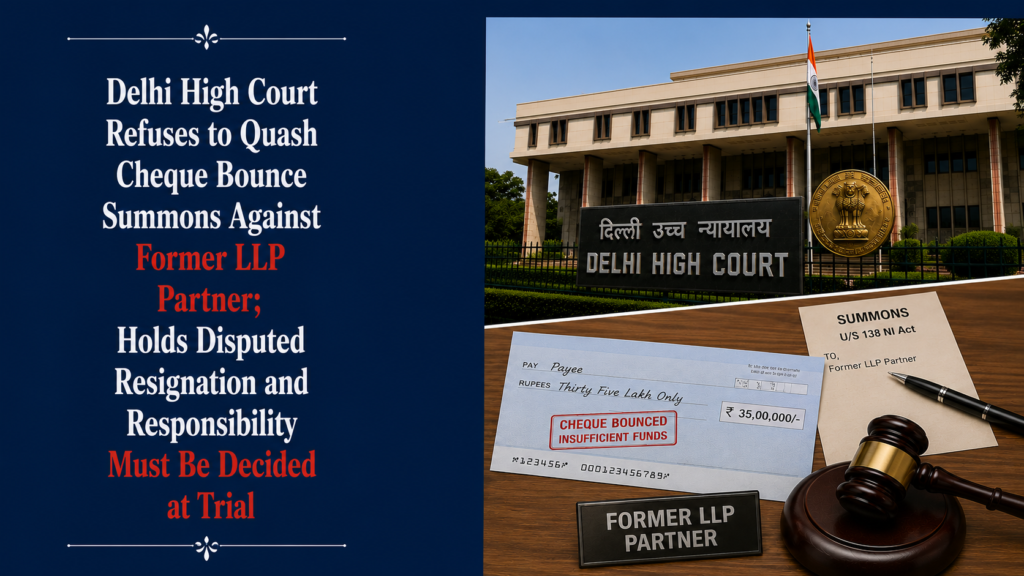
Delhi High Court Refuses to Quash Cheque Bounce Summons Against Former LLP Partner; Holds Disputed Resignation and Responsibility Must Be Decided at Trial

Delhi High Court Rejects Quashing Based on Self-Serving Resignation Documents; Holds Section 138 Liability of LLP Partner Must Be Tested at Trial
Facts
M/s Sarvodaya Traders entered into a Clearing and Forwarding Agent Agreement dated 20 November 2017 with M/s Arihant Electro Transworld LLP. Under the agreement, the complainant had deposited ₹50 lakh as refundable security. Rajesh Agrawal, the petitioner, was a partner of the LLP and a signatory to the C&F Agreement.
The complainant subsequently terminated the agreement on 8 September 2018 because of alleged outstanding dues. Towards partial discharge of the liability to refund the ₹50 lakh security deposit, the LLP issued six cheques of ₹5 lakh each.
Three of those cheques, dated 9, 12 and 13 November 2018, were presented and dishonoured for “insufficient funds.” The complainant consequently instituted complaints under Section 138 of the Negotiable Instruments Act against the LLP, another partner and Rajesh Agrawal.
The Magistrate issued summoning orders dated 24 June 2019. Rajesh Agrawal approached the Delhi High Court under Section 482 CrPC seeking quashing of the summoning orders, the three complaints and all consequential proceedings.
His principal case was that he had ceased to be a partner of the LLP with effect from 1 August 2018, whereas the disputed cheques were issued only in November 2018. He therefore claimed that he had no association with the LLP when the cheques were issued.
Issues
The principal issues before the Court were:
- Whether the Section 138 NI Act proceedings against the petitioner could be quashed on the ground that he had allegedly resigned from the LLP before issuance of the dishonoured cheques.
- Whether the petitioner’s resignation and his responsibility for the day-to-day affairs of the LLP could be determined under Section 482 CrPC at the initial stage of criminal proceedings.
- Whether documents produced by the petitioner to establish his prior resignation could be accepted by the High Court without being proved before the Trial Court.
- Whether adjudicating these disputed factual questions at the quashing stage would amount to prematurely deciding the merits of the criminal complaints.
Petitioner’s Arguments
Rajesh Agrawal argued that he had ceased to be a partner of the LLP with effect from 1 August 2018.
Since the three dishonoured cheques were issued only on 9, 12 and 13 November 2018, he contended that he was neither associated with the LLP nor responsible for its affairs when the alleged offence occurred.
He therefore argued that continuation of the complaints and summoning orders against him was unjustified and sought their quashing under Section 482 CrPC.
Respondent’s Arguments
The complainant disputed the petitioner’s assertion that he had ceased to be a partner.
According to the respondent, Rajesh Agrawal remained an active partner involved in the LLP’s day-to-day affairs. It alleged that the documents relied upon to establish his resignation were false, manipulated and fabricated, and their genuineness therefore constituted a triable issue.
The respondent further emphasised that although the petitioner was not the signatory to the dishonoured cheques, he had himself executed the underlying C&F Agreement on behalf of the LLP and was allegedly involved in its daily affairs.
Analysis of the Law
The High Court reiterated that at the summoning stage, when evidence has yet to be led, it cannot assume disputed facts and return factual findings in exercise of its inherent jurisdiction.
Whether an accused had resigned from a company or LLP before the relevant transaction and whether he remained responsible for its day-to-day business are questions that may require evidence.
Where the complainant specifically disputes the resignation and challenges the documents relied upon by the accused, the High Court cannot ordinarily treat those documents as conclusively established in proceedings under Section 482 CrPC.
The Court found that the petitioner’s plea raised precisely such disputed factual questions. Whether he had actually ceased to be a partner and whether he remained responsible for the LLP’s affairs at the relevant time required adjudication by the Trial Court.
Precedent Analysis
The High Court principally relied upon R.L. Toshniwal v. Indo Rama Synthetics, 2003 SCC OnLine Del 177.
In that case, a Coordinate Bench had held that once persons had been summoned to face trial under Section 138 NI Act, the question whether they had resigned from the accused company and ceased to be responsible for its day-to-day business was ordinarily required to be decided after evidence was led at the appropriate stage.
The judgment in R.L. Toshniwal itself referred to:
- Sunaina R. Mathani v. National Capital Territory of Delhi, (2002) 61 DRJ 439;
- Anurag Modi v. M/s MSTC Ltd., (2002) 61 DRJ 220;
- Municipal Corporation of Delhi v. Purshotam Dass Jhunjunwala, 1983 CAR 7 (SC); and
- Raj Lakshmi Mills v. Shakti Bhakoo, (2002) 8 SCC 236.
These authorities were relied upon to reinforce the proposition that disputed questions concerning resignation and responsibility for company affairs should ordinarily be tested through evidence rather than conclusively determined at the threshold.
Court’s Reasoning
The Court noted that the complaints were still at an initial stage.
The petitioner’s claim that he had ceased to be a partner before the issuance of the cheques was expressly disputed by the complainant. Likewise, whether he remained responsible for the LLP’s day-to-day affairs was a contested factual issue.
The Court characterised the documents produced by the petitioner in support of his resignation, at that stage, as prima facie self-serving documents. They had not been produced or proved before the Trial Court.
The Court further observed that issuance of the cheques on behalf of the LLP was not denied. The statutory presumptions relating to the cheques and the petitioner’s attempt to rebut the complainant’s case were matters requiring trial and evidence.
Accepting the petitioner’s factual defence at the Section 482 stage would effectively amount to pre-judging the merits of the complaints without giving the complainant an opportunity to prove its case.
The Court held that what the petitioner sought was squarely within the domain of the Trial Court. Permitting him to establish his disputed resignation directly before the High Court would allow him to circumvent the ordinary procedure of trial.
Accordingly, the Court characterised the petitions as “way too premature.”
Conclusion
The Delhi High Court refused to quash the Section 138 NI Act complaints or the summoning orders against Rajesh Agrawal.
It held that whether the petitioner had validly ceased to be a partner before issuance of the cheques and whether he was responsible for the LLP’s affairs at the relevant time were disputed questions of fact requiring evidence before the Trial Court.
The High Court could not conclusively determine those matters by relying upon documents that had neither been produced nor proved before the Trial Court.
Finding no merit in the petitions and considering them premature, the Court dismissed all three petitions along with the pending applications. It clarified that its observations would not prejudice the merits of the trial.
Case Details
Case: Rajesh Agrawal v. M/s Sarvodaya Traders
Court: High Court of Delhi at New Delhi
Case Numbers: CRL.M.C. 5410/2022, CRL.M.C. 5411/2022 and CRL.M.C. 5412/2022
Judge: Hon’ble Mr. Justice Saurabh Banerjee
Date: 11 August 2026
Result: Quashing petitions dismissed; Section 138 NI Act complaints and summoning orders allowed to continue, with the petitioner’s resignation and responsibility for LLP affairs left for determination at trial.