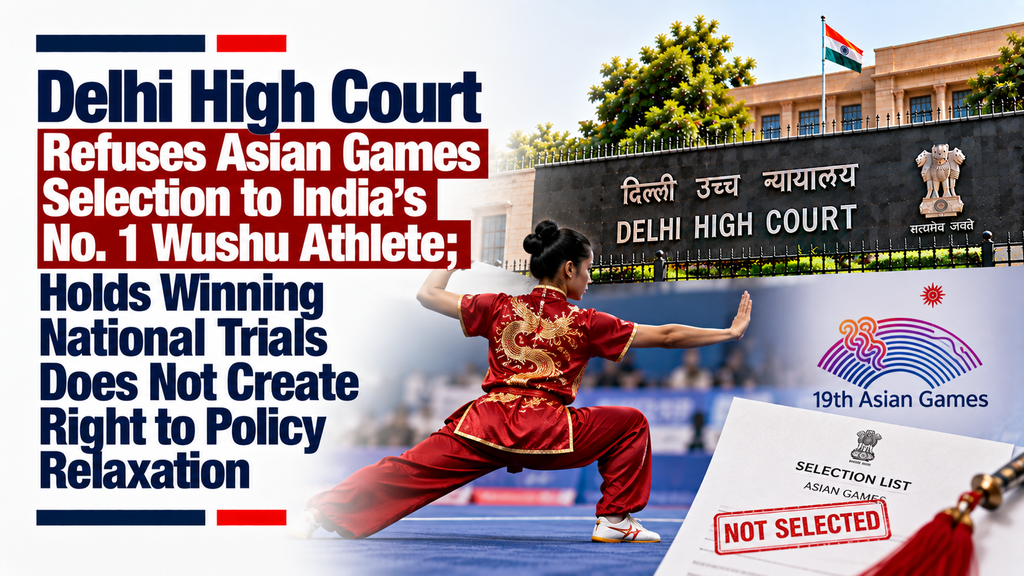
Delhi High Court Refuses Asian Games Selection to India’s No. 1 Wushu Athlete; Holds Winning National Trials Does Not Create Right to Policy Relaxation

No Automatic Asian Games Selection for National Trial Winner: Delhi High Court Upholds Sports Ministry’s Eligibility Criteria
Facts
The case concerned Suraj Yadav, an Indian Wushu athlete competing in the Men’s Sanda 70 kg category, who sought a direction requiring the Union Ministry of Youth Affairs & Sports to forward his name for participation in the 20th Asian Games, Aichi-Nagoya, 2026. In the alternative, he sought consideration under the relaxation clause contained in Clause 5 of the Ministry’s Selection Criteria dated 24 September 2025.
Yadav had represented India at the 19th Asian Games at Hangzhou in 2023, finishing fifth in his category. Between 2023 and 2025, however, he suffered serious injuries to both knees, undergoing right ACL reconstruction with meniscectomy in October 2023 and left ACL reconstruction in July 2025. His rehabilitation prevented him from participating in certain major international Wushu competitions.
For the 2026 Asian Games, the Wushu Association of India conducted Open Selection Trials at Meerut in May 2026 and Final Selection Trials at Srinagar in June 2026.
Yadav secured Rank No. 1 in the Men’s Sanda 70 kg category in the final trials. He thereafter joined the Senior National Coaching Camp.
He subsequently represented India at the SCO Wushu Competition and won a bronze medal. He was also included in the Sports Authority of India’s sanctioned National Coaching Camp at Patiala immediately preceding the Asian Games.
However, when the Ministry published the final Indian contingent on 22 August 2026, Yadav’s name was missing.
More significantly, no other Indian athlete was selected for the Men’s Sanda 70 kg category, meaning the available participation slot remained unused.
Issues
The central question framed by the Delhi High Court was:
Can an athlete who admittedly does not satisfy the benchmark prescribed under the Ministry’s Selection Policy compel the Ministry to invoke the relaxation clause in his favour?
This raised connected questions concerning the legal significance of:
- finishing Rank No. 1 in domestic selection trials;
- an available but unused Asian Games quota;
- recommendation by the National Sports Federation;
- the athlete’s recent international performance; and
- the Court’s power under Article 226 to interfere with expert sporting selection criteria.
Petitioner’s Arguments
Yadav emphasised his sporting record.
He had represented India at the 2023 Asian Games, secured gold at the 38th National Games in 2025, bronze at the SCO Wushu Sanda Tournament in 2026, and finished first in both stages of the domestic selection process.
The Wushu Federation had also recommended his inclusion.
According to Yadav, his exclusion was particularly arbitrary because India had an available participation slot in his category but chose not to nominate anybody at all.
He argued that Clause 5 of the Ministry’s policy specifically permitted relaxation for justifiable reasons and that his exceptional circumstances—including injury, rehabilitation, successful comeback, national ranking and Federation recommendation—warranted consideration under that clause.
Respondents’ Arguments
The Union of India and Sports Authority of India argued that Asian Games selection was governed by the Ministry’s uniform Selection Criteria dated 24 September 2025.
For Yadav’s discipline, the relevant benchmark required a top-six finish among Asian nations in an equivalent international competition.
The policy further required such an equivalent competition to have participation from at least 12 Asian countries in each of its previous two editions, while invitational competitions were expressly excluded.
Yadav had not competed in the 2nd Wushu Sanda Asian Cup in July 2025 or the 17th World Wushu Championships in Brazil.
The Moscow Wushu Stars Championship and SCO competition relied upon by him were invitational competitions involving only eight and eleven countries respectively and therefore did not satisfy the prescribed benchmark.
Analysis of the Law
Winning National Trials Does Not Automatically Secure Asian Games Selection
This is an important takeaway from the judgment.
The High Court accepted that Yadav had finished Rank No. 1 in the domestic selection trials.
But domestic superiority was not the benchmark prescribed by the Ministry for participation in the Asian Games.
Clause 4.1(II)(b), read with Clause 10, required the prescribed performance in an equivalent international competition.
Since the competitions relied upon by Yadav did not satisfy that definition, the Court found that he did not fall within Clause 4 of the Selection Criteria.
Thus:
Winning the national selection trial identified the leading Indian athlete in the category, but did not itself establish eligibility under the Ministry’s separate international-performance benchmark.
Relaxation Requires Both Experts and SAI
The case ultimately turned on Clause 5.
The relaxation clause stated that where, in the opinion of experts of the particular sporting discipline and SAI, participation in relaxation of the criteria is recommended for justifiable reasons, the Ministry would consider the matter for an appropriate decision.
The High Court identified three cumulative requirements:
- an opinion/recommendation from experts of the discipline and SAI;
- justifiable reasons supporting relaxation; and
- consideration thereafter by the Ministry.
The word “and” was crucial.
A recommendation from the National Sports Federation by itself was insufficient.
Although the Wushu Association of India had recommended Yadav to SAI on 28 August 2026, that letter was not itself a recommendation by SAI.
The Ministry stated on affidavit that it had received no recommendation from SAI.
Therefore, the threshold conditions necessary to activate Clause 5 had not been satisfied.
Relaxation Is Not a Right
The High Court drew an important distinction between a provision requiring consideration for relaxation and one conferring a right to receive relaxation.
Clause 5 merely stated that once its preconditions were fulfilled, the matter would be “considered” by the Ministry for an appropriate decision.
It did not say that relaxation “shall” be granted.
Relying upon the Supreme Court’s decision in State of U.P. v. Vikash Kumar Singh, the Court held that a relaxation provision is generally enabling and discretionary.
It gives the competent authority power to relax a requirement; it does not create an enforceable entitlement in favour of the person seeking relaxation.
The Court therefore held that neither:
the athlete, the Federation sponsoring him, nor the High Court itself could assume the Ministry’s discretionary power to grant relaxation.
Vacant Asian Games Slot Does Not Create a Right to Selection
Another significant aspect was Yadav’s argument that India had an available quota in the Men’s Sanda 70 kg category and was sending nobody.
The Court relied upon its recent judgment in Sanjana v. Union of India, decided on 7 September 2026.
A vacant slot may permit the competent authority to examine whether an eligible athlete should be nominated or whether relaxation is justified.
But:
an unused quota does not automatically confer a right upon an otherwise ineligible athlete to be selected.
Thus, the existence of an unused participation slot could not independently override the Ministry’s eligibility criteria.
Precedent Analysis
Yoga Federation of India v. Union of India
The Court relied upon Yoga Federation of India v. Union of India, 2026:DHC:5515.
That judgment emphasised that conditions attached to a relaxation power are not empty procedural requirements; they operate as safeguards against arbitrary departures from established selection criteria.
Relaxation therefore has to be exercised deliberately, for recorded and legally sustainable reasons, within the limits of the policy itself.
State of U.P. v. Vikash Kumar Singh
The Supreme Court held that relaxation cannot be demanded as a matter of right.
Where a rule gives the authority discretion to relax eligibility requirements, a writ court cannot ordinarily issue mandamus directing the authority to actually grant that relaxation.
Sanjana v. Union of India
The Delhi High Court’s recent judgment in Sanjana was relied upon for the proposition that an available or vacant sporting quota does not itself create an automatic entitlement to nomination where the athlete does not satisfy the prescribed criteria.
Yamini Mourya v. Indian Olympic Association
The Court also reiterated the restricted scope of judicial review over sporting selections.
Selection standards are generally formulated by experts. Unless the criteria or their application are shown to be arbitrary, irrational, mala fide or otherwise legally unreasonable, the writ court should not sit as an appellate sporting selection authority and substitute its own assessment of an athlete’s suitability.
Court’s Reasoning
The factual circumstances were undoubtedly compelling.
Yadav had undergone two reconstructive knee surgeries, returned to competitive Wushu, finished first in the Federation’s trials, remained in the national coaching setup and subsequently secured an international bronze medal.
The Court expressly acknowledged his comeback and sporting success.
But those circumstances could not change the legal architecture of the selection policy.
The prescribed international benchmark applied equally to all athletes.
Further, Clause 5 could operate only after the required recommendations were made. Since SAI had not recommended relaxation, the necessary trigger for the Ministry to exercise its discretion was absent.
The Court therefore found no arbitrariness, irrationality or mala fides in the decision-making process.
Conclusion
The Delhi High Court dismissed Suraj Yadav’s petition and refused to direct his inclusion in India’s contingent for the 2026 Asian Games.
The judgment establishes three particularly important propositions in sports-selection disputes:
Winning national selection trials does not by itself create an enforceable right to international selection where a separate Ministry benchmark remains unsatisfied.
A vacant international quota does not automatically entitle the highest-ranked domestic athlete to participate.
And most importantly, relaxation from selection criteria is discretionary rather than an athlete’s legal right, and it can operate only in accordance with the specific conditions prescribed by the policy.
Case Details
Case: Suraj Yadav v. Union of India & Ors.
Court: High Court of Delhi at New Delhi
Case No.: W.P.(C) 12991/2026
CNR: DLHC010420842026
Judge: Dr. Justice Swarana Kanta Sharma
Reserved: 14 September 2026
Pronounced: 15 September 2026
Subject: Selection for 20th Asian Games, Aichi-Nagoya, 2026 — Men’s Sanda 70 kg Wushu
Result: Petition dismissed; Court declined to direct selection or relaxation of the Ministry’s eligibility criteria.