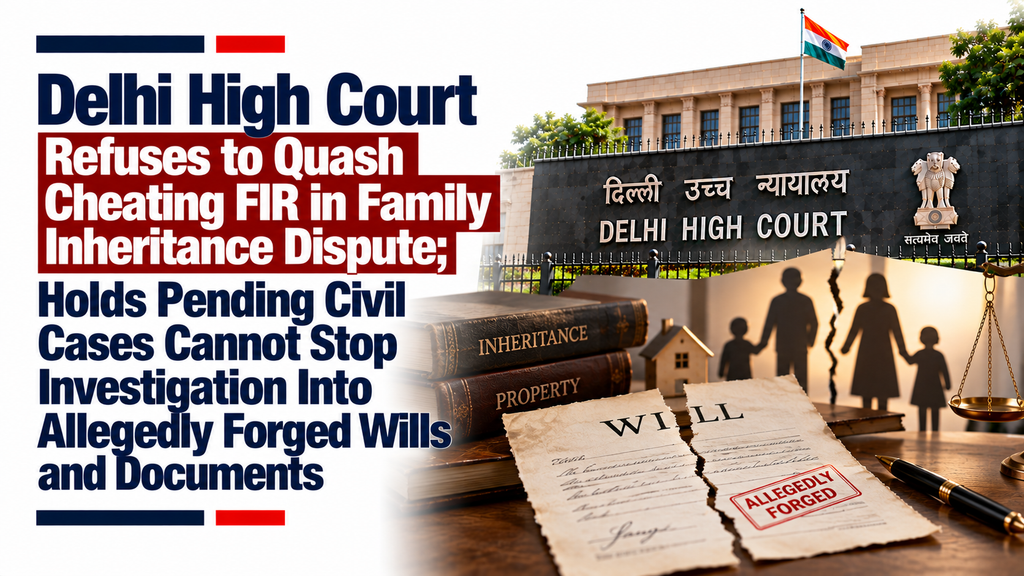
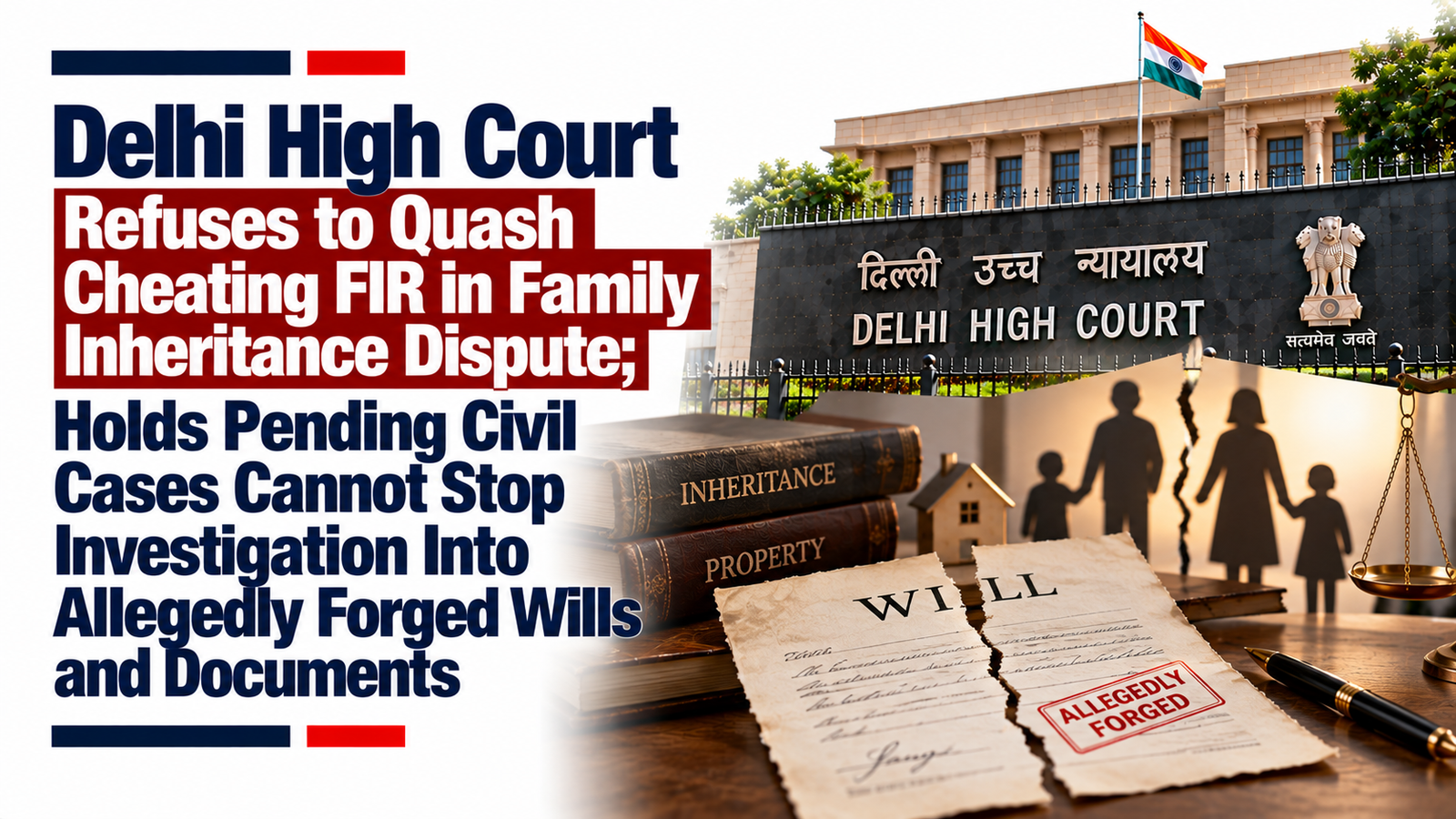
Delhi High Court Refuses to Quash Cheating FIR in Family Inheritance Dispute; Holds Pending Civil Cases Cannot Stop Investigation Into Allegedly Forged Wills and Documents

Closure Report Does Not End Criminal Case: Delhi High Court Upholds Magistrate’s Power to Order Further Investigation
Facts
The dispute arose within the Bhargava family over the estate and business interests of late K.P. Bhargava and Ganga Bhargava. Petitioner Sudhir Bhargava and complainant Kumud Bhargava are siblings, while the other two petitioners are Sudhir’s wife and son. The family had interests in Associated Chemical Industries and Associated Chemical Industries (Kanpur) Pvt. Ltd.
K.P. Bhargava had executed a Will dated 11 August 1993. After his death in 1994, a partnership deed dated 2 February 1994 was executed. Ganga Bhargava subsequently executed Wills dated 26 October 2001 and 3 April 2009, with the latter being registered.
The family had already been embroiled in extensive civil, probate and company-law litigation concerning these documents. The complainant had challenged the 1993 Will, the 2009 Will and issues surrounding the partnership and family business before different forums.
Years later, on 5 May 2022, Kumud Bhargava lodged a criminal complaint alleging that the Wills of her parents and the 1994 partnership deed had been forged or fabricated and subsequently used to deal with family assets and business interests to her detriment.
FIR No. 386/2022 was consequently registered under Sections 406, 420 and 34 IPC.
Police Initially Filed a Closure Report
The police investigated the allegations, examined attesting witnesses, contacted the Sub-Registrar at Kanpur and considered material relating to the earlier civil proceedings.
The Investigating Officer thereafter filed a closure report dated 27 July 2022, concluding that no cognizable offence was made out.
The complainant filed a protest petition.
The Magistrate declined to let the matter end there and, by orders dated 3 October 2024 and 17 February 2025, directed further investigation, including investigation into the disputed Wills and partnership deed.
The petitioners then approached the Delhi High Court seeking quashing of both the FIR and the orders directing further investigation.
Issues
The principal questions before the Delhi High Court were whether a criminal investigation could continue when the underlying dispute had already been litigated for years before civil and company-law forums, and whether the Magistrate could order further investigation after the police had filed a closure report.
The Court also considered whether allegations concerning forgery of the Wills and partnership deed disclosed sufficient criminality at the threshold, whether the ingredients of Sections 406 and 420 IPC were made out, and whether disputed handwriting and documentary evidence could properly be evaluated in quashing proceedings.
Petitioners’ Arguments
The petitioners argued that the criminal proceedings were merely an attempt to give a criminal colour to a longstanding inheritance and property dispute.
They pointed out that the complainant had known about and challenged the disputed Wills years earlier. Her challenge to the father’s 1993 Will had been dismissed as barred by limitation, with the dismissal subsequently surviving proceedings before the Allahabad High Court and Supreme Court.
They emphasised that the police had already conducted an investigation and filed a closure report.
The attesting witnesses had supported execution of the Wills, while registration material was also collected from the Sub-Registrar. According to the petitioners, there was therefore no justification for reopening the investigation merely because the complainant disagreed with the closure report.
They further argued that expert handwriting evidence concerning decades-old documents could not override the evidence of attesting witnesses and could not constitute conclusive proof of forgery.
Importantly, they contended that even the FIR did not disclose the basic ingredients of criminal breach of trust or cheating because there was no specific entrustment of property and no fraudulent inducement resulting in delivery of property.
Reliance was placed principally upon State of Haryana v. Bhajan Lal, besides Haji Iqbal, G. Sagar Suri, Krishna Lal Chawla and other authorities governing quashing and abuse of criminal process.
Respondent’s Arguments
The complainant argued that the police closure report was largely based upon the existence of civil proceedings rather than a meaningful investigation into whether the disputed documents were actually forged.
The Magistrate had specifically identified three sets of documents requiring investigation:
- the partnership deed dated 2 February 1994;
- K.P. Bhargava’s Will dated 11 August 1993; and
- Ganga Bhargava’s Will dated 3 April 2009.
According to the complainant, no effective forensic or handwriting examination had been undertaken despite specific allegations of forgery.
The respondent maintained that civil and criminal proceedings arising from the same transaction are not mutually exclusive and that the existence of a civil dimension could not prevent investigation of independently disclosed criminal offences.
Analysis of the Law
Civil Litigation Does Not Automatically Bar Criminal Proceedings
This is the central proposition emerging from the judgment.
The Delhi High Court acknowledged that the parties had been engaged in prolonged litigation concerning their parents’ estate and business interests.
However, the mere existence of civil proceedings does not bar investigation or prosecution where the allegations independently disclose a criminal offence.
The Court explained that the relief sought in civil proceedings and the ingredients constituting a criminal offence operate in different fields.
This was not merely a case where the siblings disagreed about how a Will should be interpreted or what share each heir was entitled to receive.
The complainant’s allegation went further: the very documents on which rights were claimed and assets dealt with were allegedly forged or fabricated and subsequently used to obtain or retain those rights.
Whether that allegation was ultimately true was a matter for investigation and evidence.
Earlier Civil Proceedings Did Not Establish That the Wills Were Genuine
An important aspect of the judgment is the High Court’s treatment of the earlier litigation.
The petitioners relied heavily upon the fact that the complainant’s challenge concerning the father’s 1993 Will had already travelled through various courts.
But the High Court observed that the suit challenging that Will had been dismissed on limitation.
There had therefore been no adjudication by a competent court conclusively establishing that the Will was genuine.
Similarly, proceedings concerning the mother’s 2009 Will remained pending.
The High Court therefore refused to proceed on the assumption that the disputed Wills had already been judicially declared genuine.
Closure Report Does Not Bind the Magistrate
This is another significant legal proposition from the judgment.
The High Court held that filing of a closure report by the Investigating Officer does not automatically bring criminal proceedings to an end.
A Magistrate is not required to mechanically accept the police conclusion.
When a complainant files a protest petition, the Magistrate may independently consider:
the material gathered during investigation, the deficiencies in that investigation and the complainant’s objections.
If relevant aspects remain unexplored, the Magistrate can direct further investigation.
Here, the Magistrate found that the genuineness of the disputed Wills and partnership deed had not been sufficiently examined and that no effective forensic examination had been undertaken.
The direction to obtain handwriting/FSL material and investigate further was therefore within the Magistrate’s jurisdiction.
Handwriting Expert vs. Attesting Witnesses
The High Court did not accept either side’s evidence as conclusive at the quashing stage.
The petitioners argued that the attesting witnesses supported execution of the Wills.
The complainant relied upon handwriting expert material questioning their genuineness.
The Court held that neither issue could appropriately be conclusively determined under Section 528 BNSS.
Registration records and statements of attesting witnesses may be important evidence, but they do not require the High Court to declare the documents genuine while deciding a quashing petition.
Conversely, a handwriting expert’s opinion is also not conclusive by itself.
The evidentiary value of all such material must be assessed at the appropriate stage.
Precedent Analysis
The petitioners principally relied upon State of Haryana v. Bhajan Lal, contending that the proceedings constituted an abuse of criminal process.
The High Court explained that Bhajan Lal does not require quashing merely because the accused presents an alternative factual version or produces circumstances potentially supporting the defence.
The categories recognised in Bhajan Lal are intended to prevent manifest abuse of criminal proceedings. Allegations that testamentary and other documents were fabricated and then used concerning the deceased’s estate and business interests could not, at this stage, be placed within those categories.
The Court instead relied upon the restraint emphasised by the Supreme Court in Neeharika Infrastructure Pvt. Ltd. v. State of Maharashtra.
At the investigation stage, the High Court is not supposed to determine whether the prosecution allegations will ultimately be proved or whether the accused’s defence is likely to succeed.
Court’s Reasoning
The Court found that the FIR had to be examined as a whole rather than by isolating individual allegations.
The allegations concerning the disputed documents, their alleged use, subsequent dealings with the family assets and alleged wrongful gain were interconnected.
Therefore, whether every ingredient of Sections 406 and 420 IPC would ultimately be proved against each individual petitioner could not appropriately be conclusively decided while the investigation itself remained incomplete.
The High Court further clarified that an order directing further investigation does not amount to a finding of guilt.
The Investigating Officer remains obliged to investigate fairly and place whatever material emerges—whether favourable or adverse to the accused—before the competent court.
Conclusion
The Delhi High Court refused to quash FIR No. 386/2022 and upheld the Magistrate’s orders directing further investigation.
The Court held that the existence of decades-long civil and family litigation could not, by itself, prevent criminal investigation where the complaint specifically alleged fabrication and subsequent use of Wills and other documents.
It further held that the Magistrate was competent to reject the practical effect of the police closure report and order further investigation, particularly where questions concerning the genuineness and forensic examination of the disputed documents remained unresolved.
The petition was accordingly dismissed and any interim protection stood vacated. The Court expressly clarified that it had made no finding on whether the Wills or partnership deed were actually genuine or forged.
Case Details
Case: Sudhir Bhargava & Ors. v. State Govt. of NCT of Delhi & Anr.
Court: High Court of Delhi at New Delhi
Case No.: CRL.M.C. 1633/2025
CNR: DLHC010120292025
Judge: Justice Madhu Jain
Reserved: 18 August 2026
Pronounced: 15 September 2026
FIR: FIR No. 386/2022, P.S. New Ashok Nagar
Offences: Sections 406/420/34 IPC
Jurisdiction Invoked: Section 528, Bharatiya Nagarik Suraksha Sanhita, 2023
Result: Petition dismissed; FIR and Magistrate’s orders for further investigation sustained.