Delhi High Court Refuses Medical Interim Bail to POCSO Accused; Finds Condition Stable, Treatment Adequate and No Identified Need for Better Private Care

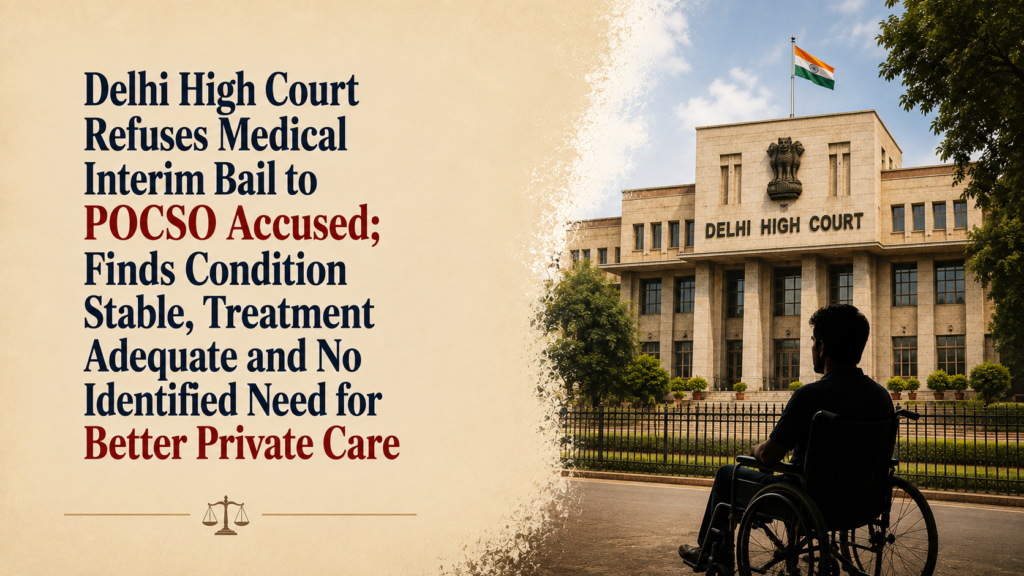
Delhi High Court Refuses Medical Interim Bail to POCSO Accused; Finds Condition Stable, Treatment Adequate and No Identified Need for Better Private Care
Facts
The petitioner, Yogesh @ Monu @ Harvinder, sought interim bail for eight weeks or more in FIR No.201/2021 registered at P.S. Maidan Garhi for offences under Section 376 IPC and Sections 6, 9, 10 and 21 of the POCSO Act.
The broad allegation against him was that he had raped a minor girl, who subsequently gave birth to a child. According to the prosecution, the paternity of the child was established through DNA analysis. Both the victim girl and the child later died. The petitioner had unsuccessfully sought regular bail and had thereafter filed repeated applications for interim bail. The present application was founded upon his alleged multiple medical ailments.
Earlier, the High Court had directed the Senior Medical Officer to personally appear and explain the medical status report dated 6 July 2026 and the nature of the petitioner’s ailments. The Jail Authorities were simultaneously directed to provide the petitioner the best possible medical treatment.
During the hearing, questions also arose regarding the authenticity and manner of preparation of the jail medical report, since the report had been signed by Dr. Sahil describing himself as Senior Medical Officer even though he did not hold that rank.
Issues
The main issue before the Court was whether the petitioner’s medical condition justified grant of interim bail.
The Court also examined whether the petitioner was already receiving adequate treatment in custody, whether his condition was stable, whether any superior treatment was actually available outside prison, and whether a general assertion of a right to treatment from a doctor of choice was sufficient in the absence of an identified doctor or hospital.
A subsidiary issue concerned the reliability and propriety of the medical status report submitted by the jail authorities.
Petitioner’s Arguments
The petitioner sought interim bail primarily on the ground that he was suffering from multiple ailments.
His counsel contended that the accused had a right to obtain medical treatment from a doctor of his own choice.
However, when the Court specifically asked which doctor or hospital the petitioner wished to approach for private treatment, counsel was unable to provide any name and sought time to obtain instructions.
Respondent’s Arguments
The State opposed the interim bail application.
The material before the Court showed that the petitioner was already receiving medical treatment through government super-speciality hospitals. The Senior Medical Officer, Dr. Rakesh Kumar, informed the Court that the petitioner’s condition was presently stable and that he had not suffered any further seizure or bleeding.
The prosecution therefore maintained that there was no demonstrated medical necessity requiring release from custody.
Analysis of the Law
Medical Bail Requires More Than Existence of Ailments
The judgment proceeds on the practical principle that the mere existence of multiple ailments does not automatically entitle an undertrial to interim bail on medical grounds.
The material question is whether the medical condition is such that adequate treatment cannot be provided in custody, or whether release is necessary to secure materially better or specialised treatment unavailable through the prison medical system.
Here, the petitioner was already being treated at super-speciality hospitals, and the Senior Medical Officer stated that his condition was stable.
Right to Medical Treatment Is Fundamental
At the same time, the Court expressly recognised that access to proper medical treatment is the petitioner’s fundamental right.
Accordingly, even while refusing bail, it directed the Jail Authorities to continue providing the best possible medical care.
Thus, the Court drew a distinction between the right to treatment and a supposed automatic right to release for treatment. The former was protected; the latter depended upon medical necessity.
Private Treatment Must Be Concrete, Not Abstract
The petitioner’s argument that he had a right to treatment by a doctor of his choice did not persuade the Court because no specific doctor, hospital or proposed course of private treatment was identified.
In the absence of such particulars, the Court had no basis to conclude that treatment outside custody would be superior or medically necessary.
The Court therefore left open the possibility of a fresh application once the petitioner actually identified a specific doctor or hospital for private treatment.
Precedent Analysis
The judgment does not undertake a detailed discussion of prior case law on medical bail.
Its reasoning is instead grounded principally in the factual medical record, the petitioner’s current condition, the nature of treatment already being administered and the fundamental right to adequate medical care.
The order therefore functions more as a fact-specific application of medical-bail principles than as a precedent-heavy exposition of the governing jurisprudence.
Court’s Reasoning
The High Court declined interim bail for three principal reasons.
First, the Senior Medical Officer confirmed that the petitioner’s medical condition was presently stable, with no further seizure or bleeding.
Second, the petitioner was already receiving treatment through super-speciality hospitals, and nothing was placed before the Court to establish that his treatment would materially improve if he were released.
Third, although counsel asserted a right to private treatment, he could not identify any particular doctor or hospital where the petitioner proposed to receive such treatment.
The Court was also critical of the jail medical report. It observed that the report appeared unusually long and appeared to advocate the petitioner’s bail case rather than merely stating his medical condition. More seriously, the doctor who signed the report as “Senior Medical Officer” admittedly did not hold that rank. The Court described this practice as unacceptable.
Nevertheless, those irregularities did not alter the ultimate medical position: the petitioner was stable and was already receiving specialist treatment.
Conclusion
The Delhi High Court dismissed the application for interim bail on medical grounds.
It held that the petitioner’s present condition was stable, that he was already receiving treatment at super-speciality hospitals, and that no concrete material had been placed before the Court showing that release would enable better medical treatment.
At the same time, the Court protected the petitioner’s right to healthcare by directing the Jail Authorities to continue providing him the best possible medical treatment, expressly recognising that as his fundamental right.
The Court further permitted the petitioner to file a fresh application if and when he decides upon a specific doctor or hospital from whom he seeks private treatment.
Case Details
Case: Yogesh @ Monu @ Harvinder v. The State Govt. of NCT of Delhi
Court: High Court of Delhi at New Delhi
Case Number: BAIL APPLN. 2334/2026; CNR No. DLHC010265592026
Judge: Justice Girish Kathpalia
Date: 10 August 2026
Result: Interim bail on medical grounds dismissed; Jail Authorities directed to continue best possible medical treatment, with liberty to file a fresh application upon identifying specific private treatment