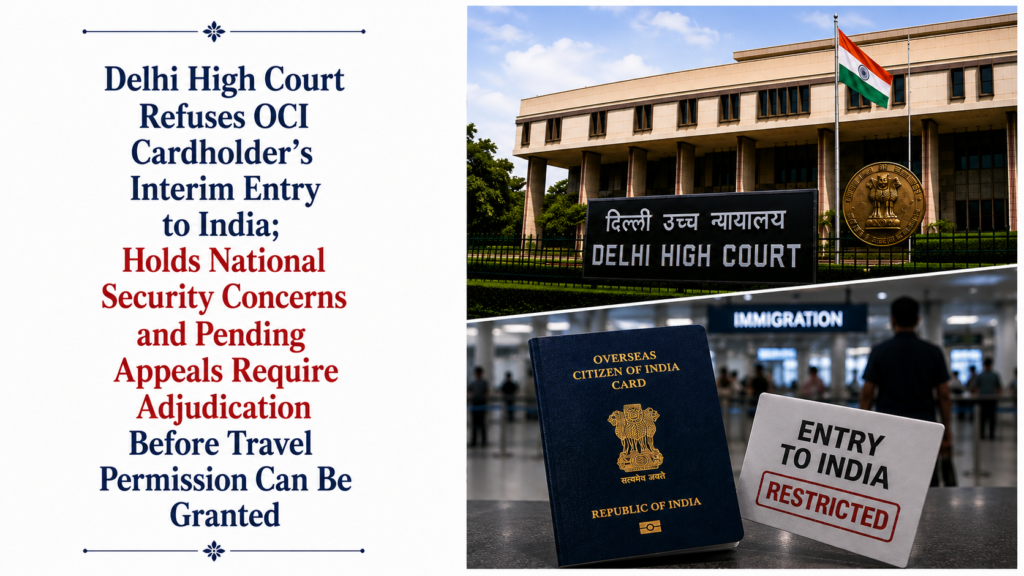
Delhi High Court Refuses OCI Cardholder’s Interim Entry to India; Holds National Security Concerns and Pending Appeals Require Adjudication Before Travel Permission Can Be Granted

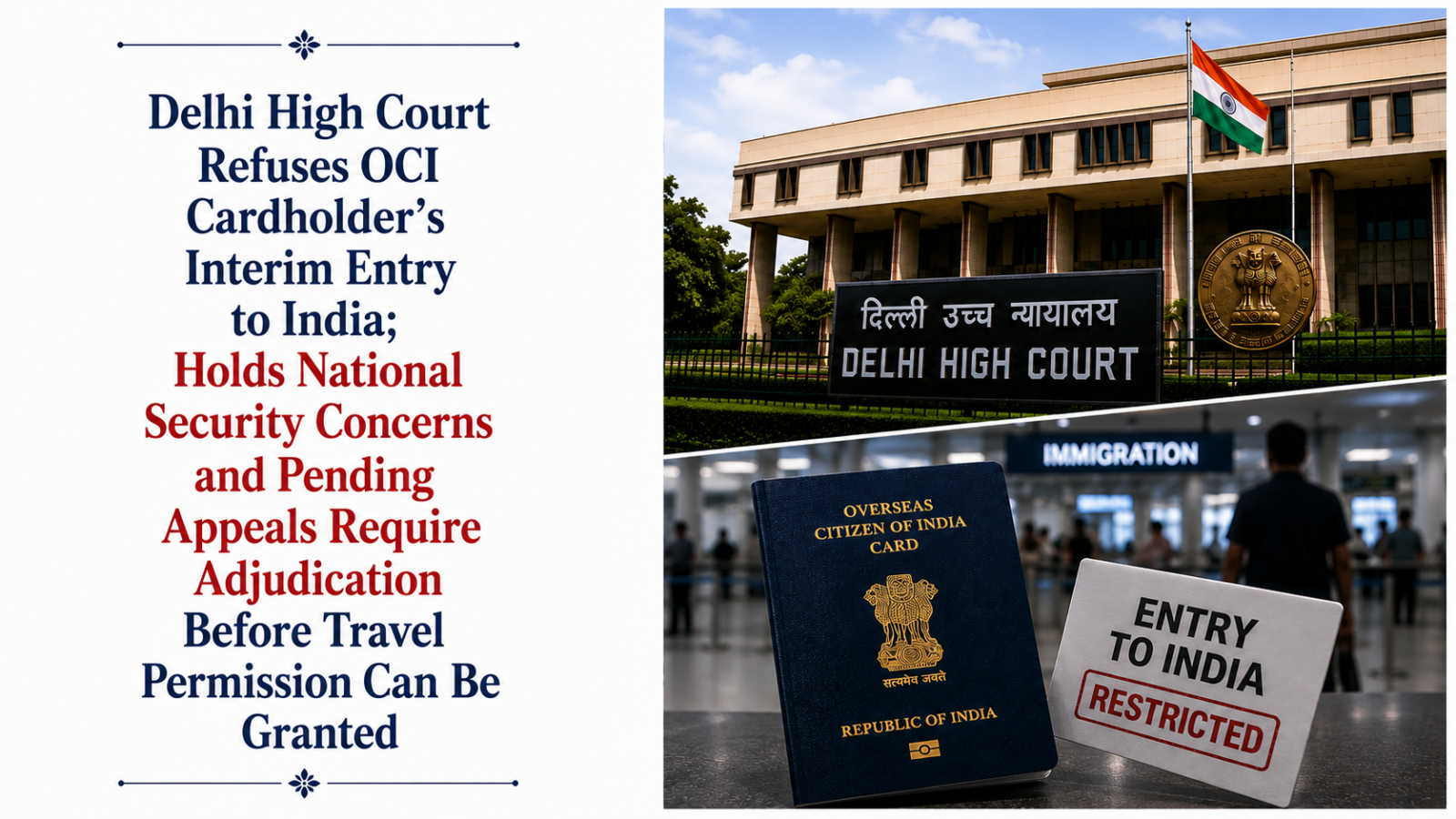
Family Wedding Not Enough for Interim Entry Where National Security and Blacklisting Issues Remain Unresolved, Delhi High Court Holds in OCI Case
Facts
Khalid Jahangir Qazi, an OCI cardholder and medical practitioner residing in the United States, was issued a show-cause notice by the Consulate General of India, New York, on 14 June 2022 proposing cancellation of his OCI card on allegations of involvement in “anti-India activities.” He responded that the material forming the basis of those allegations had not been disclosed and sought both disclosure and a personal hearing.
On 12 May 2023, the authorities cancelled his OCI registration under Section 7D(e) of the Citizenship Act, 1955, citing alleged anti-India, pro-Pakistan propaganda and activities considered inimical to India’s sovereignty, integrity and security. He challenged the cancellation before the Delhi High Court, which stayed its operation during the writ proceedings.
In August 2023, Qazi was initially denied immigration clearance at Delhi Airport but was subsequently permitted by the High Court to enter India. He remained in India from 4 August to 20 October 2023.
In 2024, when he proposed another visit, the Union disclosed that a separate blacklisting order under the Foreigners Act, 1946 had been passed against him on allegations of “pro Kashmiri separatist activities & anti-India propaganda/lobbying.” He therefore filed a second writ petition challenging the blacklisting.
On 12 November 2024, the learned Single Judge set aside the show-cause notice, OCI cancellation order and blacklisting order and directed the authorities to issue a fresh notice clearly specifying the grounds for any proposed restriction or cancellation. Both Qazi and the Union of India challenged different parts of that judgment by filing cross-appeals.
While those appeals remained pending, Qazi sought interim permission to visit India during August-September 2026 to attend family wedding festivities in Srinagar. The Supreme Court, on 3 August 2026, requested the Delhi High Court to decide his pending interim-relief application preferably within one week.
Issues
For purposes of the interim applications, the principal issue was whether Qazi had established the requirements for interim relief—a strong prima facie case, balance of convenience and irreparable injury—sufficient to justify permitting his entry into India pending final adjudication of the cross-appeals.
The underlying appeals raised broader questions concerning:
- the interplay between the Citizenship Act and the Foreigners Act;
- whether OCI status creates a special statutory regime limiting powers under the Foreigners Act;
- whether an OCI cardholder remains subject to Section 3 of the Foreigners Act;
- whether Section 7D procedural safeguards, including opportunity of hearing, extend to blacklisting under the Foreigners Act; and
- whether national-security material relied upon against an OCI cardholder must be disclosed, wholly or partly.
Appellant’s Arguments
Qazi argued that although an OCI cardholder is not an Indian citizen, OCI status carries distinct statutory rights and privileges and cannot be equated with the position of an ordinary foreigner. He relied upon Anushka Rengunthwar v. Union of India to describe OCI rights as a form of “midway right” in the absence of dual citizenship.
He submitted that Section 7D of the Citizenship Act expressly requires a reasonable opportunity of hearing before OCI registration can be cancelled. According to him, such hearing could not be meaningful unless the person was informed, at least substantially, of the allegations and material to be answered.
He further contended that the Government could not circumvent the protections under Section 7D by relying upon substantially the same allegations to blacklist him separately under the Foreigners Act without providing procedural safeguards.
His case was that, so long as his OCI registration remained valid, he could not simply be treated as an ordinary foreigner and denied entry through a parallel blacklisting mechanism.
Qazi also emphasised that both the cancellation and blacklisting orders had already been set aside by the Single Judge. He had been permitted to visit India in 2023 without any allegation of misconduct during that stay and was willing to undertake not to participate in activities objected to by the authorities.
He relied on his advanced age—81 years—and close family connections in Kashmir to argue that denial of permission would cause irreparable harm by preventing him from attending family weddings and spending time with elderly siblings.
Respondents’ Arguments
The Union of India argued that the relief sought was effectively the final relief itself because permitting Qazi to enter India during the appeal would substantially negate the consequences of the blacklisting decision under challenge.
It submitted that an OCI cardholder remains a foreigner under Section 2(a) of the Foreigners Act because he is not an Indian citizen. OCI status confers specified privileges but does not exclude the application of laws regulating foreigners.
The Government argued that Section 3 of the Foreigners Act operates independently of Section 7D of the Citizenship Act. Section 16 of the Foreigners Act expressly provides that its operation is in addition to, rather than in derogation of, other laws governing foreign nationals.
It further contended that no prior notice or hearing is statutorily required before blacklisting a foreign national under the Foreigners Act and that intelligence material supporting such action cannot necessarily be disclosed where doing so would compromise national security, intelligence methods or sources.
The Government also relied upon sealed-cover material allegedly containing adverse intelligence inputs concerning Qazi and argued that the learned Single Judge had previously refused him interim permission to enter India in July 2024 after examining that material.
Analysis of the Law
The Division Bench applied the ordinary principles governing interim relief: prima facie case, balance of convenience and irreparable injury.
However, it emphasised that where the interim relief would substantially confer the same benefit as the ultimate relief sought in the proceedings, the applicant must establish an exceptionally strong prima facie case, going beyond the ordinary threshold applicable to interim applications.
At the interim stage, the Court formed the prima facie view that the Citizenship Act and the Foreigners Act operate in distinct statutory spheres and that procedural safeguards contained in Section 7D of the Citizenship Act could not automatically be imported into proceedings under the Foreigners Act.
The Court also found support for this prima facie view in Section 7 of the Immigration and Foreigners Act, 2025, which is pari materia with Section 3 of the Foreigners Act and does not reproduce the hearing safeguards contemplated under Section 7D of the Citizenship Act.
The Bench nevertheless made clear that these were only tentative observations and that the substantial questions concerning OCI rights, blacklisting, procedural fairness and the interaction between the two statutory regimes would be decided at final hearing.
Precedent Analysis
The appellant relied on Anushka Rengunthwar v. Union of India, (2023) 11 SCC 209, for the distinct statutory status and privileges attached to OCI registration.
He also relied on Gorkha Security Services v. GNCTD, (2014) 9 SCC 104, along with Ramesh Ganeriwal, Mohammad Abdul Moyeed and Triveni Engineering, to argue that effective notice and opportunity of hearing are indispensable where adverse civil consequences follow.
Qazi invoked Madhyamam Broadcasting Ltd. v. Union of India, (2023) 13 SCC 401 to argue that national-security claims do not automatically eliminate procedural fairness and that courts must examine whether non-disclosure is genuinely justified.
The Union relied upon Louis De Raedt v. Union of India, (1991) 3 SCC 554 for the limited constitutional rights available to foreigners.
It also relied on Ex-Armymen’s Protection Services (P) Ltd. v. Union of India, (2014) 5 SCC 409, Madhyamam Broadcasting and Celebi Airport Services India Pvt. Ltd. v. Union of India for the principle that national-security considerations may justify restrictions upon normal procedural safeguards and that executive assessments in that domain receive substantial judicial deference.
The Division Bench itself noted that Ex-Armymen’s Protection Services recognises national security as primarily entrusted to the designated executive authorities, while Madhyamam Broadcasting acknowledges confidentiality and national security as legitimate grounds for limiting procedural rights.
Court’s Reasoning
The Court was not persuaded that the Single Judge’s setting aside of the cancellation and blacklisting orders automatically strengthened Qazi’s case for interim entry.
The Single Judge had set those orders aside principally on procedural grounds and had expressly left open the validity and substance of the confidential material relied upon by the Government. Significantly, the same Single Judge had earlier refused Qazi permission to enter India in July 2024 after perusing the sealed-cover material.
The Division Bench therefore rejected the argument that the sealed-cover material must necessarily have been insignificant merely because the impugned orders had eventually been set aside.
At the same time, the Division Bench itself declined to inspect the sealed-cover material at the interim stage, observing that it would be more appropriately examined, if necessary, at the final hearing.
The Court considered the Government’s assertion that the material relating to blacklisting involved sensitive national-security intelligence. Pending final adjudication of the competing statutory and constitutional contentions, it held that the balance of convenience favoured the Government, which was entrusted with safeguarding national security, sovereignty and the larger public interest.
The Court further held that Qazi’s 2023 visit could not by itself justify interim relief because his subsequent request to travel in 2024 had specifically been rejected after examination of confidential material.
His contention that the authorities had not issued a fresh show-cause notice for approximately 20 months also did not assist him because the Government itself had challenged the Single Judge’s directions and those appeals remained pending.
Most importantly, the Court held that permitting him to enter India would substantially overlap with the ultimate relief sought in the appeals and could prejudice the Government’s challenge founded upon issues of national interest. Qazi therefore had to show an exceptionally strong prima facie case, which the Court found he had not established.
Conclusion
The Delhi High Court refused interim permission to Khalid Jahangir Qazi to enter India for attending family wedding festivities while the cross-appeals concerning cancellation of his OCI card and blacklisting remained pending.
The Court held that complex legal issues concerning the relationship between the Citizenship Act and Foreigners Act, the procedural rights of OCI cardholders, powers of blacklisting, disclosure of intelligence material and national-security considerations required final adjudication.
Since permitting Qazi to enter India would substantially amount to granting the final relief sought, an exceptionally strong prima facie case was required. The Court found that threshold unmet and held that the balance of convenience, at the interim stage, favoured the authorities responsible for national security.
Accordingly, CM APPL. 75597/2024 in LPA 1239/2024 and CM APPL. 75638/2024 in LPA 1243/2024 were dismissed.
Case Details
Case: Khalid Jahangir Qazi through Power of Attorney Holder Ms. Farida Siddiqi v. Union of India & Ors. with connected cross-appeals
Court: High Court of Delhi at New Delhi
Case Numbers: LPA 1239/2024, LPA 1243/2024, LPA 1245/2024 and LPA 1246/2024
Judge: Hon’ble Chief Justice Devendra Kumar Upadhyaya and Hon’ble Mr. Justice Tejas Karia
Date: 11 August 2026
Result: Interim applications seeking permission for the OCI cardholder to enter India dismissed; substantive cross-appeals kept pending for final adjudication.