Delhi High Court Sets Aside Possession Decree Passed on Admissions; Holds Disputed Ownership, License Deed and Alleged Loan Transaction Require Full Trial

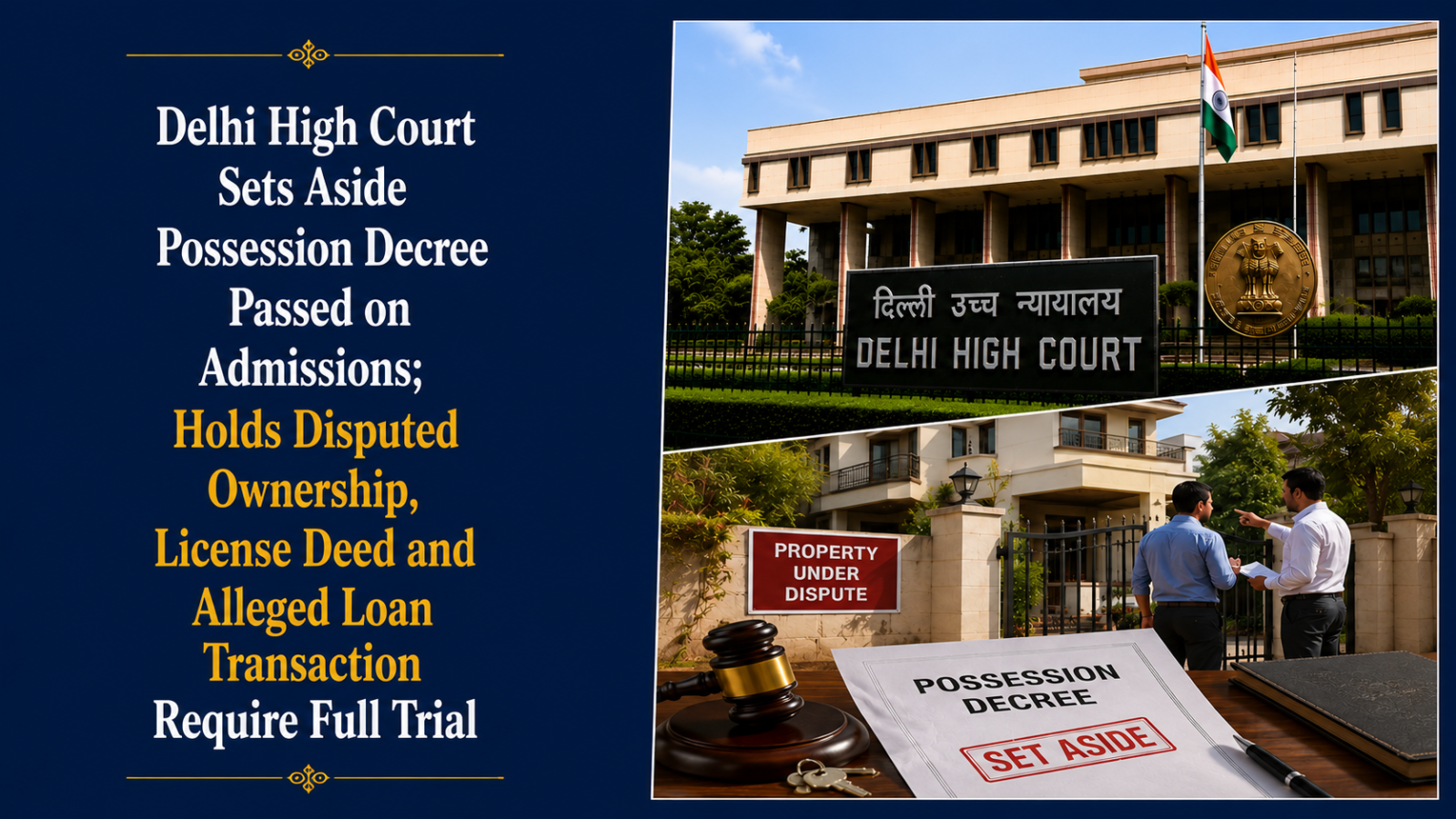
Order XII Rule 6 Cannot Deny Trial Where Ownership and License Are Contested, Delhi High Court Holds; Property Possession Decree Set Aside
Facts
The dispute concerned industrial property bearing No. A-137/1, Group Wazirpur Industrial Area, Delhi, measuring approximately 334.4 square metres. Vijay Gupta filed a suit against Subhash Chand Jindal seeking possession, damages and permanent injunction.
Vijay Gupta’s case was that he was the owner of the property and that a License Deed dated 9 November 2001 had permitted Subhash Chand Jindal to occupy it for 11 months at ₹60,000 per month. The licence allegedly expired on 8 October 2002, but Jindal failed to vacate.
Jindal denied Gupta’s ownership and claimed that he/HUF had acquired the property from Kailash Chand through an Agreement to Sell and registered GPA dated 23 March 1998. According to him, the documents executed in Gupta’s favour in 2001 were merely part of a paper arrangement intended to facilitate a loan from a private financier and were never meant to transfer title.
He further alleged that Gupta subsequently obtained a Conveyance Deed dated 23 April 2014 from the DDA on the strength of those documents despite never having obtained possession. Jindal separately instituted proceedings challenging the 2001 documents and the 2014 Conveyance Deed.
The Trial Court allowed Gupta’s application under Order XII Rule 6 CPC, treated Jindal’s admissions regarding execution of the documents and License Deed as sufficient, and decreed possession in Gupta’s favour without a full trial.
Jindal challenged that decree before the Delhi High Court.
Issues
The principal issues were:
- Whether Jindal had made clear, categorical and unconditional admissions sufficient to justify a decree under Order XII Rule 6 CPC.
- Whether admission of execution of the License Deed amounted to admission of the jural relationship of licensor and licensee.
- Whether the defence that the 2001 documents were sham paper transactions connected with an alleged loan required evidentiary trial.
- Whether the pending challenge to the 2001 title documents and 2014 Conveyance Deed raised triable questions of ownership.
- Whether the Trial Court could assess and reject the plausibility of the defendant’s defence while deciding an application for judgment on admissions.
Appellant’s Arguments
Jindal argued that he had never admitted Gupta’s ownership. His categorical stand was that the property belonged to the HUF and that he had remained in continuous possession while operating M/s Mohit Industries from the premises.
He contended that the 2001 Agreement to Sell, GPA, Will, Possession Letter and License Deed were executed only as part of a financing arrangement and were never intended to operate as actual instruments of transfer or licence.
He stressed that no license fee had ever been paid from 2001 onward and none had been demanded by Gupta, which according to him supported the plea that the License Deed was never acted upon.
He also pointed out that a separate suit challenging the Conveyance Deed and underlying title documents was already pending. Therefore, title itself remained sub judice and could not be treated as conclusively established.
His central legal submission was that Order XII Rule 6 can be invoked only where admissions are clear, unequivocal, unambiguous and unconditional, which was not the case here.
Respondent’s Arguments
Gupta argued that Jindal had admitted execution of the 2001 Agreement to Sell, Receipt, Possession Letter, GPA, Will and License Deed and that these admissions established Gupta’s title and the licensor-licensee relationship.
He further relied on the registered Conveyance Deed dated 23 April 2014 executed by the DDA in his favour after conversion of the property from leasehold to freehold.
According to him, Jindal’s alleged loan transaction was a vague and unsupported defence barred by Sections 91 and 92 of the Evidence Act.
He contended that once the License Deed stood admitted, Jindal could not deny the relationship of licensor and licensee or resist restoration of possession after expiry of the licence.
Analysis of the Law
The High Court reiterated that the power under Order XII Rule 6 CPC is discretionary, not mandatory.
A judgment on admission can be passed only where the admission is specific, deliberate, categorical and unequivocal. Because such a decree dispenses with trial, courts must be particularly cautious before denying a defendant the opportunity to contest the claim through evidence.
The Court held that pleadings must be read as a whole. An admission to execution of a document cannot automatically be severed from the explanation accompanying that admission.
Here, while Jindal admitted signing certain documents, he consistently asserted that they were sham documents created for a loan transaction and were never intended to transfer ownership or create a genuine licence.
Accordingly, there was no unconditional admission either of Gupta’s ownership or of a genuine licensor-licensee relationship.
Precedent Analysis
The Court relied on Himani Alloys Ltd. v. Tata Steel Ltd., (2011) 15 SCC 273, which holds that Order XII Rule 6 is an enabling and discretionary provision and that a judgment on admissions should not be passed unless the admission is clear, unambiguous and unconditional.
It also relied substantially on Karan Kapoor v. Madhuri Kumar, (2022) 10 SCC 496, where the Supreme Court held that even an admitted lease relationship may not justify summary judgment where the defendant simultaneously asserts a competing ownership claim requiring trial.
The Court further referred to S.M. Asif v. Virender Kumar Bajaj, (2015) 9 SCC 287, emphasising that mere admission of tenancy is not always sufficient where a substantive defence going to the root of the relationship requires evidence.
It also relied on Rajesh Mitra v. Karnani Properties Ltd., 2024 SCC OnLine SC 2607 and Vikrant Kapila v. Pankaja Panda, 2023 SCC OnLine SC 1298, reiterating that courts should not use Order XII Rule 6 to avoid a trial where genuinely contested issues exist.
On the plea that the License Deed was a sham document, the Court relied on Roop Kumar v. Mohan Thedani, (2003) 6 SCC 595, which recognises that oral evidence may be admissible to show that a written document was never intended to operate and was merely a sham arrangement.
Court’s Reasoning
The High Court found that the Trial Court had wrongly treated Jindal’s acknowledgment of having signed the documents as an admission of Gupta’s ownership.
Reading the written statement as a whole, Jindal had consistently asserted precisely the opposite: that he/HUF owned the property and that the 2001 documents were sham instruments connected with a financing arrangement.
The Court also considered it important that Jindal had separately challenged the very documents on which Gupta’s title depended, including the 2014 Conveyance Deed. That suit remained pending, and even the DDA had stated that steps had been initiated towards cancellation of the Conveyance Deed.
The alleged License Deed also raised significant factual questions. Although executed in 2001 for 11 months, there was no evidence that any licence fee had ever been paid or demanded, and Gupta filed the possession suit only in 2014—approximately 12 years after the alleged licence expired.
These circumstances lent sufficient plausibility to Jindal’s argument that the document might not have been acted upon. Whether that defence would ultimately succeed was not for determination at the Order XII Rule 6 stage.
The Court held that the Trial Court had effectively assessed the plausibility and merits of the defence without permitting evidence, which was impermissible. The genuineness, purpose and legal effect of the License Deed had to be determined at trial.
Jindal had also produced electricity bills, water bills, property tax receipts, MCD licence records and HUF financial documents to support his claim of longstanding possession. His defence could therefore not be characterised as merely evasive.
The Court ultimately found no clear, definite or unequivocal admission that could sustain a decree under Order XII Rule 6 CPC.
Conclusion
The Delhi High Court held that the case involved genuine and substantial disputes concerning ownership, the nature of the 2001 transactions, the validity and effect of the License Deed and the respondent’s Conveyance Deed.
Since these issues could only be resolved after evidence, the Trial Court had erred in granting possession summarily under Order XII Rule 6 CPC.
The High Court therefore set aside the impugned judgment and decree and remanded the matter to the Trial Court for proceedings in accordance with law. It expressly clarified that it had not expressed any opinion on the merits.
The application by alleged HUF coparceners seeking impleadment in the appeal was rendered infructuous, though their separate impleadment application pending before the Trial Court was directed to be decided in accordance with law.
The amounts deposited during the appeal were directed to remain in an interest-bearing account and would be released to the appropriate party depending upon the final outcome before the Trial Court.
Case Details
Case: Subhash Chand Jindal v. Vijay Gupta
Court: High Court of Delhi at New Delhi
Case Number: RFA 741/2016 & CM APPLs. 57489/2023, 63392/2023, 48255/2025 & 20928/2026
Judge: Hon’ble Ms. Justice Mini Pushkarna
Date: 11 August 2026
Result: Appeal allowed; judgment and decree under Order XII Rule 6 CPC set aside; suit remanded to the Trial Court for full adjudication on evidence.