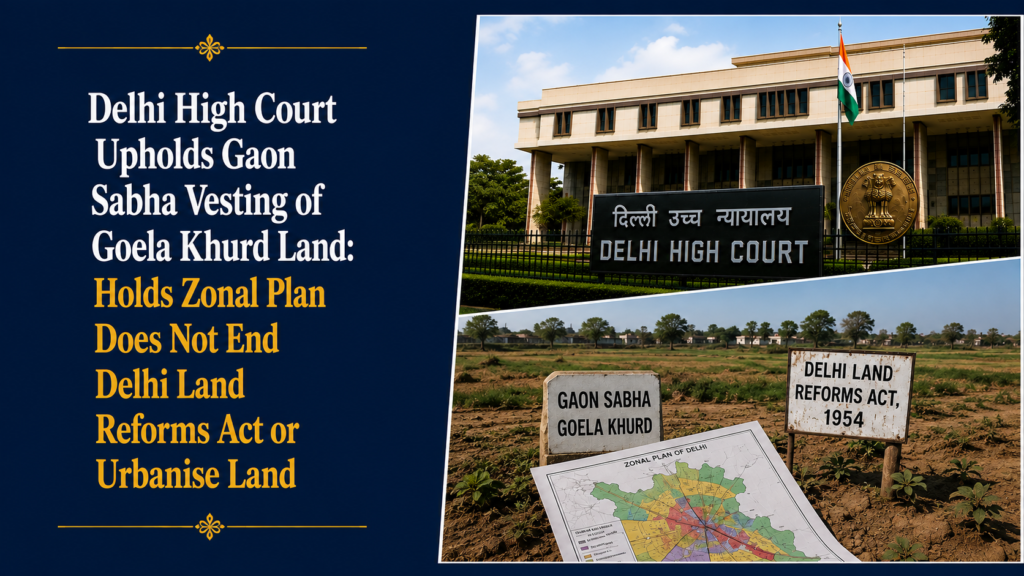
Delhi High Court Upholds Gaon Sabha Vesting of Goela Khurd Land; Holds Zonal Plan Does Not End Delhi Land Reforms Act or Urbanise Land

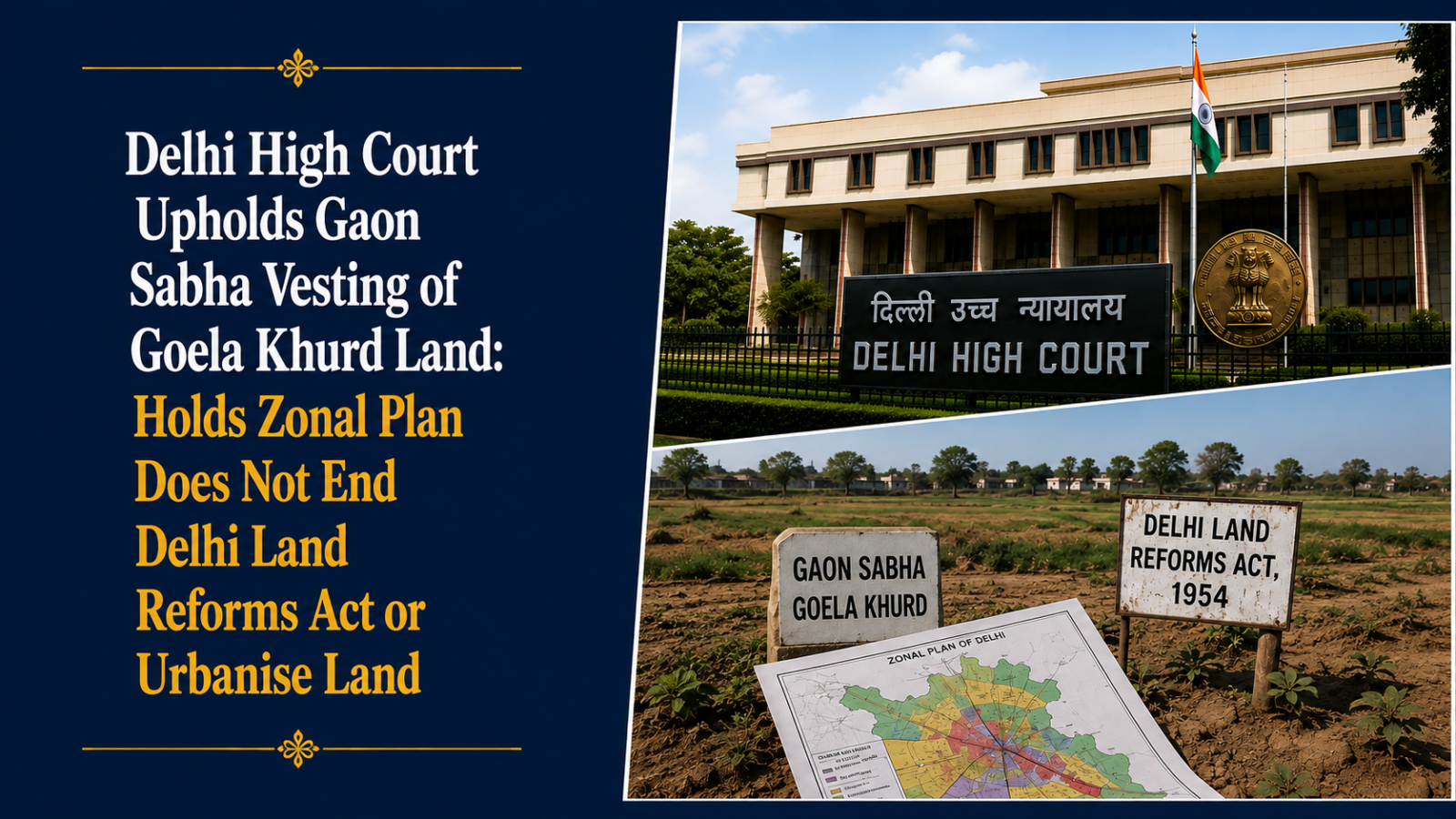
Landowners’ Eight-Year Delay Also Bars Relief, Delhi High Court Holds; Restores SDM Order Vesting Goela Khurd Land in Gaon Sabha
Facts
The dispute concerned land situated in Village Goela Khurd, Delhi. On 2 January 2010, the Halqa Patwari reported that the land had been converted to non-agricultural use. The SDM/Revenue Assistant inspected the site and found plots carved out, DPC work and construction of houses as part of an unauthorised colony, which was treated as contravention of Section 81 of the Delhi Land Reforms Act, 1954 (“DLR Act”).
On 24 June 2010, the SDM/RA ordered ejectment of the recorded Bhumidhar and vested the land in the Gaon Sabha. Neither the Bhumidhar nor the respondents challenged this order through the statutory first and second appeals available under Sections 185(3) and 185(4) of the DLR Act.
Meanwhile, a Zonal Development Plan had been notified on 4 June 2010 under the Delhi Development Act, 1957. Much later, on 16 May 2017, a notification under Section 507(a) of the Delhi Municipal Corporation Act, 1957 (“DMC Act”) declared the area urban. The land had also been allotted in 2015 to the Directorate of Education for setting up a school.
The respondents claimed to have purchased the land through GPA from the original Bhumidhar. They first challenged the 2010 vesting order in 2018. Eventually, a Single Judge, by judgment dated 7 March 2023, set aside the SDM/RA’s vesting order and directed the Government to hand possession of the land to the respondents. GNCTD challenged that judgment through the present Letters Patent Appeal.
Issues
The Division Bench identified three principal issues:
- Whether land governed by Section 3(13) of the DLR Act becomes urbanised upon publication of a notification under Section 507(a) of the DMC Act, or merely upon publication of Master and Zonal Development Plans under the Delhi Development Act.
- What consequences follow from a Section 507(a) urbanisation notification by operation of Section 150(3) of the DLR Act.
- Whether the SDM/Revenue Assistant’s order dated 24 June 2010 vesting the land in the Gaon Sabha was legally valid.
Appellant’s Arguments
GNCTD argued that the respondents and their predecessor had never availed themselves of the statutory appellate remedies under Sections 185(3) and 185(4) of the DLR Act and challenged the vesting order only after eight years. Their claim was therefore hit by unexplained delay and laches.
It argued that Section 81(2) empowered the Revenue Assistant to eject a Bhumidhar where agricultural land was being used for non-agricultural purposes. The Patwari’s report and site inspection disclosed construction of houses and development of an unauthorised colony, bringing the matter within the Revenue Assistant’s jurisdiction.
Most importantly, GNCTD argued that notification of a Master Plan or Zonal Plan under the Delhi Development Act does not automatically terminate the DLR Act. Urbanisation occurs only when a notification under Section 507(a) of the DMC Act is issued. Here, that occurred only on 16 May 2017, long after the SDM’s 2010 order.
Respondents’ Arguments
The respondents defended the Single Judge’s judgment by arguing that the land stood urbanised once the Master and Zonal Plans were notified. Since the Zonal Plan became operative on 4 June 2010, they contended that Section 81 of the DLR Act had ceased to apply before the SDM passed the vesting order on 24 June 2010.
They also relied on Section 53 of the Delhi Development Act, which gives that enactment overriding effect over inconsistent laws, to contend that the SDM lacked jurisdiction after notification of the Zonal Plan.
On delay, they argued that they had purchased the property through GPA and did not learn of the 2010 vesting order until 2016, when they discovered a notice board indicating that the property had been transferred to the Directorate of Education.
They additionally invoked Section 82 of the DLR Act, arguing that the Bhumidhar had not been afforded the statutory opportunity to repair the damage within three months.
Analysis of the Law
The Division Bench drew a crucial distinction between planned development under the Delhi Development Act and urbanisation under the DMC Act read with the DLR Act.
A Master Plan provides the broad framework for Delhi’s planned development, while a Zonal Development Plan specifies the site plan and permissible land uses within individual zones. Their publication regulates how land may be developed but does not, by itself, change a rural area into an urban area for purposes of the DLR Act.
The Court held that there was no statutory provision under which publication of a Master or Zonal Plan automatically caused the DLR Act to cease operating.
Instead, the statutory mechanism for urbanisation is a notification under Section 507(a) of the DMC Act. Upon such notification, the consequences specified in Section 150(3) of the DLR Act follow, including dissolution of the Gaon Sabha and vesting of its properties and interests in the Government.
Accordingly, the Court categorically held that publication of Master and Zonal Plans does not halt Sections 81 and 82 of the DLR Act. The DLR Act ceases to operate in the relevant manner only upon the statutory urbanisation process under Section 507(a).
Precedent Analysis
The Division Bench placed substantial reliance on the Supreme Court’s decision in Mohinder Singh v. Narain Singh, (2023) 19 SCC 535.
The Court understood Mohinder Singh as recognising that the Delhi Development Act deals with planned development irrespective of whether an area is rural or urban, whereas rural-to-urban conversion is governed separately by the DMC Act and DLR Act. It further recognised that upon a Section 507(a) notification, the DLR Act ceases to apply in the manner provided by Section 150(3).
The Court distinguished Gur Partap Singh v. Union of India, 2004 SCC OnLine Del 269. It explained that while land may be used for a non-agricultural purpose permitted by the Master/Zonal Plan without requiring permission under Section 23 of the DLR Act in appropriate circumstances, Gur Partap Singh did not establish that mere publication of such plans amounts to statutory urbanisation.
The Bench expressly disagreed with the contrary approach in Shri Neelpadmaya Consumer Products Pvt. Ltd. v. Satyabir, 2016 SCC OnLine Del 761, insofar as it treated notification of a Master or Zonal Plan as sufficient to urbanise land and oust the DLR Act.
It also declined to concur with conclusions in Sanvik Engg. India (P) Ltd. v. State (NCT of Delhi), (2022) 2 HCC (Del) 165 to the extent those conclusions were inconsistent with the legal position flowing from Mohinder Singh.
Court’s Reasoning
The chronology was decisive.
The Zonal Plan was notified on 4 June 2010. The SDM/RA passed the Section 81 vesting order on 24 June 2010. The Section 507(a) notification actually urbanising the area was issued only on 16 May 2017.
Since notification of the Zonal Plan did not terminate the operation of the DLR Act, the Revenue Assistant continued to possess jurisdiction under Section 81 on 24 June 2010. The Court therefore held that the vesting order was passed within the SDM/RA’s legal authority.
The Division Bench consequently found that the Single Judge ought not to have interfered with the 2010 order.
The Court identified an independent additional ground against the respondents: delay and laches. Neither they nor their predecessor pursued the statutory remedies available under Section 185. They waited approximately eight years before filing the first writ petition, during which the land had already been allotted to the Directorate of Education for construction of a school. The Court found no plausible or sufficient explanation for that delay.
Conclusion
The Delhi High Court held that mere notification of a Master Plan or Zonal Development Plan does not urbanise rural land or terminate the operation of the Delhi Land Reforms Act. Statutory urbanisation occurs through a notification under Section 507(a) of the DMC Act, with the consequences contemplated by Section 150(3) of the DLR Act.
Since the relevant Section 507(a) notification was issued only in 2017, the SDM/Revenue Assistant possessed jurisdiction when he passed the Section 81 order on 24 June 2010. The vesting of the land in the Gaon Sabha was therefore valid.
The Court additionally held that the respondents’ challenge suffered from inordinate delay and laches, having been initiated approximately eight years after the vesting order without pursuing the statutory appellate remedies.
Accordingly, the Division Bench allowed GNCTD’s Letters Patent Appeal and set aside the Single Judge’s judgment dated 7 March 2023, thereby restoring the legal effect of the SDM/RA’s 2010 vesting order.
Case Details
Case: Government of NCT of Delhi v. Ruksana Bano & Ors.
Court: High Court of Delhi at New Delhi
Case Number: LPA 34/2024, CM APPLs. 1681/2024 & 25148/2024
Judge: Hon’ble Chief Justice Devendra Kumar Upadhyaya and Hon’ble Mr. Justice Tejas Karia
Date: 11 August 2026
Result: Appeal allowed; Single Judge’s judgment directing restoration of possession to the respondents set aside; SDM/RA’s 24 June 2010 order vesting the land in Gaon Sabha upheld.