Delhi High Court Rejects Rival Athlete’s Review Against Kashish Malik’s Asian Games Nomination; Holds Comparative Sporting Merit Cannot Be Reconsidered in Review Proceedings

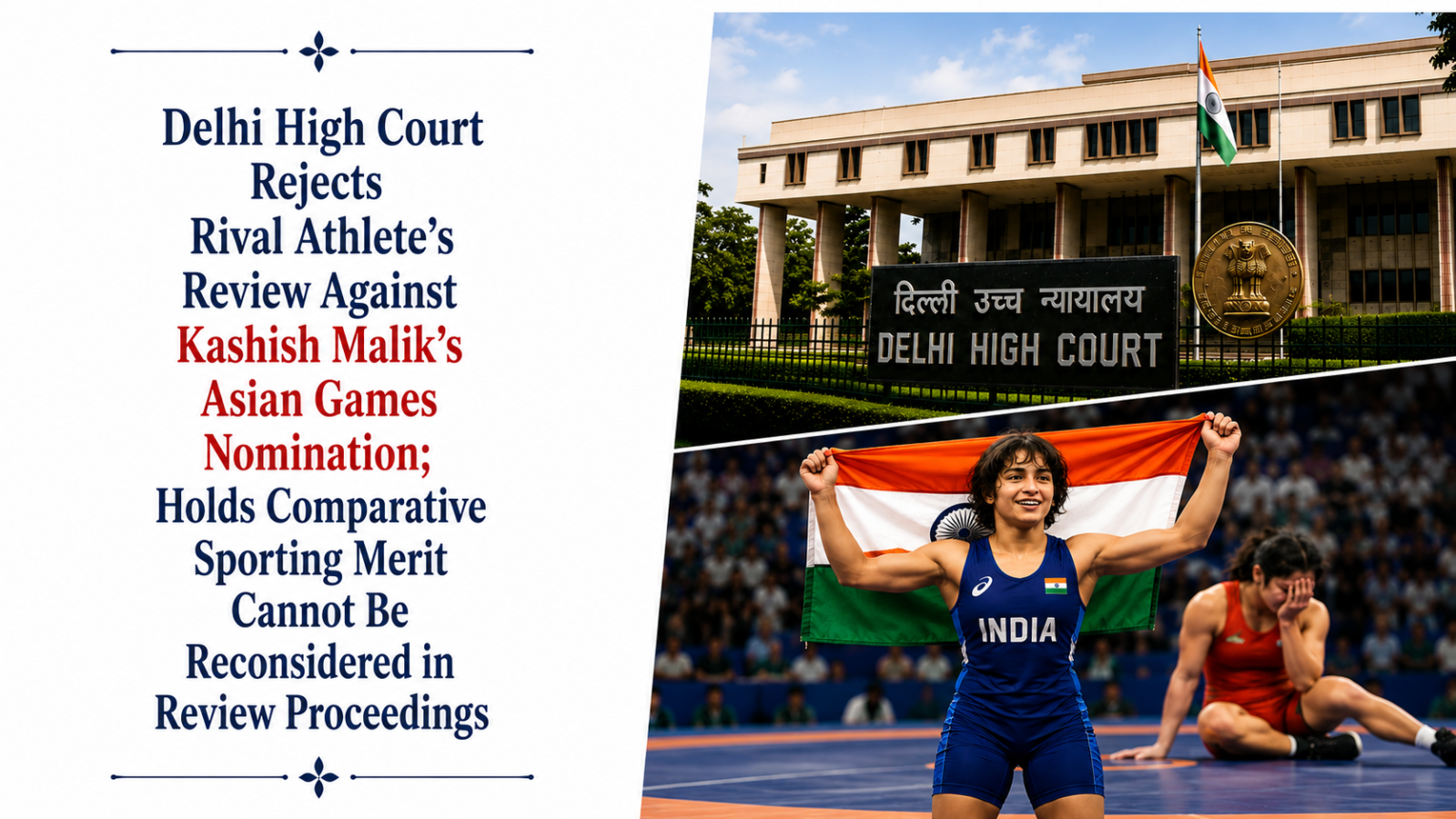
Rival’s Selection-Trial Gold and Higher World Ranking Cannot Expand Scope of Review, Delhi High Court Holds; Kashish Malik Judgment Left Intact
Facts
The dispute concerned India’s nomination for the Women’s Under-57 kg Taekwondo event at the 20th Asian Games, 2026.
Aranaya Thakur, claiming to be a rival contender for the sole available slot, sought review of the Delhi High Court’s judgment dated 1 July 2026 in the writ petition filed by Kashish Malik. She contended that the earlier judgment had been delivered without affording her an effective opportunity of hearing despite her being arrayed as a respondent and had prejudicially affected her competing claim for nomination.
Aranaya relied upon her sporting credentials, including her Gold Medal in the Open Selection Trials, higher world ranking and the relaxation clause under Paragraph 5 of the Ministry’s Selection Criteria. Kashish Malik had secured Bronze in the Open Selection Trials.
Kashish opposed the review, pointing out that the relevant qualifying event was the Senior Asian Taekwondo Championship, where Aranaya had finished ninth, while Kashish had won a Bronze Medal, placing third. Kashish contended that she alone satisfied the prescribed sixth-or-better eligibility benchmark.
Issues
The principal issues were:
- Whether the judgment dated 1 July 2026 suffered from an error apparent on the face of the record because Aranaya Thakur’s competing claim had not been adjudicated.
- Whether Aranaya’s Gold Medal in the Open Selection Trials, higher world ranking and claim under the relaxation clause justified reopening the earlier judgment.
- Whether review jurisdiction could be used to undertake a fresh comparative assessment of the sporting merits of two rival athletes.
- Whether the original writ petition required the Court to decide who between Kashish Malik and Aranaya Thakur was more meritorious for the Asian Games slot.
Review Petitioner’s Arguments
Aranaya Thakur argued that the earlier judgment adversely affected her competing claim for the Women’s Under-57 kg slot despite her being a party to the writ proceedings.
She emphasised that she had won the Gold Medal in the Open Selection Trials, whereas Kashish had secured Bronze. She also relied upon her allegedly superior world ranking and sought application of the relaxation clause contained in Paragraph 5 of the Ministry’s Selection Criteria.
Her principal grievance was that where only one slot was available, a judgment effectively favouring Kashish could not have been rendered without considering her competing credentials and giving her an effective opportunity to present her case.
Respondent’s Arguments
Kashish Malik argued that the judgment under review was well reasoned and did not suffer from any error apparent on the face of the record.
She pointed out that Aranaya had finished ninth in the qualifying Senior Asian Taekwondo Championship, whereas Kashish had won Bronze and therefore secured third position.
Under Clause 4(ii)(a) of the applicable Selection Criteria, an athlete obtaining a sixth or better finish in the qualifying Senior Asian Championship was eligible for nomination. Kashish therefore contended that she satisfied the prescribed criterion, whereas Aranaya did not on that basis.
It was further argued that Aranaya had no vested right to nomination merely because she possessed other sporting credentials.
Analysis of the Law
The High Court began by emphasising the extremely limited scope of review jurisdiction.
A review proceeding does not permit a court to rehear the dispute, reconsider the entire case or sit in appeal over its own judgment. Review is confined principally to:
- discovery of new and important matter or evidence which could not despite due diligence have been produced earlier;
- an error apparent on the face of the record; or
- another legally recognised sufficient reason analogous to those grounds.
An error apparent must be self-evident. If establishing the alleged error requires elaborate arguments, reconsideration of evidence or detailed examination of law and facts, it falls outside review jurisdiction.
The Court further emphasised the doctrine of finality of judicial decisions. Once issues have been fairly considered and adjudicated, parties cannot repeatedly reopen the controversy merely because another view may be possible.
Precedent Analysis
The Court relied upon Kamlesh Verma v. Mayawati, (2013) 8 SCC 320, which delineates the permissible and impermissible grounds for review.
The Supreme Court had recognised review where new and important evidence emerges despite due diligence, where an error is apparent on the face of the record or where another analogous sufficient reason exists. Conversely, review cannot be used for rehearing, re-appreciating evidence, correcting inconsequential errors or substituting one possible view with another.
The High Court also relied upon Malleeswari v. K. Suguna, 2025 SCC OnLine SC 1927, reiterating that review cannot become an “appeal in disguise” or a vehicle for obtaining fresh adjudication on facts or law already decided.
Court’s Reasoning
The Court held that Aranaya’s review proceeded on an incorrect understanding of the scope of Kashish Malik’s original writ petition.
The original proceeding did not require the Court to compare the sporting merits of Kashish and Aranaya or decide which athlete was better. Its limited purpose was to examine the legality of the Ministry’s order dated 23 June 2026 rejecting Kashish’s candidature despite material showing that she fulfilled the applicable eligibility criteria.
India Taekwondo, the competent National Sports Federation responsible for recommending athletes, had itself forwarded and recommended Kashish Malik for the Women’s Under-57 kg event.
Clause 4(ii)(a) of the Selection Criteria provided that where a Senior Asian Championship had taken place within the preceding 12 months, an athlete could qualify by securing sixth position or better in that Championship or satisfying the alternative world-ranking benchmark.
Kashish had secured third position by winning Bronze in the relevant Senior Asian Taekwondo Championship. The authorities had also not specifically disputed that India’s qualification for the Women’s Under-57 kg event had been secured through her performance, and the Federation had recommended her candidature. Only one athlete could ultimately be nominated.
In contrast, Aranaya’s reliance upon her Open Selection Trials Gold, higher world ranking, relaxation clause and status as a natural Under-57 kg athlete represented grounds supporting her own independent claim for nomination.
Those matters did not demonstrate any error in the earlier judgment. Rather, they sought to introduce and adjudicate a controversy that had not formed the subject matter of the original writ petition.
The Court also considered it significant that Aranaya had finished ninth in the qualifying Championship, whereas Kashish had finished third, and the applicable benchmark placed athletes finishing sixth or better in the first line of consideration.
The review petition therefore effectively sought a fresh comparative adjudication between two athletes, something that neither arose in the original writ petition nor could lawfully be undertaken within review jurisdiction.
Conclusion
The Delhi High Court held that Aranaya Thakur had failed to establish any error apparent on the face of the record or any other legally recognised ground for reviewing its judgment dated 1 July 2026.
Her contentions regarding superior performance in the Open Selection Trials, higher world ranking and relaxation under the Selection Criteria amounted to grounds supporting her own competing candidature rather than demonstrating an error in the earlier judgment.
The Court held that review proceedings could not be transformed into a fresh contest requiring comparison of the sporting merits of rival athletes.
Accordingly, the review petition was dismissed, along with all pending applications.
Case Details
Case: Kashish Malik v. Union of India & Ors. — Review Petition by Aranaya Thakur
Court: High Court of Delhi at New Delhi
Case Number: W.P.(C) 8545/2026, REVIEW PET. 332/2026
Judge: Hon’ble Dr. Justice Swarana Kanta Sharma
Date: 11 August 2026
Result: Review petition dismissed; Court refused to reopen its earlier judgment or undertake a fresh comparative assessment of the rival athletes’ claims.