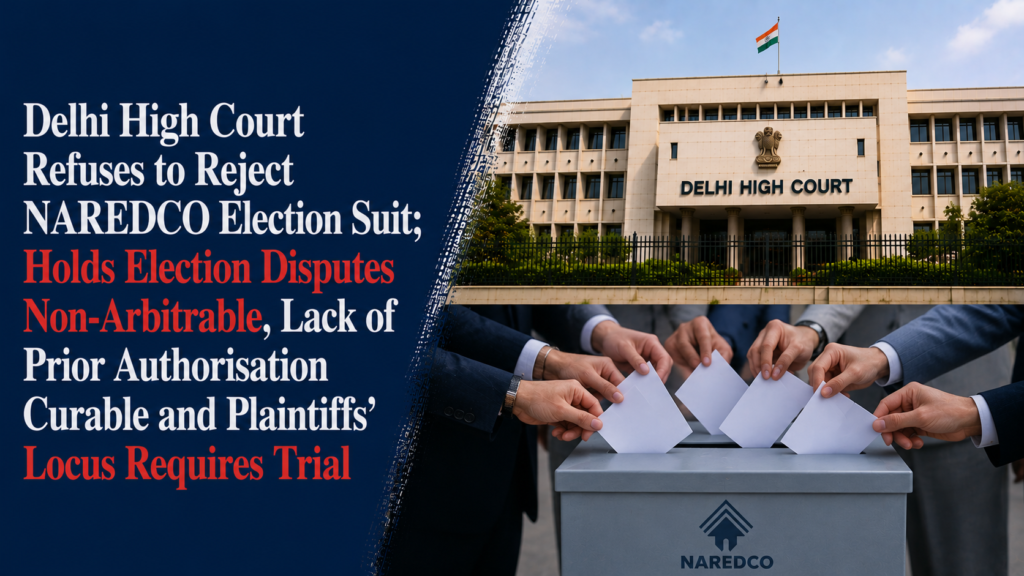
Delhi High Court Refuses to Reject NAREDCO Election Suit; Holds Election Disputes Non-Arbitrable, Lack of Prior Authorisation Curable and Plaintiffs’ Locus Requires Trial

Delhi High Court Allows Challenge to NAREDCO Leadership Elections to Proceed; Says Authority, Locus and Alleged Election Irregularities Are Matters Requiring Evidence
Facts
The Delhi High Court considered an application under Order VII Rule 11 read with Section 151 CPC filed by defendants in a suit challenging elections of the National Real Estate Development Council (NAREDCO). The defendants sought rejection of the plaint on the ground that it disclosed no cause of action because the contesting plaintiffs had instituted the proceedings in their personal capacities despite allegedly not being members of NAREDCO.
The plaintiffs challenged elections conducted for NAREDCO’s office bearers, alleging that the procedure prescribed under its Rules and Regulations and the agenda/additional agenda of the 138th Governing Council Meeting had not been followed.
According to the plaintiffs, although the Governing Council had appointed an Election Officer and prescribed an election process, the dais members themselves proposed and declared persons to the posts of President, Vice President and Chairman without giving the plaintiffs an opportunity either to vote or submit nominations.
The plaint alleged that Dr. Niranjan Hiranandani was elected Chairman, Praveen Jain President and Rajan Bandelkar Vice President without following due election procedure. It further alleged that the appointments were neither unanimous nor consensual and were effectively thrust upon members of the Governing Council.
During the proceedings, four original plaintiffs withdrew and were deleted from the array of parties. The contesting plaintiffs included Binoy Thomas, President of the NAREDCO Kerala Chapter, and Halarameshwara Channaveerappa, Secretary of the NAREDCO Karnataka Chapter. G. Hari Babu was subsequently transposed as plaintiff no.7.
The defendants sought rejection of the suit principally on three grounds: lack of locus standi, absence of a cause of action, and existence of arbitration clauses in agreements involving the Kerala and Karnataka Chapters.
Issues
The principal issues before the High Court were:
- Whether the plaint challenging the NAREDCO elections disclosed a cause of action sufficient to survive Order VII Rule 11(a) CPC;
- Whether the individual plaintiffs had locus standi to challenge the elections when NAREDCO’s Rules contemplated enterprises, rather than individuals, as its members;
- Whether absence of specific Board Resolutions or letters authorising the plaintiffs to institute the suit required rejection of the plaint;
- Whether such absence of authority was a curable defect capable of subsequent ratification;
- Whether the arbitration clauses contained in agreements between NAREDCO and its Kerala/Karnataka Chapters rendered the civil suit non-maintainable;
- Whether a dispute concerning elections to the Governing Council and its office-bearer positions was arbitrable;
- Whether mere existence of an arbitration agreement could justify rejection under Order VII Rule 11 when no proper application under Section 8 of the Arbitration and Conciliation Act had been filed; and
- Whether questions concerning the plaintiffs’ authority and locus required evidence and trial rather than determination at the threshold.
Plaintiffs’ Arguments
The plaintiffs argued that the subject matter of the suit was the validity of NAREDCO’s elections, and election disputes could not be referred to arbitration.
They relied upon Nathu Ram Jain v. Akhil Bhartiya Agarwal Sammelan and Din Dayal Agrawal HUF v. Capriso Finance Ltd. to resist the arbitration objection.
They further contended that the defendants were incorrectly conflating membership of NAREDCO with membership and participation in its Governing Council.
While the member of the society could be an enterprise, the Governing Council necessarily consisted of individuals representing various membership categories, including representatives of State REDCOs and NAREDCO State Branches.
The plaintiffs argued that representatives of State Chapters formed part of the relevant electoral college and were entitled to participate in and contest elections to Governing Council positions. Consequently, such representatives had locus to challenge alleged illegalities in the election process.
On cause of action, the plaintiffs contended that the plaint specifically described how the election process had allegedly been violated and therefore satisfied the requirements of Order VI Rule 2 CPC.
They relied upon Liverpool & London S.P. & I Assn. Ltd. v. M.V. Sea Success I, (2004) 9 SCC 512, on the principles governing disclosure of cause of action.
Plaintiff no.7 separately relied upon the Delhi High Court’s decision in Rita Solomon v. Republic of Italy, 2025 SCC OnLine Del 8779, to contend that the suit disclosed a cause of action and could not be rejected at the threshold.
Defendants’ Arguments
The defendants contended that the remaining plaintiffs were not registered members of NAREDCO in their personal capacities and therefore lacked locus to institute the suit.
According to them, Rule 2 of NAREDCO’s Memorandum of Association and Rules and Regulations contemplated enterprises as members rather than individuals. An individual representative could not sue without specific authorisation from the concerned member or State Chapter.
They pointed out that Binoy Thomas had instituted the suit without a Board Resolution or authorisation from the Kerala Chapter, while Halarameshwara Channaveerappa similarly lacked authorisation from the Karnataka Chapter.
The defendants further argued that the plaint failed to identify the particular NAREDCO rule allegedly violated during the elections and therefore contained only bald allegations incapable of constituting a valid cause of action.
They also relied upon the plaintiffs’ conduct. Despite having been invited during the 137th Governing Council Meeting to submit nominations for office-bearer positions, the contesting plaintiffs allegedly did not submit nominations. According to the defendants, they could not later challenge the elections after voluntarily abstaining from contesting.
The defendants additionally argued that agreements between NAREDCO and its Kerala and Karnataka Chapters contained arbitration clauses. If the plaintiffs claimed to represent those Chapters, the dispute should therefore be pursued through arbitration rather than a civil suit.
Analysis of the Law
Order VII Rule 11: Only the Plaint Is Material
The Court began by reiterating the settled parameters governing an application under Order VII Rule 11 CPC.
At this stage, the Court must examine only the averments contained in the plaint and, where necessary, the documents annexed to it.
The defence pleaded by the defendants and documents produced to substantiate that defence are irrelevant to determining whether the plaint should be rejected.
The Court referred to the Supreme Court’s decision in T. Arivandandam v. T.V. Satyapal, while recognising that cleverly drafted suits creating an illusory cause of action can be “nipped in the bud.”
Election Disputes Are Non-Arbitrable
The Court rejected the defendants’ arbitration objection.
It held that election disputes are not arbitrable.
Relying upon Nathu Ram Jain, which had considered the Supreme Court decisions in Booz Allen & Hamilton Inc. v. SBI Home Finance Ltd. and Vidya Drolia v. Durga Trading Corporation, the Court held that an election dispute cannot be treated merely as a dispute in personam.
The rights determined in an election dispute are not confined to the parties inter se. They affect the entire body of the electorate.
The Court therefore characterised such an election dispute as a dispute in rem, rendering the arbitration objection untenable.
Mere Arbitration Clause Does Not Justify Rejection of Plaint
The Court identified a second and independent problem with the arbitration objection.
The defendants had invoked the arbitration clauses through their Order VII Rule 11 application rather than filing the appropriate application under Section 8 of the Arbitration and Conciliation Act, 1996.
Relying upon Din Dayal Agrawal, the Court explained that Section 8 does not itself create a statutory bar to a civil suit.
A proper Section 8 application asks the Court to refer parties to arbitration, whereas Order VII Rule 11 seeks rejection and termination of the suit.
Therefore, mere reference to an arbitration clause in an Order VII Rule 11 application was insufficient.
The Court held that this provided an additional reason why the defendants’ arbitration objection could not succeed.
Plaint Disclosed Sufficient Cause of Action
The Court examined the relevant paragraphs of the plaint as a whole.
It reiterated that while deciding an Order VII Rule 11 application, the averments must be read harmoniously and in their entirety rather than dissected into isolated compartments.
A plaint may be inadequately worded or imperfectly drafted, but that alone cannot justify rejection if it contains material particulars disclosing a cause of action capable of being proved through evidence.
The Court emphasised:
“No mini trial is required to be conducted at this stage.”
The plaint contained allegations concerning irregularities in elections to various NAREDCO office-bearer positions, participation of alleged non-members and elections allegedly conducted by circulation rather than in the prescribed manner.
On a holistic reading, these allegations disclosed a sufficient cause of action.
Whether the plaintiffs could ultimately prove those allegations was a question for evidence and trial.
Locus Standi Required Trial
The Court acknowledged that NAREDCO’s rules appeared prima facie to contemplate enterprises rather than individuals as members.
However, the documents annexed to the plaint showed that:
- G. Hari Babu was Chairman of Lahari Infrastructure Pvt. Ltd. and appeared as a Governing Council member;
- Binoy Thomas was President of NAREDCO Kerala Chapter and shown as a State Member; and
- Halarameshwara Channaveerappa was Secretary of NAREDCO Karnataka Chapter and shown as a State Representative.
Their entities/Chapters were represented in the electoral college, and the plaintiffs appeared authorised to participate in the very Governing Council meetings whose election process they were challenging.
The more difficult question was whether authority to participate and vote in the elections necessarily included authority to institute litigation challenging those elections.
The Court held that this issue could not conclusively be determined at the Order VII Rule 11 stage and required evidence.
Lack of Authorisation Is a Curable Defect
This is another significant holding of the judgment.
The Court relied upon United Bank of India v. Naresh Kumar, (1996) 6 SCC 660, which recognised that absence of formal authority to institute proceedings on behalf of a juristic entity may subsequently be cured through express or implied ratification.
The Court also referred to the Delhi High Court’s recent decision in Microwave Communications Ltd. v. Credit Agricole Corporate and Investment Bank, 2026 SCC OnLine Del 4656.
Accordingly, even assuming lack of authorisation was significant, the defect was curable and could not automatically non-suit the plaintiffs.
Precedent Analysis
T. Arivandandam v. T.V. Satyapal, 1977 AIR 2421
The Court referred to this seminal Supreme Court authority while explaining the Order VII Rule 11 framework.
While cleverly drafted suits creating an artificial cause of action can be terminated at the threshold, ordinarily only the plaint and its supporting documents are relevant while determining whether a cause of action exists.
Nathu Ram Jain v. Akhil Bhartiya Agarwal Sammelan
This Delhi High Court decision was central to the arbitrability issue.
After considering Booz Allen and Vidya Drolia, it held that election disputes are non-arbitrable. The Court expressly concurred with that position because election disputes affect the electorate as a whole and therefore involve rights in rem.
Booz Allen & Hamilton Inc. v. SBI Home Finance Ltd., (2011) 5 SCC 532
Vidya Drolia v. Durga Trading Corporation, (2021) 2 SCC 1
These Supreme Court decisions supplied the broader doctrinal foundation for distinguishing disputes concerning rights in personam from those concerning rights in rem.
Applying that framework through Nathu Ram Jain, the Court concluded that the NAREDCO election dispute was non-arbitrable.
Din Dayal Agrawal HUF v. Capriso Finance Ltd.
This judgment supported the separate proposition that mere existence of an arbitration clause is not sufficient to reject a plaint under Order VII Rule 11 where no proper Section 8 application seeking reference to arbitration has been filed.
Liverpool & London S.P. & I Assn. Ltd. v. M.V. Sea Success I, (2004) 9 SCC 512
The plaintiffs relied upon this Supreme Court authority in support of their contention that the plaint contained sufficient material particulars to disclose a cause of action.
United Bank of India v. Naresh Kumar, (1996) 6 SCC 660
This precedent was important on the issue of authority to institute proceedings.
The Supreme Court recognised that absence of formal authorisation for an officer to institute proceedings on behalf of a corporation can be cured through subsequent express or implied ratification and should not necessarily defeat an otherwise genuine claim on a technical ground.
Delhi Technological University v. B.S. Rawat, 2026 SCC OnLine SC 1482
The Supreme Court recently explained the doctrine of ratification.
The High Court extracted the principles that:
- ratification validates an act initially performed without authority;
- subsequent ratification is equivalent to prior authority;
- it operates retrospectively and relates back to the original act;
- only the competent authority can ratify the act; and
- ratification cures defects of authority, but cannot validate an act inherently prohibited by law.
Applying these principles, the Court held that a subsequent Board Resolution or authorisation could potentially ratify the plaintiffs’ institution of the suit.
Court’s Reasoning
The High Court found that none of the defendants’ objections justified the drastic consequence of rejecting the plaint at the threshold.
First, the arbitration objection failed on substance because election disputes affect the entire electorate and are therefore non-arbitrable disputes in rem.
Second, even independently of non-arbitrability, mere existence of an arbitration clause could not be used through an Order VII Rule 11 application as a substitute for the statutory procedure under Section 8 of the Arbitration Act.
Third, the plaint disclosed a clear factual grievance: the plaintiffs alleged that office bearers had been declared without the election process prescribed by NAREDCO’s governing documents being followed. Whether those allegations were ultimately correct was not relevant at the threshold.
Fourth, although NAREDCO’s members were enterprises, the elections necessarily operated through human representatives of those enterprises and State Chapters. The plaintiffs appeared in the Governing Council records as such representatives.
Finally, even if the plaintiffs lacked specific authority to institute the suit on the date it was filed, that deficiency was capable of subsequent authorisation and ratification.
The Court therefore concluded that the locus objection raised a triable issue requiring evidence, rather than a self-evident defect justifying rejection under Order VII Rule 11(a).
Importantly, the Court did not finally determine that the plaintiffs possessed locus standi. It held only that their lack of locus could not be conclusively established at this preliminary stage. The defendants remained free to raise these objections in their written statements and at trial.
Conclusion
The Delhi High Court dismissed the defendants’ application under Order VII Rule 11 CPC and permitted the NAREDCO election challenge to proceed.
The Court held that:
- the plaint disclosed sufficient cause of action concerning alleged irregularities in the NAREDCO elections;
- election disputes are non-arbitrable disputes in rem because their determination affects the entire electorate;
- mere existence of an arbitration clause could not justify rejection of the plaint in the absence of the appropriate statutory procedure;
- questions regarding the plaintiffs’ locus and authority required evidence and were therefore triable issues;
- absence of prior authorisation or Board Resolution was capable of being cured by subsequent ratification; and
- no mini-trial could be conducted while deciding an application under Order VII Rule 11.
The application was accordingly dismissed, while all objections were preserved for the defendants to raise in their written statements. The suit was directed to be listed on 22 September 2026.
Case Details
Case: Binoy Thomas & Ors. v. National Real Estate Development Council & Ors.
Court: High Court of Delhi at New Delhi
Case Number: CS(OS) 881/2025; CNR No. DLHC010975812025; IA 11202/2026
Judge: Justice Tushar Rao Gedela
Date: 12 August 2026
Result: Application under Order VII Rule 11 CPC dismissed; plaint challenging NAREDCO elections not rejected and suit permitted to proceed.