Delhi High Court Restores DTC Driver’s Removal for 139-Day Unauthorised Absence; Upholds Vitiated Enquiry Finding but Quashes Reinstatement and 10% Back-Wages Award

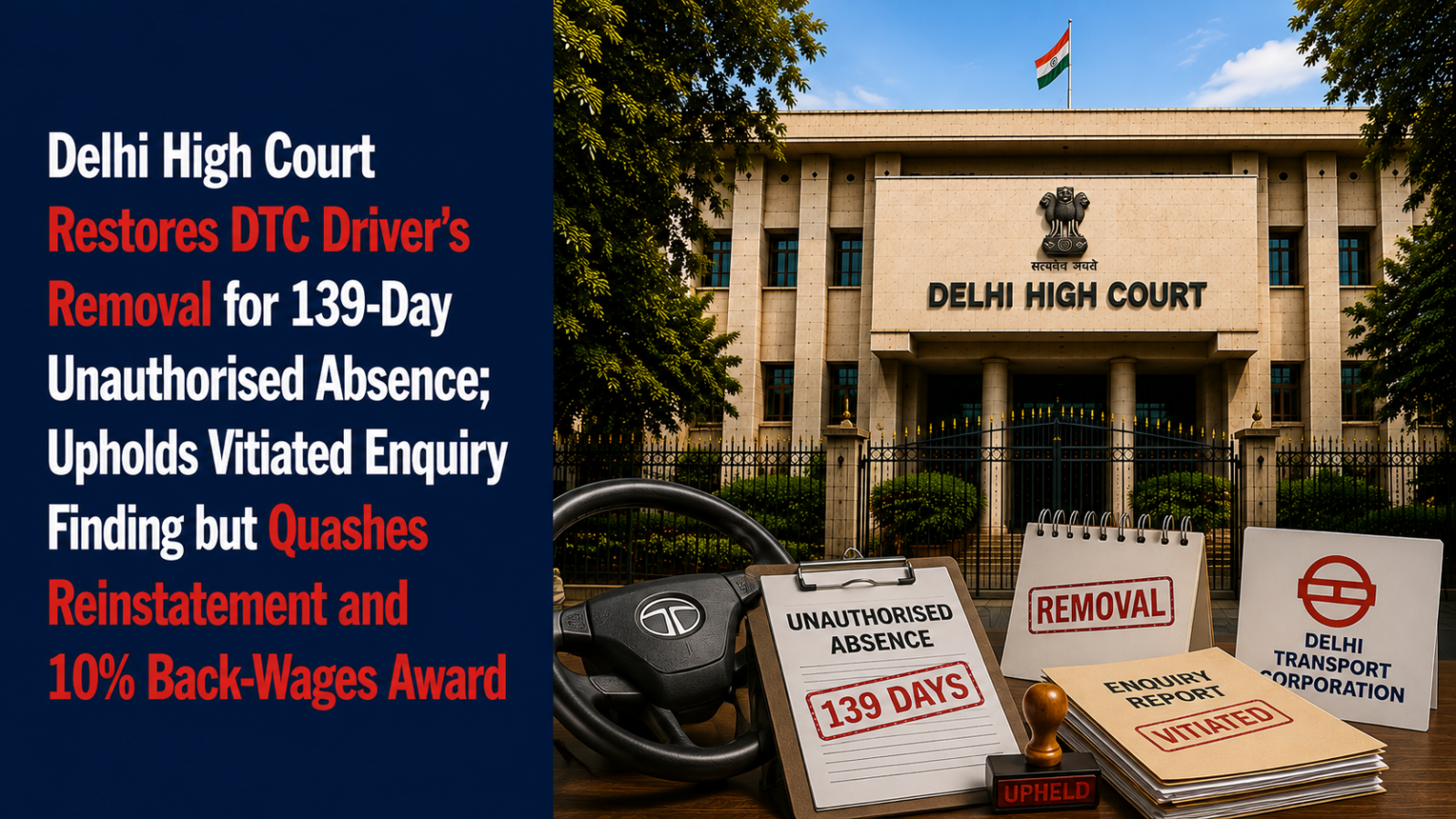
Delhi High Court Upholds Finding That DTC Enquiry Was Vitiated but Restores Driver’s Dismissal After Unauthorised 139-Day Absence Stood Proved
Facts
The respondent-workman, Pratap Singh, joined the Delhi Transport Corporation as a Driver (Retainer) on 6 February 1981. The dispute arose after DTC issued a charge-sheet dated 28 June 1994 alleging that he had remained absent from duty without authority or sanctioned leave for 139 days between September 1993 and May 1994.
The workman explained the circumstances of his absence but maintained that he had never admitted guilt. According to him, the Inquiry Officer wrongly treated his explanation as an admission and proceeded to hold the charge proved.
Acting on the enquiry report, DTC removed him from service on 28 November 1994. He raised an industrial dispute challenging the removal.
By order dated 30 September 2004, the Labour Court held the domestic enquiry to be vitiated, observing that the workman’s explanation could not be treated as an unequivocal admission of guilt. The parties were then permitted to lead evidence independently on the merits.
Thereafter, by Award dated 19 March 2009, the Labour Court held the removal illegal and unjustified and directed reinstatement with continuity of service and 10% back wages.
DTC challenged both the order invalidating the departmental enquiry and the consequential reinstatement Award under Articles 226 and 227 of the Constitution.
Issues
The High Court identified three principal stages of consideration:
- Whether the Labour Court was correct in holding the domestic enquiry vitiated.
- Whether, after the enquiry was invalidated, the evidence independently led before the Labour Court nevertheless established the misconduct of unauthorised absence.
- Whether the relief of reinstatement, continuity of service and 10% back wages was legally sustainable.
The Court also examined the proper scope of writ interference with Labour Court findings and the proportionality of the punishment of removal.
Petitioner’s Arguments
DTC argued that the Labour Court erred in invalidating the departmental enquiry because the workman had allegedly admitted his unauthorised absence during the enquiry itself.
It contended that once the misconduct was admitted, no further issue of natural justice arose, particularly because the workman had been given opportunities to defend himself, lead evidence and make submissions but had chosen not to avail of them.
DTC further argued that prolonged unauthorised absence was grave misconduct and that removal from service was proportionate.
It also contended that once the workman admitted the factum of absence, the burden shifted to him to establish that the absence was justified or covered by sanctioned leave.
Finally, DTC submitted that the Labour Court had exceeded its jurisdiction by effectively sitting in appeal over the Inquiry Officer’s findings.
Respondent’s Arguments
The workman supported the Labour Court’s Award.
He argued that he had never made any clear or unequivocal admission of guilt and that the Inquiry Officer had incorrectly converted his explanation into an admission.
He further submitted that after the departmental enquiry was invalidated, DTC had been given a full opportunity to prove misconduct before the Labour Court but failed to produce important records.
He specifically relied upon the fact that his leave applications were never formally rejected or that no rejection was communicated to him.
The workman also argued that the Labour Court was the final fact-finding authority under the Industrial Disputes Act and that the High Court should not reappreciate evidence merely because another view was possible.
Analysis of the Law
The High Court first reiterated the limited scope of interference under Articles 226 and 227.
A writ court does not sit as an appellate authority over a Labour Court and ordinarily will not substitute its own appreciation of evidence. However, interference is justified where the decision proceeds on an erroneous legal principle, ignores material evidence, is perverse, or the decision-making process violates natural justice.
On domestic enquiries, the Court relied on the principles of natural justice laid down in Sur Enamel and Stamping Works Ltd. v. Workmen.
A fair enquiry requires that the employee be clearly informed of the charges, be allowed to meet the evidence, cross-examine where necessary, lead defence evidence and receive a reasoned finding from the Inquiry Officer.
The Court emphasised that mere formal compliance is insufficient. The opportunity must be real, effective and meaningful.
Precedent Analysis
The Court relied substantially upon Sur Enamel and Stamping Works Ltd. v. Workmen to assess whether the enquiry satisfied minimum natural justice requirements.
The Court also considered:
- Chikkam Koteswara Rao v. Chikkam Subbarao, concerning evidentiary effect of admissions;
- LIC v. R. Suresh;
- Mavji C. Lakum v. Central Bank of India; and
- State of Haryana v. Devi Dutt.
The Court distinguished these authorities on the facts.
It observed that the present case was not one where reinstatement automatically followed merely because the domestic enquiry was defective. Once the enquiry was invalidated, the employer was still entitled to establish the misconduct on evidence before the Labour Court, and that evidence had to be independently assessed.
Court’s Reasoning
Domestic Enquiry
The High Court agreed with the Labour Court that the departmental enquiry was defective.
The enquiry report was described as a one-page, pre-typed document containing formal recitals that the workman had been given opportunities to represent himself, produce witnesses and make submissions.
The Court held that such formal recitals did not establish that a genuine and meaningful opportunity had actually been afforded.
The workman’s signature on the pre-typed report could not amount to a waiver of his right to a fair enquiry or an acknowledgment that natural justice had been complied with.
Accordingly, the finding that the domestic enquiry was vitiated was upheld.
Whether Misconduct Was Independently Proved
However, the Court disagreed with the Labour Court on the merits of the misconduct.
The workman did not dispute that he had remained absent. His defence was that the absence was justified because his wife was pregnant and required his care, and that leave applications had been sent through another person.
The evidence, however, did not establish that the leave was ever sanctioned. The person allegedly carrying the leave applications could not give precise details, and the workman himself did not know whether the applications had been rejected.
The medical material also failed to account for the entire 139-day period.
The Court held that once the factum of absence was admitted, the evidentiary burden shifted to the workman to establish his positive defence that such absence was covered by sanctioned leave.
The ultimate burden of proving misconduct remained with DTC, but the workman could not simply assert authorised leave without producing supporting material.
The Labour Court had placed excessive emphasis on DTC’s failure to produce the original Master Attendance Register and leave applications.
The High Court held that the absence of those records could not erase the workman’s own admission that he had remained absent.
Past Record and Punishment
The Court also noted that the workman had more than 30 previous disciplinary entries. Although those past incidents could not prove the present charge, they were relevant to punishment.
The workman had admittedly remained absent for 139 days and failed to prove sanctioned leave. The High Court therefore held that the misconduct stood established.
On punishment, the Court held that interference is justified only where the penalty is shockingly disproportionate.
Repeated and prolonged unauthorised absence in a disciplined organisation like DTC was serious misconduct, and the Court found no justification to interfere with the punishment of removal.
Conclusion
The Delhi High Court reached a split result on the two principal components of the Labour Court’s decision.
It upheld the Labour Court’s order dated 30 September 2004 holding the departmental enquiry vitiated because the enquiry did not afford a meaningful and effective opportunity of defence.
However, it held that the Labour Court subsequently erred in concluding that misconduct had not been established.
The admitted 139-day absence, coupled with the workman’s failure to prove that the leave had been sanctioned, established the misconduct.
Accordingly, the Court quashed the Award dated 19 March 2009 insofar as it directed reinstatement, continuity of service and 10% back wages, and restored the original order removing the workman from service.
The writ petition was partly allowed, with no order as to costs.
Case Details
Case: Delhi Transport Corporation v. Pratap Singh
Court: High Court of Delhi at New Delhi
Case Number: W.P.(C) 4943/2010 with CM APPL. 9765/2010
CNR Number: DLHC011077262010
Judge: Justice Shail Jain
Date: 17 August 2026; reserved on 6 May 2026
Result: Writ petition partly allowed; finding that the domestic enquiry was vitiated upheld, but reinstatement with continuity and 10% back wages quashed and DTC’s removal order restored.