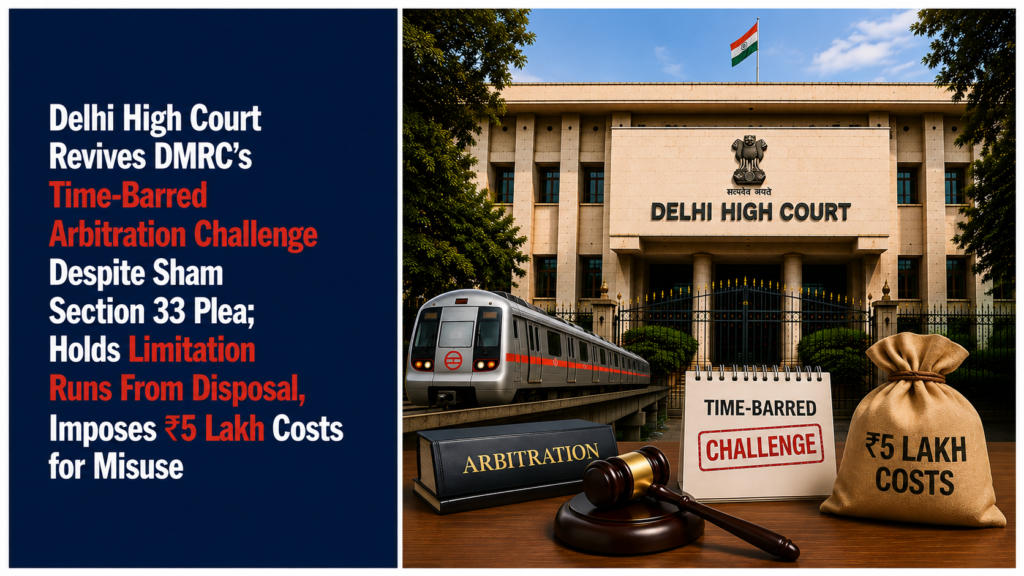
Delhi High Court Revives DMRC’s Time-Barred Arbitration Challenge Despite Sham Section 33 Plea; Holds Limitation Runs From Disposal, Imposes ₹5 Lakh Costs for Misuse

Delhi High Court Restores DMRC’s Section 34 Challenge; Holds Even Frivolous Section 33 Application Extends Limitation but Imposes ₹5 Lakh Punitive Costs
Facts
The dispute arose between Delhi Metro Rail Corporation Ltd. (DMRC) and HCC Samsung JV from a contract dated 28 February 2013 under which HCC Samsung JV was to execute certain civil works for DMRC. On 30 July 2018, the contractor raised a claim for compensation arising from variations and delay in completion of the works. DMRC rejected the claim on 23 May 2019, following which arbitration was invoked.
A three-member Arbitral Tribunal was constituted on 24 September 2020. The majority award was released on 23 February 2024, while the dissenting award of the third arbitrator was released on 28 February 2024.
On 22 March 2024, DMRC filed an application purportedly under Section 33 of the Arbitration and Conciliation Act, 1996 seeking “correction” of the majority award.
However, the application did not merely identify clerical, typographical or similar errors. It challenged numerous substantive findings and calculations made by the Arbitral Tribunal relating to cross-passages, extended-stay costs, machinery, overheads, wages and other claims.
The Division Bench itself found that DMRC’s Section 33 application actually sought a “wholesale review” of the arbitral award and questioned substantive findings on the merits. The Court concluded that the application had been filed merely to obtain additional time to institute the substantive Section 34 challenge.
The Arbitral Tribunal rejected DMRC’s Section 33 application on 3 June 2024. DMRC thereafter filed OMP (Comm) 381/2024 under Section 34 on 29 August 2024, challenging the arbitral award.
The Section 34 petition was within limitation if time was calculated from 3 June 2024, when the Section 33 application was disposed of. However, it was beyond the maximum permissible period if limitation was calculated from the original awards of 23/28 February 2024.
The learned Single Judge dismissed DMRC’s Section 34 petition as time-barred on 20 February 2025, finding that its Section 33 application was not genuinely a Section 33 application but an attempt to obtain wholesale review and circumvent limitation.
DMRC appealed.
Issues
The central issue before the Division Bench was narrow but significant:
Whether a timely application formally filed under Section 33 extends the limitation period for filing a Section 34 challenge from the date of its disposal, even when that Section 33 application is frivolous, non-maintainable or actually seeks wholesale review of the arbitral award.
The Court was therefore required to determine:
- Whether limitation should run from the original arbitral award or from disposal of DMRC’s Section 33 application.
- Whether the Court could examine the maintainability or substantive character of the Section 33 application while calculating limitation under Section 34(3).
- Whether a sham Section 33 application could nevertheless trigger the statutory extension contemplated by Section 34(3).
- How misuse of Section 33 should be dealt with if limitation cannot be denied.
Appellant’s Arguments
DMRC contended that limitation for its Section 34 petition had to be calculated from 3 June 2024, when its Section 33 application was rejected, rather than from 23/28 February 2024 when the awards were rendered.
It principally relied upon the Supreme Court’s subsequent judgment in Geojit Financial Services Ltd. v. Sandeep Gurav, which had considered and distinguished the earlier decision in State of Arunachal Pradesh v. Damani Construction Co.
DMRC argued that under Geojit, once a request under Section 33 is made within 30 days of receipt of the award and with notice to the opposite party, limitation under Section 34(3) begins from the date on which that request is disposed of.
Therefore, whether the Section 33 application ultimately fell within the permissible scope of Section 33 was irrelevant to computation of limitation.
Respondent’s Arguments
HCC Samsung JV supported the learned Single Judge’s decision.
Its case was that DMRC’s purported Section 33 application was, in substance, an attempt to review the arbitral award on merits, rather than an application confined to correction of computational, clerical or typographical errors.
It contended that DMRC sought modification of substantive findings, which was outside Section 33(1)(a), and that only a legally maintainable Section 33 application could extend limitation under Section 34(3).
Relying upon Damani Construction, the respondent argued that an application falling outside Section 33 could not enable DMRC to exclude the period spent pursuing that application.
Analysis of the Law
Section 34(3) ordinarily requires a challenge to an arbitral award to be filed within three months from receipt of the award, subject to a further maximum condonable period of 30 days.
However, where a request under Section 33 has been made, Section 34(3) provides that limitation runs from the date on which that request is disposed of.
Section 33 itself has a narrow scope. It permits correction of computational, clerical, typographical or similar errors and, where agreed, interpretation of specific points or parts of an award.
The Division Bench accepted that DMRC’s application did not genuinely fall within that narrow scope. It sought reconsideration of substantive findings and effectively re-adjudication of the dispute.
However, that did not answer the limitation question.
Following the Supreme Court’s decisions in Geojit and National Highways Authority of India v. T. Younis, the Court held that the critical consideration under Section 34(3) is the factum of a Section 33 request made in the statutorily prescribed manner, not whether the application ultimately succeeds or is even maintainable on its merits.
Therefore, courts cannot effectively rewrite Section 34(3) by adding a requirement that only a maintainable Section 33 application will postpone commencement of limitation.
Precedent Analysis
Geojit Financial Services Ltd. v. Sandeep Gurav
This was the controlling authority.
The Supreme Court held that where a Section 33 request is made within 30 days of receipt of the award and with notice to the other party, limitation under Section 34(3) commences upon its disposal.
Importantly, what matters is not whether the request actually fell within Section 33, but whether it was made in the manner prescribed by Section 33.
The Supreme Court reasoned that limitation must operate through objective and ascertainable parameters and cannot depend upon a later subjective determination regarding why the Section 33 application was dismissed.
NHAI v. T. Younis
The Division Bench noted that Geojit had subsequently been followed by another two-Judge Bench of the Supreme Court in T. Younis.
T. Younis made the consequence particularly clear: even where the Section 33 application is a sham, the Section 34 petition cannot be dismissed as time-barred by ignoring the period consumed in disposal of the Section 33 application.
The proper response to such abuse is punitive costs.
State of Arunachal Pradesh v. Damani Construction Co.
The learned Single Judge had relied on Damani to hold that a misconceived Section 33 application seeking review could not generate a fresh starting point for limitation.
The Division Bench held that Geojit had distinguished Damani.
Damani involved no formal Section 33 application invoking the Tribunal’s jurisdiction; the party had merely addressed a letter seeking review and ancillary clarification. In contrast, where a formal Section 33 application is filed within the prescribed period and dealt with by the Tribunal, Geojit and T. Younis govern.
Court’s Reasoning
The Court first unequivocally agreed that DMRC had misused Section 33.
Its application did not seek correction of clerical or typographical mistakes. Instead, it attacked the Tribunal’s interpretation of contractual provisions, calculations and substantive conclusions and effectively sought re-adjudication of the entire dispute.
The Court went so far as to state that it was impossible to believe that an organisation such as DMRC did not understand the fundamentals and limits of Section 33.
It characterised the case as a “classic case of misuse of Section 33”, apparently aimed at obtaining breathing space to mount a substantive challenge to the award.
Nevertheless, the statutory consequence laid down by the Supreme Court could not be avoided.
Geojit and T. Younis establish that once a formal Section 33 application satisfying the statutory timing and notice requirements has been made, limitation under Section 34(3) begins from its disposal irrespective of whether the application was maintainable, frivolous or a sham.
The Single Judge’s approach would effectively require inserting additional words into Section 34(3)—that limitation extends only when the Section 33 application is “maintainable.” The Supreme Court had already rejected such an interpretation.
The Court therefore held that DMRC’s Section 34 petition could not have been dismissed as time-barred.
However, because DMRC’s Section 33 application was clearly abusive, the Court followed T. Younis and imposed punitive costs.
Conclusion
The Delhi High Court set aside the Single Judge’s judgment dismissing DMRC’s Section 34 petition as barred by limitation.
It held that the Section 34 challenge had to receive the benefit of limitation running from disposal of the Section 33 application, even though DMRC’s Section 33 application was itself sham, lacking in bona fides and an abuse of the statutory mechanism.
At the same time, the Court imposed ₹5 lakh costs on DMRC, payable to HCC Samsung JV within 12 weeks, for misuse of Section 33.
Thus, the Court drew a clear distinction between the limitation consequence of filing a Section 33 application and the sanction for abusing Section 33: the former cannot be denied, but the latter can be addressed through punitive costs.
Case Details
Case: Delhi Metro Rail Corporation Ltd. v. HCC Samsung JV
Court: High Court of Delhi at New Delhi
Case Number: FAO(OS) (COMM) 74/2025 with CM APPL. 25351/2025
CNR Number: DLHC010247192025
Judge: Justice C. Hari Shankar and Justice Om Prakash Shukla
Date: 17 August 2026; reserved on 11 May 2026
Result: Appeal disposed of; Single Judge’s judgment set aside and DMRC’s Section 34 petition restored as not time-barred, but DMRC ordered to pay ₹5 lakh costs for misuse of Section 33.