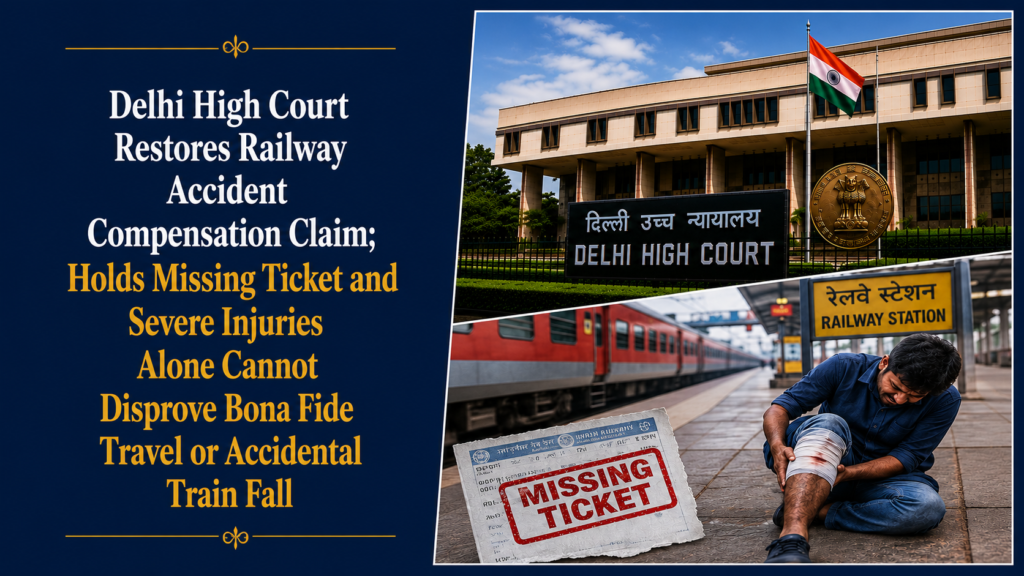
Delhi High Court Restores Railway Accident Compensation Claim; Holds Missing Ticket and Severe Injuries Alone Cannot Disprove Bona Fide Travel or Accidental Train Fall

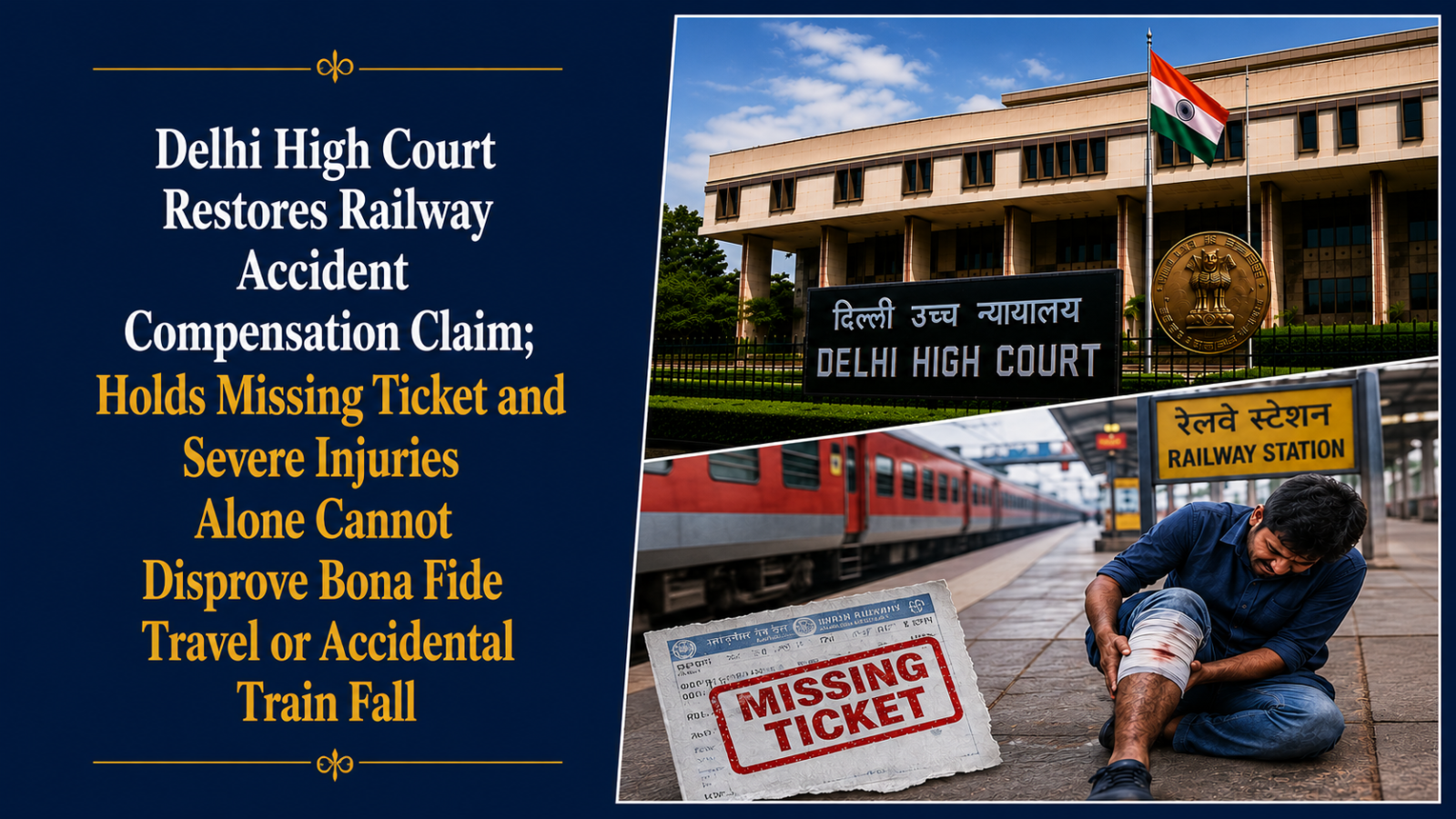
Railway Cannot Avoid Compensation Merely on Missing Ticket and Injury Pattern, Delhi High Court Holds; Matter Sent Back for Quantum Assessment
Facts
The appellants challenged a judgment dated 23 March 2022 of the Railway Claims Tribunal, Principal Bench, Delhi, dismissing their compensation claim arising from the death of Naresh Mahor.
According to the claimants, on 20 October 2019, the deceased was travelling from New Delhi to Faridabad by a local EMU train. While the train was running between Tuglakabad and Faridabad Railway Stations, he allegedly fell accidentally from the train, sustained fatal injuries and died at the spot.
The Tribunal rejected the claim on two grounds: first, that the deceased had not been proved to be a bona fide passenger; and second, that the incident did not qualify as an “untoward incident” under the Railways Act, 1989.
The claimants therefore approached the Delhi High Court under Section 23 of the Railway Claims Tribunal Act, 1987.
Issues
The principal issues were:
- Whether the deceased could be treated as a bona fide passenger despite non-recovery of his railway ticket.
- Whether the fatal injuries and condition of the body necessarily established that he had been run over while crossing the track rather than accidentally falling from a train.
- Whether the delayed discovery of the body and the fact that several trains had passed the location before it was noticed could defeat the claim.
- Whether the case fell within the strict liability regime under Section 124-A of the Railways Act.
Appellants’ Arguments
The appellants argued that the deceased had undertaken a lawful journey after purchasing a valid ticket, which was lost during the accident.
They relied upon Union of India v. Rina Devi to contend that mere non-recovery of a ticket is not conclusive against bona fide passenger status.
They further contended that the deceased had accidentally fallen from the running train and that the nature of his injuries did not exclude such a possibility.
The appellants also relied upon the affidavit of the deceased’s father, Chandu Lal, who stated that his son was travelling from New Delhi to Faridabad after purchasing DJ-related equipment.
Respondent’s Arguments
The Union of India supported the Tribunal’s decision and argued that this was not a case of accidental fall but of the deceased being run over by an unknown locomotive.
It relied upon the seriousness of the injuries, including multiple abrasions, fractures and bruises.
The respondent further argued that there was no eyewitness to the deceased purchasing a ticket, boarding the train or falling from it.
It also relied upon Call Detail Record material said to indicate that the deceased’s mobile phone remained active at Faridabad until the night of 19 October 2019, thereby casting doubt on the alleged journey from New Delhi.
Analysis of the Law
The High Court first examined the question of bona fide passenger status.
It reiterated the principle in Rina Devi that non-recovery of a journey ticket cannot by itself be treated as conclusive proof that the passenger was travelling without authority.
The Court also relied upon the Supreme Court’s subsequent decision in Lata v. Union of India, 2026 SCC OnLine SC 1350, which clarified that a claimant may discharge the initial burden regarding bona fide travel through an affidavit. Once that initial burden is discharged, the absence of a recovered ticket does not automatically defeat the claim, particularly where there is no sufficient material to rebut the assertion of lawful travel.
Applying that principle, the Court held that the deceased’s father had discharged the initial burden through his affidavit. The Tribunal was therefore wrong to discard his evidence merely because he was not an eyewitness to the ticket purchase or accident.
Precedent Analysis
The Court principally relied upon Union of India v. Rina Devi, (2019) 3 SCC 572, for the proposition that absence of a recovered ticket is not determinative of bona fide passenger status.
It relied upon Lata v. Union of India, 2026 SCC OnLine SC 1350, for the further proposition that the claimant’s initial burden may be discharged through affidavit evidence.
On the nature of the accident, the Court referred to Rajpati v. Union of India, 2014 SCC OnLine Del 2540, where it had been recognised that a body found in a severely mutilated or cut-up condition does not necessarily rule out an accidental fall from a moving train.
The Court also relied on Surendra Prasad Verma v. Union of India, 2014 SCC OnLine Del 2917, holding that delay in discovery of the body is not by itself sufficient to disbelieve an accidental fall claim.
Finally, the Court referred to Union of India v. Prabhakaran Vijaya Kumar, (2008) 9 SCC 527, reiterating that Section 124-A creates a strict liability regime. Once the incident falls within the statutory definition of an untoward incident, compensation cannot be denied unless one of the limited statutory exceptions is proved.
Court’s Reasoning
On bona fide passenger status, the Court held that the deceased’s father’s affidavit was sufficient to satisfy the initial evidentiary burden.
There was no cogent material produced by the Railways to rebut that evidence. Accordingly, the Tribunal erred in holding that the deceased was not a bona fide passenger.
On the nature of the occurrence, the High Court found that the Tribunal had placed excessive emphasis on the physical condition of the body.
The post-mortem report recorded the injuries but did not contain any medical opinion excluding the possibility that the deceased had first fallen from the train and thereafter come under its wheels. The Court observed that he could have become entangled in the steps or wheels of the same train after falling, which could explain both the injuries and grease marks.
The Tribunal had also reasoned that, because several trains passed the location before the body was discovered, the body would ordinarily have been noticed earlier if the fall had occurred as alleged.
The High Court rejected this inference. The mere fact that the body remained unnoticed by the loco pilots of several trains could not, by itself, negate an accidental fall.
The Court therefore found that the Tribunal’s conclusions on both bona fide passenger status and the nature of the accident were unsupported by the evidentiary record.
Conclusion
The Delhi High Court allowed the appeal and set aside the Railway Claims Tribunal’s judgment dated 23 March 2022.
It held that the deceased could not be denied bona fide passenger status merely because his ticket was not recovered, particularly when the initial burden had been discharged through affidavit evidence and no cogent rebuttal was produced.
The Court also held that the injuries and delayed discovery of the body did not exclude the possibility of an accidental fall from the train.
The matter was therefore remanded to the Railway Claims Tribunal for assessment of the compensation payable in accordance with law. The Tribunal was requested to direct disbursement of the compensation within two months from receipt of the High Court’s order.
The matter was directed to be listed before the Tribunal on 25 August 2026.
Case Details
Case: Chandu Lal & Anr. v. Union of India
Court: High Court of Delhi at New Delhi
Case Number: FAO 315/2022
Judge: Hon’ble Mr. Justice Manoj Kumar Ohri
Reserved on: 31 July 2026
Date: 11 August 2026
Result: Appeal allowed; Tribunal judgment set aside; matter remanded for determination and disbursement of compensation