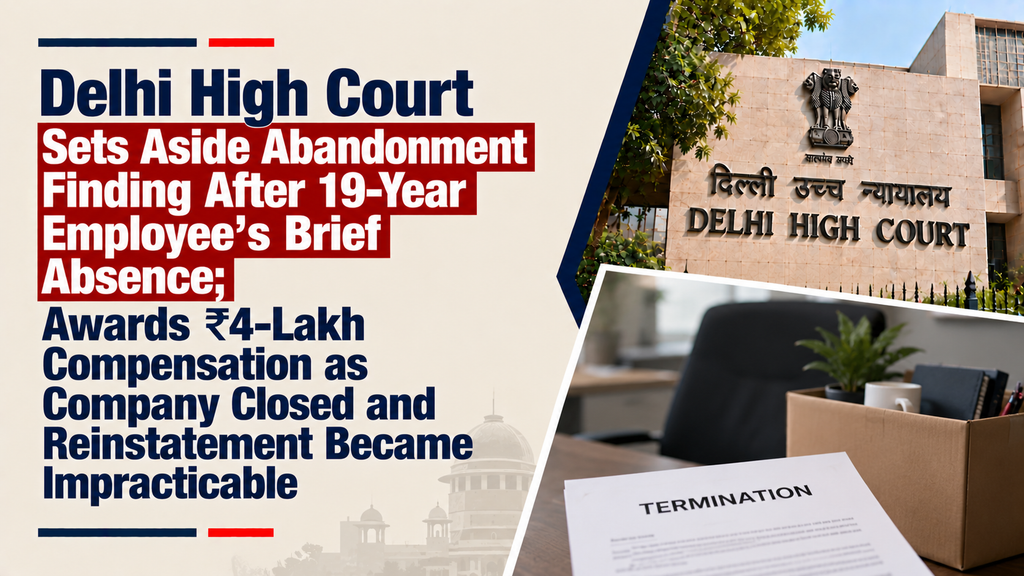
Delhi High Court Sets Aside Abandonment Finding After 19-Year Employee’s Brief Absence; Awards ₹4-Lakh Compensation as Company Closed and Reinstatement Became Impracticable

Mere Absence From Duty Does Not Establish Voluntary Abandonment Without Proof of Intention to Sever Employment: Delhi High Court
Facts
The petitioner, Tarkeshwar, challenged a Labour Court award dated 30 August 2008 which had dismissed his claim for reinstatement and back wages against A.V. Engineering Industries Pvt. Ltd.
Tarkeshwar had joined the management on 1 August 1987 as a Spray Painter and had served for nearly 19 years. His last drawn monthly wages were ₹3,931.
He claimed that he had proceeded on sanctioned leave from 15 May 2006 to 3 June 2006 to visit his native village, fell ill during that period and was unable to resume duty as scheduled. According to him, he informed the employer and sent a medical certificate by registered post.
The management issued a letter on 15 June 2006 asking him to report for work and subsequently terminated his services on 26 June 2006.
The management’s defence before the Labour Court was that Tarkeshwar had voluntarily abandoned his employment and had failed to report for duty despite being called upon to do so.
The Labour Court accepted this plea, reasoning that the workman had failed to prove that he had rejoined duty, approached the management, or furnished the claimed fitness certificate. It therefore treated the employment as voluntarily abandoned and denied reinstatement or consequential relief.
Issues
The principal issues before the Delhi High Court were:
- Whether the Labour Court was justified in inferring voluntary abandonment of service merely from the workman’s absence and failure to produce certain documents.
- On whom lay the burden of proving abandonment of employment.
- Whether the management had produced any evidence establishing Tarkeshwar’s intention to permanently sever the employment relationship.
- Whether termination without inquiry or statutory compliance was illegal.
- What relief was appropriate where the company had since shut down and reinstatement had become impracticable.
- Whether the workman was entitled to back wages.
- Whether the legal representative of the erstwhile director could be deleted from the proceedings and whether personal or successor liability could be determined in the writ itself.
Workman’s Arguments
The workman argued that after nearly 19 years of continuous service, there was no basis to infer that he suddenly intended to abandon his employment.
He maintained that his absence was due to illness and that he had informed the employer. Upon recovery, he claimed to have approached the management with a fitness certificate and expressed willingness to resume work, but was refused employment.
He further argued that:
- no notice was issued before termination;
- no domestic inquiry was conducted;
- statutory safeguards were not followed; and
- the management had led no oral or documentary evidence proving abandonment.
Accordingly, he contended that the Labour Court’s finding was unsupported by evidence and legally perverse.
Management’s Arguments
The management sought dismissal of the writ and relied upon the Labour Court’s reasoning.
It additionally informed the High Court that the company had closed down, and that its director, Y.P. Khanna, had died. It therefore argued that reinstatement was no longer feasible.
Analysis of the Law
1. Abandonment cannot be inferred merely from absence
This is the core legal proposition of the judgment.
The High Court held that absence from duty, by itself, is insufficient to establish abandonment of service.
For abandonment to be proved, there must be cogent material demonstrating that the employee intended to permanently sever the employment relationship.
Thus, abandonment involves not merely physical absence, but an element of intention.
2. Burden lies on the employer
Where an employer specifically pleads that the employee voluntarily abandoned service, the burden of establishing that plea rests upon the employer.
In this case, the management:
- examined no witness;
- produced no documentary evidence; and
- placed no material showing that Tarkeshwar intended to desert his employment.
The High Court therefore held that there was no evidence whatsoever supporting the abandonment defence.
3. Employee’s failure to prove illness does not prove abandonment
The Labour Court had reasoned that because Tarkeshwar did not prove his medical certificate, fitness certificate or reply to the employer’s letter, abandonment stood established.
The High Court expressly rejected this approach.
A finding of abandonment cannot arise solely from weaknesses in the employee’s evidence when the employer itself has produced no evidence supporting its affirmative defence.
That was a material error in the allocation of the burden of proof.
Brief Absence Versus 19 Years of Service
The Court also considered the chronology important.
Tarkeshwar’s sanctioned leave ended on 3 June 2006.
The employer issued its reporting letter only twelve days later, on 15 June 2006, and terminated him on 26 June 2006.
Thus, within a matter of weeks, the employer treated the employment as abandoned.
Against this, Tarkeshwar had admittedly worked for the establishment for nearly 19 years.
The High Court held that voluntary abandonment could not reasonably be inferred from such a short spell of absence, particularly without clear evidence of an intention to permanently give up employment.
Termination Held Illegal
Because wilful abandonment was not established, the High Court held that the employer could not simply treat the employment relationship as terminated.
The management ought to have followed the applicable procedure, including the requirements associated with Section 25F of the Industrial Disputes Act, 1947, and afforded the employee an opportunity of hearing.
The Labour Court’s award was therefore set aside as suffering from perversity and erroneous application of the burden of proof.
Precedent Analysis
Assistant Engineer, Rajasthan Development Corporation v. Gitam Singh
The Supreme Court authority was relied upon at the relief stage.
It establishes that even where termination is wrongful, reinstatement is not an inflexible or automatic consequence.
Relevant considerations include:
- nature of employment;
- manner of appointment;
- length of service; and
- surrounding circumstances.
The Court may award monetary compensation where reinstatement is no longer appropriate.
BSNL v. Bhurumal
The High Court also relied upon BSNL v. Bhurumal for the modern principle that reinstatement with back wages is not to be applied mechanically in every case of illegal termination.
The judgment recognizes that monetary compensation can appropriately substitute reinstatement depending on the circumstances.
Why Reinstatement Was Not Granted
Although Tarkeshwar succeeded on the issue of illegal termination, the Court found reinstatement impracticable because:
- the respondent company had permanently closed;
- the litigation had remained pending for nearly two decades; and
- reinstatement into a non-functioning establishment was no longer a workable remedy.
The Court therefore moulded the relief into monetary compensation.
Why Back Wages Were Denied
The Court separately declined to grant back wages.
It noted that Tarkeshwar had neither pleaded nor produced material showing that he:
- remained continuously unemployed; or
- was not gainfully employed during the intervening period.
In the absence of evidence concerning unemployment, the High Court held that an award of back wages was not justified.
Compensation Awarded
The High Court took into account the undisputed fact that Tarkeshwar had rendered 19 years of service.
Instead of reinstatement and back wages, it awarded him ₹4,00,000 as lump-sum compensation, payable by the erstwhile employer within eight weeks.
Liability of Director’s Legal Representative
An additional issue arose because Arun Khanna, son of the deceased director Y.P. Khanna, sought deletion of his name from the proceedings.
He argued that:
- he had never personally employed Tarkeshwar;
- the company was a separate legal entity;
- the company had been struck off;
- his father had died; and
- he was neither a successor-in-interest nor personally liable.
The High Court declined to delete him at that stage because he was the son and legal representative of the director who had represented the company during the proceedings.
However, the Court made an important qualification.
It expressly did not decide personal liability, successor liability or the assets against which the compensation could be recovered.
Those questions were left open for determination in appropriate execution proceedings.
Court’s Reasoning
The judgment turns on a basic evidentiary distinction:
The workman’s inability to fully establish his explanation for absence is not equivalent to the employer proving voluntary abandonment.
The management had raised abandonment as an affirmative defence, yet led no evidence at all to show an intention by Tarkeshwar to permanently quit.
Given:
- nearly 19 years of prior service;
- only a brief post-leave absence;
- no departmental inquiry;
- no evidence of intention to resign or desert employment; and
- the employer’s failure to discharge its own burden,
the Labour Court’s conclusion could not stand.
At the same time, later circumstances—particularly permanent closure of the company—made reinstatement impossible. The Court therefore awarded monetary compensation rather than attempting to restore an employment relationship that no longer practically existed.
Conclusion
The Delhi High Court set aside the Labour Court’s finding that Tarkeshwar had voluntarily abandoned his employment.
It held that abandonment requires cogent evidence of an intention to permanently sever employment and that the burden lies upon the employer asserting it. Mere absence from duty and deficiencies in the employee’s explanation cannot by themselves establish abandonment.
The termination was consequently held illegal.
However, because the company had closed and reinstatement was no longer practicable, the Court awarded ₹4 lakh lump-sum compensation in lieu of reinstatement and back wages, payable within eight weeks.
Questions concerning the personal or successor liability of the director’s legal representatives were expressly left open for execution proceedings.
Case Details
Case: Tarkeshwar v. A.V. Engineering Industries Pvt. Ltd.
Court: Delhi High Court
Case Number: W.P.(C) 888/2009
CNR: DLHC010237192009
Judge: Justice Amit Mahajan
Reserved On: 24 July 2026
Pronounced On: 8 September 2026
Impugned Award: Labour Court-I, Karkardooma Courts, Delhi, dated 30 August 2008 in I.D. No. 284/2006
Length of Service: Approximately 19 years
Compensation Awarded: ₹4,00,000
Result: Labour Court award set aside; abandonment not proved; termination held illegal; reinstatement and back wages denied due to company closure and lack of proof of unemployment; ₹4 lakh compensation awarded.