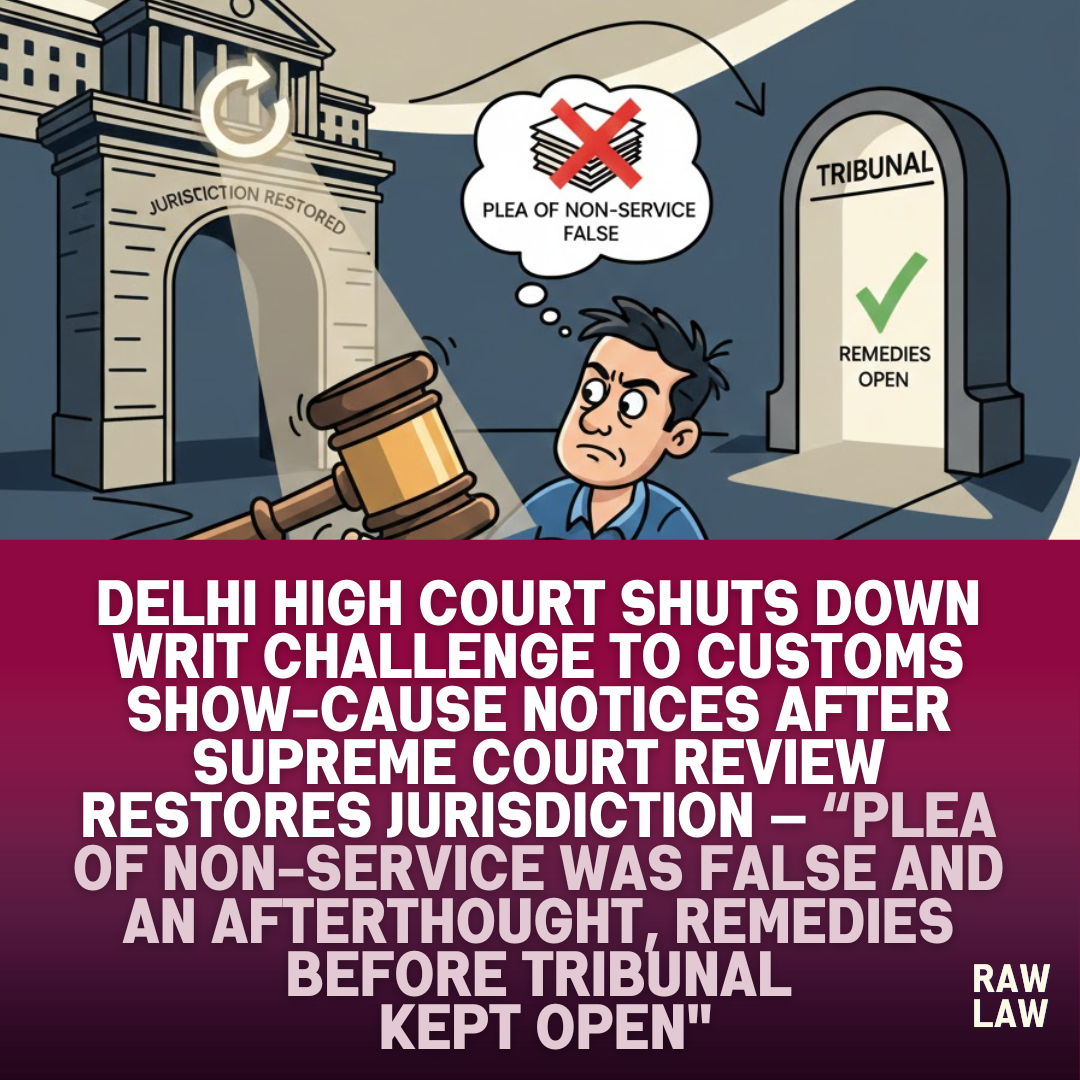
Delhi High Court shuts down writ challenge to customs show-cause notices after Supreme Court review restores jurisdiction — “Plea of non-service was false and an afterthought, remedies before tribunal kept open”

1. Court’s decision
The Delhi High Court disposed of two connected writ petitions that sought to quash customs show-cause notices and orders-in-original primarily on the ground that Directorate of Revenue Intelligence officers were not “proper officers” to issue notices under Section 28 of the Customs Act, 1962. The Court held that, after the Supreme Court’s review decision restoring such officers’ competence, the jurisdictional challenge no longer survived. The Court also rejected an additional plea regarding non-service of the show-cause notice, finding on the basis of the Department’s affidavit and surrounding circumstances that service had been effected, and describing the non-service plea as “clearly a false one” and an afterthought. While disposing of the petitions, the Court kept all remedies against the orders-in-original open, and noted that the petitioner may seek benefit of Section 14 of the Limitation Act for the pendency period.
2. Facts
Two writ petitions were filed under Article 226 challenging (i) a show-cause notice dated 18 September 2019 and an order-in-original dated 14 September 2020, and (ii) a show-cause notice dated 29 April 2019 and an order-in-original dated 29 September 2020. The petitions were largely anchored in the Supreme Court’s 2021 ruling in Canon India which had initially held that DRI officers were not “proper officers” for issuing show-cause notices under Section 28 of the Customs Act. During hearing, an additional contention was raised about alleged non-service of the show-cause notice. The High Court called for a departmental affidavit to address service, and the affidavit traced dispatch, notice-board display, email references, and subsequent conduct indicating knowledge of the notice and participation in proceedings.
3. Issues
The High Court considered two main issues. First, whether writ petitions challenging DRI-issued show-cause notices and consequent adjudication orders could survive after the Supreme Court’s review decision clarified that officers of DRI and similarly situated formations are “proper officers” for Section 28 purposes. Second, whether the petitioner’s plea that the show-cause notice was never served could justify writ intervention despite the record indicating dispatch, notice-board display, email communications referencing issuance, receipt of seized goods, and requests for relied upon documents and hearings. A consequential issue was the forum and limitation pathway for challenging the orders-in-original once the writ petitions were closed.
4. Petitioner’s arguments
The petitioner sought quashing of the show-cause notices and corresponding orders-in-original, contending that in light of the Supreme Court’s decision in Canon India DRI officers lacked jurisdiction as “proper officers” under the Customs Act, making the notices and downstream adjudication null. In one petition, the petitioner expressly prayed that the show-cause notice and order-in-original be declared void “in the light of” the Canon India judgment dated 9 March 2021. During the proceedings, an additional plea was raised that the show-cause notice had not been served, and therefore the process was vitiated.
5. Respondent’s arguments
The respondents relied on the Supreme Court’s review ruling in the Canon India litigation, which held that DRI officers and officers of specified investigative and preventive formations are “proper officers” competent to issue show-cause notices under Section 28, and which also laid down how pending challenges should be disposed of and where appeals should lie. On service, the Department’s affidavit asserted that the show-cause notice and its corrigendum were dispatched to the registered/last known addresses, displayed on the office notice board, and that subsequent emails, acknowledgements, and requests for relied upon documents and personal hearing demonstrated awareness and participation by noticees and their counsel.
6. Analysis of the law
The legal backbone of the petitions was the “proper officer” requirement under Section 28 of the Customs Act, 1962, which governs recovery of duties not levied/short-levied and the issuance of show-cause notices. In Canon India (2021), the Supreme Court had initially held that DRI officers were not “proper officers” for this purpose, prompting a wave of jurisdictional challenges. However, the Supreme Court’s later review decision recalibrated the law by recognizing DRI and similarly situated officers as proper officers for Section 28, and by prescribing a structured approach for disposing of pending writs/appeals and channeling disputes to statutory remedies, including appeals to the Customs Excise and Service Tax Appellate Tribunal. Against this landscape, the High Court’s writ role was narrowed: once the Supreme Court clarified jurisdiction, the petitions could not persist on the earlier jurisdictional premise.
7. Precedent analysis
The High Court explicitly invoked the Supreme Court’s ruling in Canon India Pvt. Ltd. v. Commissioner of Customs and, more importantly, the Supreme Court’s review decision in Commissioner of Customs v. M/s Canon India Pvt. Ltd. The review judgment concluded that DRI and related formations are proper officers under Section 28 and set out directions for pending matters: writ petitions challenging show-cause notices should be disposed of and notices restored for adjudication; challenges to orders-in-original on jurisdictional grounds should be channelled to appellate remedies with timelines; and matters pending before the tribunal or against tribunal orders should be decided on merits consistent with the review ruling. The High Court treated these Supreme Court directions as determinative, leaving no independent space for continuing the writs on the “proper officer” objection.
8. Court’s reasoning
The Court held that the “only issue” in the petitions had been the Canon India jurisdiction point, and that after the Supreme Court’s review decision, that challenge “no longer survives.” It then dealt with the service plea, observing that it appeared to be an afterthought. To verify, the Court had called for an affidavit. The affidavit narrated dispatch of the notice/corrigendum to last known addresses, display on the notice board, and later conduct: an email from a co-noticee referring to issuance of show-cause notice and seeking release of seized items; an appearance and acknowledgment by the petitioner while receiving seized items; and requests by the noticees’ counsel for relied upon documents and further documents for the scheduled personal hearing. On evaluating these circumstances, the Court recorded that it was “fully satisfied” service had been effected and that the non-service plea was “clearly a false one” and an afterthought. Consequently, the writ petitions were disposed of.
9. Conclusion
The Delhi High Court closed the chapter on these writ challenges by applying the Supreme Court’s review ruling that restored DRI officers’ jurisdiction under Section 28. With the jurisdiction argument extinguished, and the service challenge rejected on facts, the Court disposed of both petitions. Importantly, it did not leave the petitioner remediless: it kept “all remedies” against the orders-in-original open, and specifically noted that, for the time spent litigating in the High Court, the petitioner may seek the benefit of Section 14 of the Limitation Act, 1963 in accordance with law.
10. Implications
For customs litigation, this decision is a template for how High Courts will treat Canon India-based writ petitions post-review: jurisdictional writ attacks against DRI-issued Section 28 notices are unlikely to survive, and parties will be steered back to statutory adjudication and appeal mechanisms. The ruling also signals a cautionary note on pleading service defects: where documentary and conduct-based indicators show awareness and participation, courts may treat non-service arguments as factual disputes—and, in strong cases, may record adverse findings about the credibility of such pleas. Practically, the order underscores that assessees must pivot to appellate remedies against orders-in-original, and may invoke Section 14 Limitation Act to protect limitation where time was consumed in pursuing a writ remedy in good faith, subject to satisfying the statutory requirements.
Case law references
1) Supreme Court: Canon India Pvt. Ltd. v. Commissioner of Customs (2021 (18) SCC 563)
- What it held (initially): DRI officers were not “proper officers” under the Customs Act for issuing show-cause notices under Section 28.
- How treated here: The petitions were founded on this proposition, but the High Court held the point no longer survived after the later review ruling.
2) Supreme Court (Review): Commissioner of Customs v. M/s Canon India Pvt. Ltd. (Review Petition No. 400 of 2021)
- What it held: DRI and similarly situated officers are proper officers for Section 28 purposes, and it laid down the manner in which pending writs/appeals and jurisdiction-based challenges should be disposed of and redirected to adjudication/appeals.
- How applied here: The High Court disposed of the writs because the jurisdictional objection stood resolved by the Supreme Court; it left remedies against the orders-in-original open and flagged the Section 14 limitation pathway.
FAQs
1) Are DRI officers “proper officers” to issue customs show-cause notices under Section 28 of the Customs Act?
As noted by the Delhi High Court, the Supreme Court’s review decision in the Canon India litigation holds that DRI and similarly situated officers are proper officers competent to issue show-cause notices under Section 28, subject to the review judgment’s observations and directions.
2) Can a High Court entertain a writ to quash a customs show-cause notice after the Canon India review ruling?
This order shows that where the writ is founded only on the earlier “lack of proper officer jurisdiction” objection, the challenge may not survive after the Supreme Court review, and parties may be directed back to adjudication and statutory appeals.
3) What happens if a party says the customs show-cause notice was never served?
Service is a factual issue. In this case, the High Court examined the Department’s affidavit and surrounding conduct (dispatch records, notice-board display, emails referencing issuance, document requests, and participation), found service proved, and rejected the non-service plea as false and an afterthought.