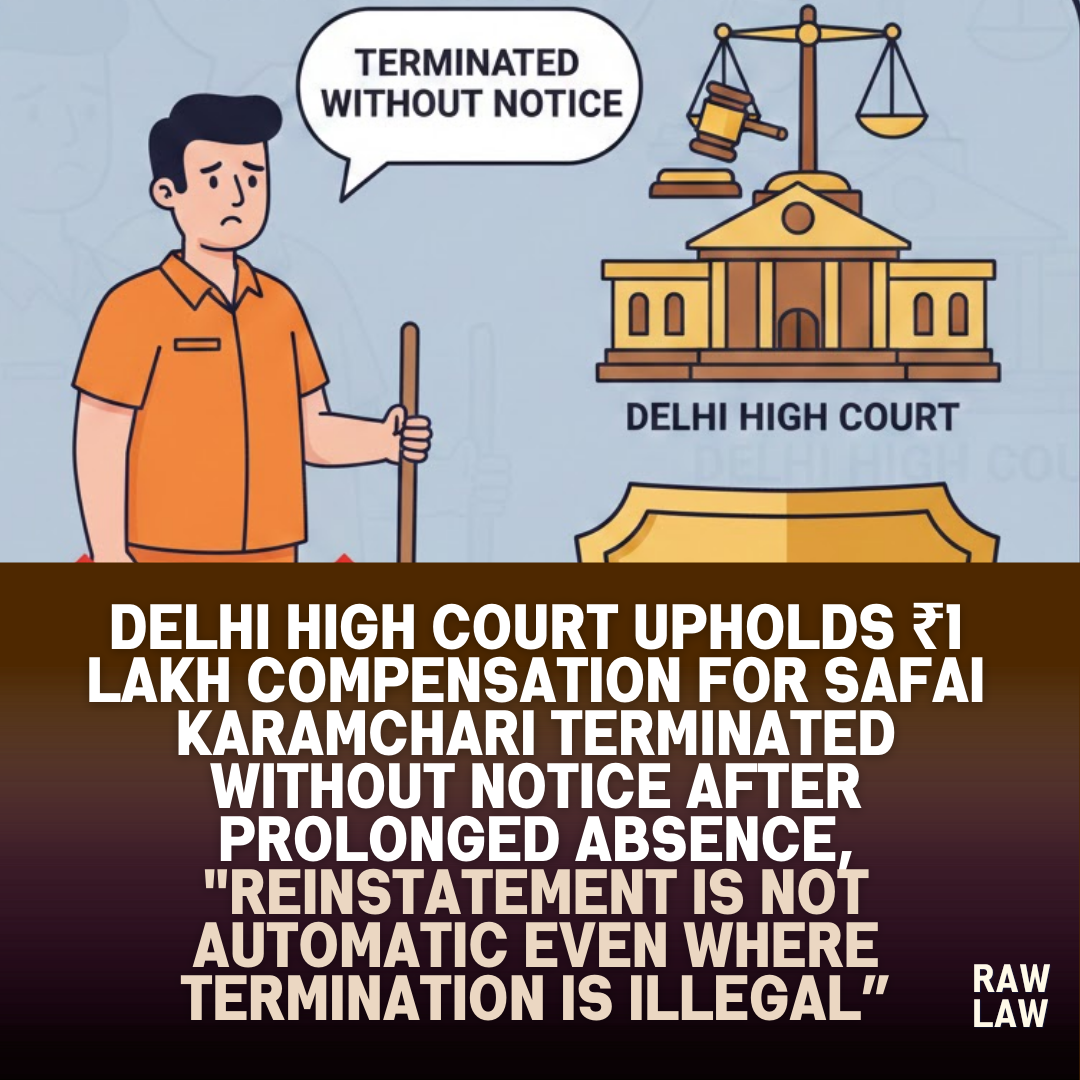
Delhi High Court upholds ₹1 lakh compensation for Safai Karamchari terminated without notice after prolonged absence, “Reinstatement is not automatic even where termination is illegal”

HEADNOTE
Case Title: North Delhi Municipal Corporation v. Shri Darshan Singh & Shri Darshan Singh v. North Delhi Municipal Corporation
Court: Delhi High Court
Bench: Hon’ble Mr. Justice Manoj Kumar Ohri
Date of Judgment: 20 January 2026
Case Numbers: W.P.(C) 5116/2019 and W.P.(C) 1726/2022
Tribunal Award Challenged: Award dated 05 April 2018 in ID No. 12/2013 (CGIT-cum-Labour Court No. 01, Dwarka)
Laws/Sections Involved:
Section 25F, Industrial Disputes Act, 1947;
Section 95(2)(b), Delhi Municipal Corporation Act, 1957;
Principles governing retrenchment, reinstatement, and compensation
Keywords: illegal termination, Section 25F ID Act, municipal employee, compassionate appointment, long absence, reinstatement vs compensation, labour jurisprudence
Summary
The Delhi High Court dismissed cross writ petitions filed by the North Delhi Municipal Corporation and a Safai Karamchari, upholding an Industrial Tribunal award which declared the workman’s termination illegal but limited relief to retrenchment compensation of ₹1 lakh instead of reinstatement with back wages. The Court held that termination without notice or inquiry violated Section 25F of the Industrial Disputes Act and the Corporation’s own stand before the High Court in earlier proceedings. However, relying on settled Supreme Court jurisprudence, the Court ruled that reinstatement is not automatic in cases of daily-wage or non-permanent employees, particularly where termination is illegal only on procedural grounds. Justice Manoj Kumar Ohri concluded that monetary compensation struck a fair balance between illegality of termination and practical realities of employment, and found no reason to interfere with the Tribunal’s award.
Court’s decision
In a detailed common judgment, the Delhi High Court dismissed two cross writ petitions filed by the North Delhi Municipal Corporation (NDMC) and its former employee, Darshan Singh, thereby affirming an Industrial Tribunal award that struck a careful balance between illegality of termination and appropriate relief. While the Tribunal had held that Darshan Singh’s termination as a Safai Karamchari was illegal for non-compliance with statutory safeguards, it declined reinstatement and instead awarded retrenchment compensation of ₹1 lakh. Justice Manoj Kumar Ohri upheld this approach, holding that although the termination violated Section 25F of the Industrial Disputes Act, reinstatement with back wages was neither automatic nor appropriate in the facts of the case.
Factual background
Darshan Singh was appointed as a Safai Karamchari with the Municipal Corporation on 7 April 2005 on compassionate grounds, following the death of his mother while in service. His employment continued uninterrupted until July 2008, when he proceeded to Gomukh for collecting “Kanwar” and did not return. His prolonged absence prompted his wife to lodge a missing person report in September 2008.
According to the workman, he returned home only in May 2011 and suffered from depression and anxiety neurosis, supported by medical documentation. Meanwhile, a Public Interest Litigation filed by Jagrook Welfare Society exposed large-scale irregularities in municipal employment records, leading the High Court to direct verification of biometric attendance of thousands of employees. Darshan Singh was among those whose biometric details could not be generated due to long absence.
Termination by the Municipal Corporation
On 5 January 2012, the NDMC terminated Darshan Singh’s services, citing unauthorized absence since July 2008. The termination order invoked Section 95(2)(b) of the Delhi Municipal Corporation Act, stating that it was not practical to grant any further opportunity of hearing due to his prolonged absence.
Significantly, the termination was effected without issuance of any notice, without retrenchment compensation, and without conducting a departmental inquiry. This became the central flaw that later weighed heavily with both the Tribunal and the High Court.
Proceedings before the Industrial Tribunal
Aggrieved, Darshan Singh raised an industrial dispute. The Central Government Industrial Tribunal-cum-Labour Court held that the termination was illegal, as it violated Section 25F of the Industrial Disputes Act, which mandates notice and compensation prior to retrenchment of a workman who has completed one year of continuous service.
However, while holding the termination illegal, the Tribunal declined reinstatement with back wages. Instead, it awarded lump-sum retrenchment compensation of ₹1 lakh, considering the peculiar facts, including long absence and the nature of employment.
Both parties were dissatisfied: the Corporation challenged the award of compensation, while the workman sought reinstatement with full back wages.
Issues before the High Court
The High Court was called upon to decide two interconnected issues:
- Whether the Tribunal erred in holding the termination illegal and awarding compensation; and
- Whether the workman was entitled to reinstatement with back wages once termination was found to be illegal.
Corporation’s arguments
The NDMC argued that Darshan Singh had remained absent for nearly three years without permission and, therefore, no show-cause notice or hearing was required. It was contended that compassionate appointment is an exception to normal recruitment rules and does not confer absolute or permanent rights.
The Corporation further submitted that the Tribunal failed to appreciate that prolonged unauthorized absence itself justified termination, and hence even compensation should not have been granted.
Workman’s arguments
On the other hand, Darshan Singh argued that once the Tribunal had concluded that the termination was illegal, reinstatement with full back wages ought to have followed as a natural consequence. He contended that he was not gainfully employed after termination and that the Corporation led no evidence to rebut this claim.
Illegality of termination reaffirmed
Justice Manoj Kumar Ohri categorically held that the termination order was illegal. The Court noted that the admitted position was that no notice was issued and no opportunity of hearing was granted. This was in clear violation of Section 25F of the Industrial Disputes Act.
The Court also referred to the stand taken by the Corporation before the Division Bench in Jagrook Welfare Society, where it had undertaken to issue show-cause notices before termination. The failure to follow this procedure further weakened the Corporation’s case.
The judgment relied on the Supreme Court’s ruling in MCD v. Praveen Kumar Jain, which held that termination without complying with Section 25F or without holding a departmental inquiry is unsustainable, whether the termination is styled as simpliciter or penal.
Reinstatement not automatic
Having upheld the finding of illegality, the Court turned to the more nuanced question of relief. Justice Ohri undertook an extensive survey of Supreme Court jurisprudence, particularly Bharat Sanchar Nigam Limited v. Bhurumal and Jagbir Singh v. Haryana State Agriculture Marketing Board.
The Court reiterated that while earlier decisions leaned towards reinstatement with back wages as a rule, the modern trend recognises that reinstatement is not automatic, especially for daily-wage or non-permanent employees whose termination is illegal only due to procedural defects.
The rationale, the Court explained, is practical: even if reinstated, such a workman can lawfully be retrenched again after complying with Section 25F, rendering reinstatement a futile exercise.
Application to the present case
Applying these principles, the Court observed that Darshan Singh had remained absent for nearly three years and that his case did not fall within the exceptional categories where reinstatement is warranted, such as victimisation or unfair labour practice.
The Court held that monetary compensation was an appropriate and equitable remedy, balancing the illegality of termination with the realities of employment and the long lapse of time.
Final outcome
Finding no merit in either petition, the Delhi High Court dismissed both writ petitions and upheld the Tribunal’s award granting retrenchment compensation of ₹1 lakh. The Court concluded that the Tribunal’s approach was just, lawful, and consistent with binding precedent.
Conclusion
The judgment reinforces the evolving labour law position that illegality of termination does not mechanically translate into reinstatement. Courts must tailor relief to the facts, particularly where the employee is not a permanent workman and the defect lies in procedure rather than substance.
Implications
This ruling is significant for municipal bodies and public employers dealing with long-absent or daily-wage employees. It affirms that while statutory safeguards like Section 25F are mandatory, relief for their breach may legitimately take the form of compensation rather than reinstatement. The decision provides clarity and balance in labour jurisprudence, preventing both arbitrary termination and impractical reinstatement.