

Court’s decision
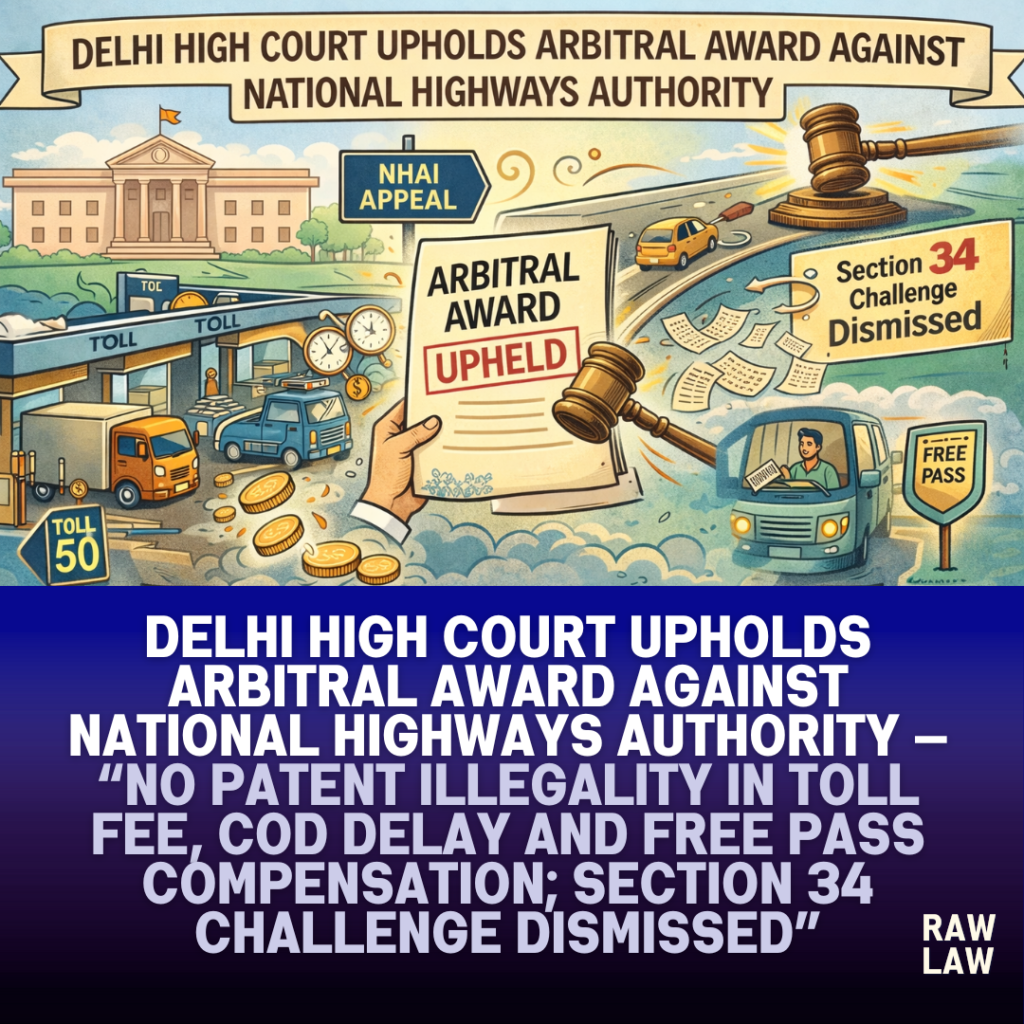
The Delhi High Court dismissed a petition filed by the National Highways Authority of India challenging an arbitral award passed in favour of a toll concessionaire, holding that none of the findings of the Arbitral Tribunal suffered from patent illegality, perversity, or jurisdictional error under Section 34 of the Arbitration and Conciliation Act. The Court ruled that the Tribunal’s interpretation of the concession agreement on toll fee rates, delay in declaration of the commercial operation date, and reimbursement for free local passes was a plausible and reasoned view — “Section 34 is not an appellate jurisdiction”; arbitral award upheld in full.
Court’s decision
Justice Amit Bansal upheld the arbitral award dated 10 October 2018 and rejected all objections raised by the National Highways Authority of India. The Court reiterated that re-appreciation of evidence and substitution of contractual interpretation are impermissible under Section 34, and where the arbitrator’s view is a possible view based on the contract and record, judicial interference is barred. The commercial arbitration petition was accordingly dismissed.
Facts
The dispute arose out of a concession agreement executed in April 2015 for operation, maintenance and transfer of a national highway stretch in Kerala on an operate-maintain-transfer basis. Disputes emerged soon after commencement regarding fixation of user fee rates, delay in declaration of the commercial operation date, and losses suffered due to issuance of free local monthly passes following public agitation.
The concessionaire invoked arbitration and raised three principal claims: compensation for discrepancy in user fee rates, damages for delay in declaration of commercial operation date, and reimbursement of costs incurred on issuing free local passes. The Arbitral Tribunal allowed all three claims in substantial part. The National Highways Authority approached the High Court under Section 34 seeking to set aside the award.
Issues
The principal issue before the High Court was whether the arbitral award suffered from patent illegality, perversity, or excess of jurisdiction warranting interference under Section 34 of the Arbitration and Conciliation Act. Specifically, the Court examined whether the Tribunal had rewritten the contract or adopted an implausible interpretation while awarding compensation on toll fee rates, delay in commercial operation date, and reimbursement of free pass costs.
Petitioner’s arguments
The National Highways Authority argued that the Tribunal had exceeded its jurisdiction by fixing toll fee rates allegedly reserved for the Central Government and not the Authority. It contended that damages for delay in declaration of commercial operation date were barred under the concession agreement and that the Tribunal had impermissibly relied on clauses meant to impose damages on the concessionaire, not on the Authority.
In respect of free local passes, it was submitted that the Tribunal wrongly treated costs incurred on issuing monthly passes as reimbursable force majeure costs, despite the agreement distinguishing between “fee” and “costs”. The Authority alleged that the award amounted to rewriting the contract and was therefore patently illegal.
Respondent’s arguments
The concessionaire opposed the petition, contending that the Tribunal’s findings were firmly rooted in the concession agreement, the National Highways Fee Rules, and contemporaneous correspondence. It was argued that the Authority itself had validated incorrect toll rates and delayed the declaration of the commercial operation date despite fulfilment of conditions precedent by the concessionaire.
The respondent further submitted that losses arising from forced issuance of free local passes were squarely covered under the “indirect political event” force majeure clause and were reimbursable under the contract. It was emphasised that Section 34 does not permit a merits review or substitution of the arbitrator’s interpretation.
Analysis of the law
The Court undertook an extensive survey of Supreme Court jurisprudence on Section 34, reiterating that interference is permissible only on limited grounds such as patent illegality, perversity, or decisions based on no evidence. The Court emphasised that contractual interpretation lies primarily within the arbitrator’s domain and that even an erroneous interpretation is not a ground for interference unless it is wholly implausible or contrary to the contract’s express terms.
The Court reaffirmed that re-appreciation of evidence and re-calculation of damages are impermissible under Section 34, which is not an appellate provision.
Precedent analysis
Relying on authoritative Supreme Court decisions governing arbitral interference, the Court reiterated that a finding based on a possible and reasonable interpretation of the contract cannot be set aside merely because another view is possible. The Court applied these principles consistently across all three claims and rejected the petitioner’s attempt to re-argue the merits of the dispute under the guise of patent illegality.
Court’s reasoning
On toll fee rates, the Court held that the Tribunal had correctly applied the concession agreement read with statutory fee rules and that the Authority’s contention about lack of power to determine fees was both factually and legally untenable.
On delay in declaration of commercial operation date, the Court agreed with the Tribunal that the delay was attributable to the Authority’s failure to fulfil conditions precedent and that damages were rightly quantified by drawing guidance from contractual parameters without rewriting the contract.
On reimbursement for free local passes, the Court held that costs incurred due to public agitation constituted an indirect political event under the force majeure clause and were contractually reimbursable, irrespective of whether the Authority had itself received reimbursement from the State Government.
Conclusion
The Delhi High Court dismissed the Section 34 petition and upheld the arbitral award in its entirety, finding no perversity, patent illegality, or jurisdictional excess in the Tribunal’s reasoning. The Court reaffirmed that arbitral awards cannot be interfered with merely because a different contractual interpretation is possible.
Implications
This judgment strongly reinforces the pro-arbitration stance of Indian courts and the narrow scope of judicial review under Section 34. It provides significant comfort to infrastructure concessionaires that well-reasoned arbitral awards on contractual disputes with public authorities will not be lightly interfered with. The ruling also underscores that public authorities cannot evade contractual liability by re-litigating factual and interpretative issues before constitutional courts.
Case law references
- Scope of Section 34 review: Courts cannot re-appreciate evidence or substitute contractual interpretation. Applied to uphold the award.
- Patent illegality doctrine: Only illegality going to the root of the matter warrants interference. Applied to reject all objections.
- Force majeure reimbursement: Costs arising from indirect political events are reimbursable if contractually provided. Applied to sustain free pass compensation.
FAQs
1. Can courts re-examine contract interpretation under Section 34?
No. Courts interfere only if the arbitrator’s view is implausible or patently illegal.
2. Does Section 34 permit re-calculation of damages?
No. Re-assessment of quantum or evidence is impermissible.
3. Are public authorities treated differently in arbitration challenges?
No. Public bodies are bound by the same contractual and arbitral standards as private parties.


