

1. Court’s decision
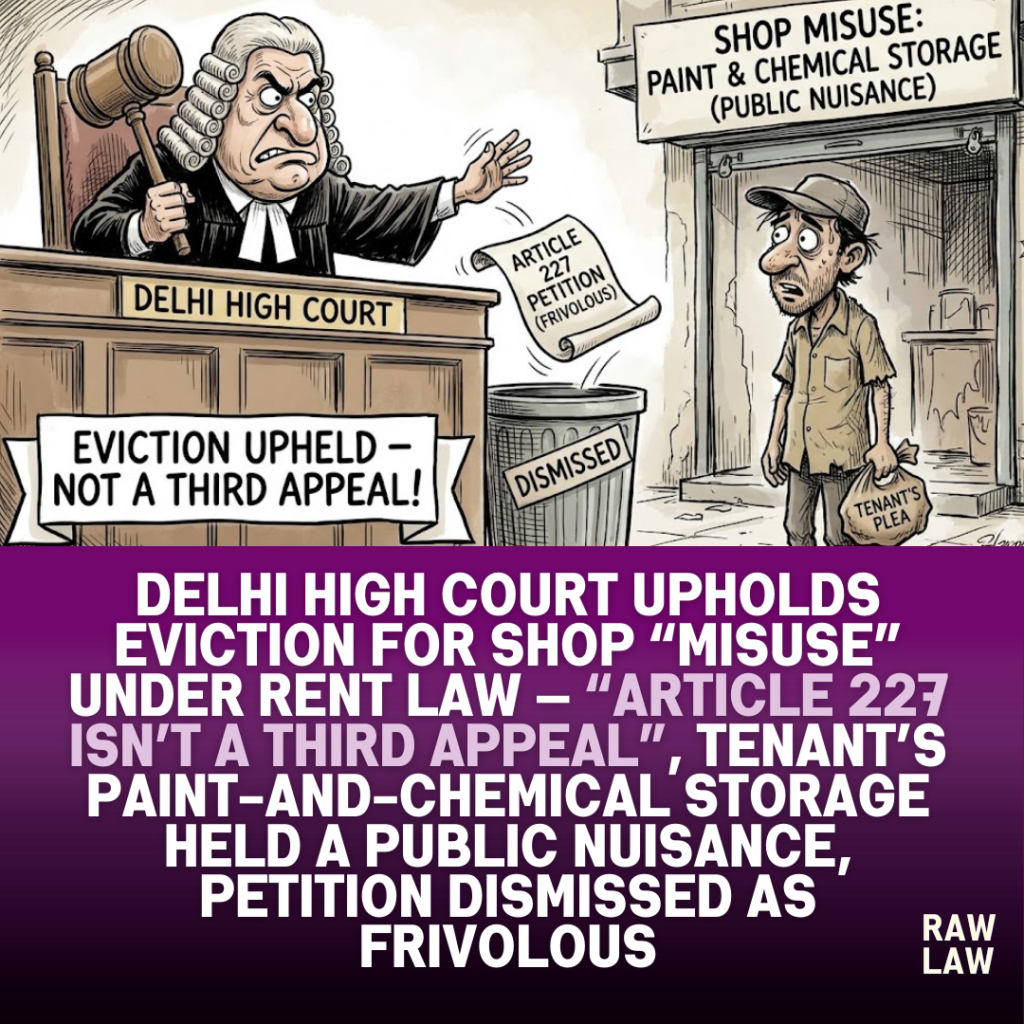
The Delhi High Court dismissed an Article 227 petition filed by a tenant challenging concurrent findings of the Rent Controller and the Rent Control Tribunal directing eviction under Section 14(1)(c) of the Delhi Rent Control Act. The Court held that its supervisory jurisdiction is extremely limited, especially when two courts below have concurred, and it would not reappreciate evidence unless the findings were grossly illegal or perverse. Finding no perversity, the Court upheld the eviction order, rejected the tenant’s arguments on “no change of use” and “non-service” of the statutory notice, and termed the petition and applications “frivolous.” The Court also requested the executing court to ensure expeditious execution because execution had remained stayed for over a decade.
2. Facts
The landlord initiated eviction proceedings alleging that the tenant was inducted into a shop in a larger property for selling electrical goods, but later changed the user by stocking allegedly inflammable and hazardous items such as paints, thinners, turpentine and chemicals. The landlord pleaded that the changed use endangered safety and health of other tenants and amounted to public nuisance, particularly because it was done without any municipal licence. A notice was issued to stop the misuse, but the tenant did not comply. After pleadings and a full trial, the Additional Rent Controller allowed eviction by judgment dated 20 December 2012. The tenant appealed; the Additional Rent Control Tribunal dismissed the appeal on 12 January 2015. The tenant then invoked Article 227 to challenge the appellate order.
3. Issues
The case turned on the legal and evidentiary requirements for eviction on “change of user/misuse” under Section 14(1)(c), read with the statutory notice requirement under Section 14(5). The High Court had to consider whether the tenant used the premises for a purpose other than that for which it was let, without the landlord’s written consent, and whether the landlord proved service of a valid Section 14(5) notice requiring the tenant to stop misuse. A further requirement under Section 14(5) is that eviction cannot be ordered unless the Controller is satisfied the misuse is a public nuisance or causes damage or is detrimental to the landlord’s interest. The tenant’s Article 227 challenge essentially asked whether the concurrent findings on these ingredients were perverse or illegal.
4. Petitioner’s arguments
The tenant argued that the impugned appellate order was perverse because there was no reliable evidence that the stored goods were inflammable or dangerous. He also contended that an earlier notice dated 16 August 1999 indicated the premises were leased for “hardware, sanitary work and paints,” meaning there was no change of use; according to him, concealment of that notice should have led to dismissal of the eviction petition. He further argued that municipal licensing is not required for storage of paints unless the quantity crosses a prescribed limit, and relied on a photograph showing two drums outside the shop to submit there was no evidence of what was stored in them. On service, he argued that the courts wrongly invoked Section 27 of the General Clauses Act because the Section 14(5) notice was received by his brother, not personally by him.
5. Respondent’s arguments
The landlord supported the concurrent orders and stressed the narrow scope of Article 227. He submitted that the 16 August 1999 notice was a quit notice issued in a different context and was irrelevant to eviction on Section 14(1)(c), whereas the foundational notice required by Section 14(5) had been duly served and proved in evidence. The landlord also relied on the fact that the tenant had been restrained by a civil court decree from storing hazardous and inflammable articles without licence, and that both rent courts had, on evidence, concluded the shop was originally let for electrical goods but was later used for storing paints and other material without consent, creating nuisance for other occupants.
6. Analysis of the law
Section 14(1)(c) permits eviction where a tenant uses premises for a purpose other than that for which they were let, without the landlord’s consent (writing required for post-1952 letting). But Section 14(5) adds two crucial safeguards: the landlord must first serve a prescribed notice requiring the tenant to stop the misuse and give one month to comply; and even thereafter, eviction cannot be ordered unless the Controller is satisfied the misuse amounts to public nuisance, causes damage, or is otherwise detrimental to the landlord’s interest. The Delhi High Court reproduced these provisions and treated them as the controlling framework.
Equally central was the procedural law governing Article 227. The Court reiterated that Article 227 is supervisory, not appellate. Where two courts below have concurrently assessed evidence and reached findings, the High Court will interfere only if the findings are grossly illegal or perverse. This legal threshold shaped the outcome: unless the tenant could show perversity in the rent courts’ reasoning on change of use, notice service, and nuisance, the High Court would not reassess factual disputes.
7. Precedent analysis
The judgment is primarily statutory and record-driven rather than precedent-heavy. The Court did not hinge its decision on a long line of reported cases; instead, it applied the settled supervisory standard for Article 227 and the statutory conditions under Section 14(1)(c) and 14(5). The Court’s approach reflects familiar doctrine—Article 227 is not a “third round” on facts—without building its reasoning around a catalogue of authorities.
8. Court’s reasoning
The High Court first emphasised that two courts below had concurred and that evidence could not be reappreciated under Article 227. On merits, it relied on multiple record features showing the tenant’s misuse. A key factor was an earlier civil suit culminating in a decree restraining the tenant from storing hazardous and inflammable articles and directing him to stop nuisance and obtain appropriate licence; this decree was not challenged and had attained finality, which the Court treated as clearly establishing user beyond the permitted purpose without consent/licence.
The Court also noted that both rent courts had found, on evidence, that the shop was let for electrical goods but later used for storing paints and inflammable material. The unchallenged photograph on the trial record showed drums and hardware materials stored outside the shop causing nuisance to other shopkeepers. A challan issued to the tenant for storing goods without municipal licence was also noted. These elements, taken together, supported the findings that the misuse was detrimental and nuisance-causing.
On the tenant’s “concealment” argument, the Court held the 16 August 1999 notice was a quit notice linked to an earlier civil suit and did not substitute the statutory notice required for Section 14(1)(c) eviction. The relevant notice was the Section 14(5) notice proved as Ex.PW1/3.
On service of the Section 14(5) notice, the Court held it was received at the shop by the tenant’s brother who signed the acknowledgment card; since there was no case of estrangement or any reason to infer the tenant did not see it, the service finding was not perverse. The Court further noted there was no evidence that the tenant stopped the misuse after notice. Concluding there was no infirmity, much less perversity, the Court dismissed the petition as meritless and asked the execution court to proceed expeditiously given the decade-long stay.
9. Conclusion
The Delhi High Court upheld eviction under Section 14(1)(c) by affirming the rent courts’ findings that the tenant changed the shop’s use without the landlord’s consent and continued misuse even after statutory notice, with the misuse amounting to nuisance/detriment. The Court rejected the tenant’s defences on earlier notices, licensing arguments, and alleged improper service, holding that none revealed perversity in the concurrent findings. The petition and applications were dismissed as frivolous, and the executing court was requested to ensure speedy execution.
10. Implications
This decision is a clear reminder that Article 227 is not a substitute for a full merits appeal in rent matters. Tenants facing eviction for “misuse/change of user” cannot expect the High Court to revisit factual findings once the Rent Controller and Tribunal have concurrently evaluated evidence. Substantively, the order demonstrates how “misuse” can be established not only through witness testimony but also through collateral records like unchallenged civil decrees, municipal challans, and photographs showing nuisance-causing storage. Procedurally, it reinforces the importance of the Section 14(5) notice: landlords must prove service and non-compliance within one month, while tenants must show compliance or risk eviction if the misuse is found to be a public nuisance or otherwise detrimental. Finally, the Court’s direction for expeditious execution signals judicial intolerance for decade-long stays in rent litigation once eviction has been upheld through two tiers.
Case law references
No external case citations form the basis of the decision. The Court’s reasoning rests on the text of Section 14(1)(c) and Section 14(5) of the Delhi Rent Control Act, and the limited supervisory scope under Article 227, applied to the evidence and findings recorded by the Rent Controller and the Rent Control Tribunal.
FAQs
1) What is “misuse” or “change of user” under Section 14(1)(c) of the Delhi Rent Control Act?
It refers to a tenant using rented premises for a purpose other than the one for which it was originally let, without the landlord’s consent (and for post-1952 lettings, consent must be in writing). The Court upheld eviction where a shop allegedly let for electrical goods was used for storing paints and other materials.
2) Is a landlord required to send a notice before filing eviction for misuse under Section 14(1)(c)?
Yes. Section 14(5) mandates a prescribed notice requiring the tenant to stop misuse and giving one month to comply. The Court treated the Section 14(5) notice proved in evidence as foundational and rejected reliance on an earlier unrelated quit notice.
3) Can the High Court recheck evidence in an Article 227 petition against rent tribunal orders?
Usually no. The High Court reiterated that Article 227 jurisdiction is limited and it will not reappreciate evidence, particularly where two courts below have concurred, unless findings are grossly illegal or perverse.


Interesting analysis of the Delhi High Court’s stance on property misuse under rent control laws. This makes me wonder – how do courts typically handle evidentiary requirements when translated documents are submitted in such cases? For instance, if a tenant presented foreign-language lease agreements or municipal licenses, would they need to follow the notarized translation process outlined at https://notariuspublic.com/service/notarised-translations/ to be considered valid evidence? The court here seemed quite strict about proper documentation, so I’m curious whether notarized translations carry more evidentiary weight in Indian rent control proceedings compared to regular translations.