

Court’s decision
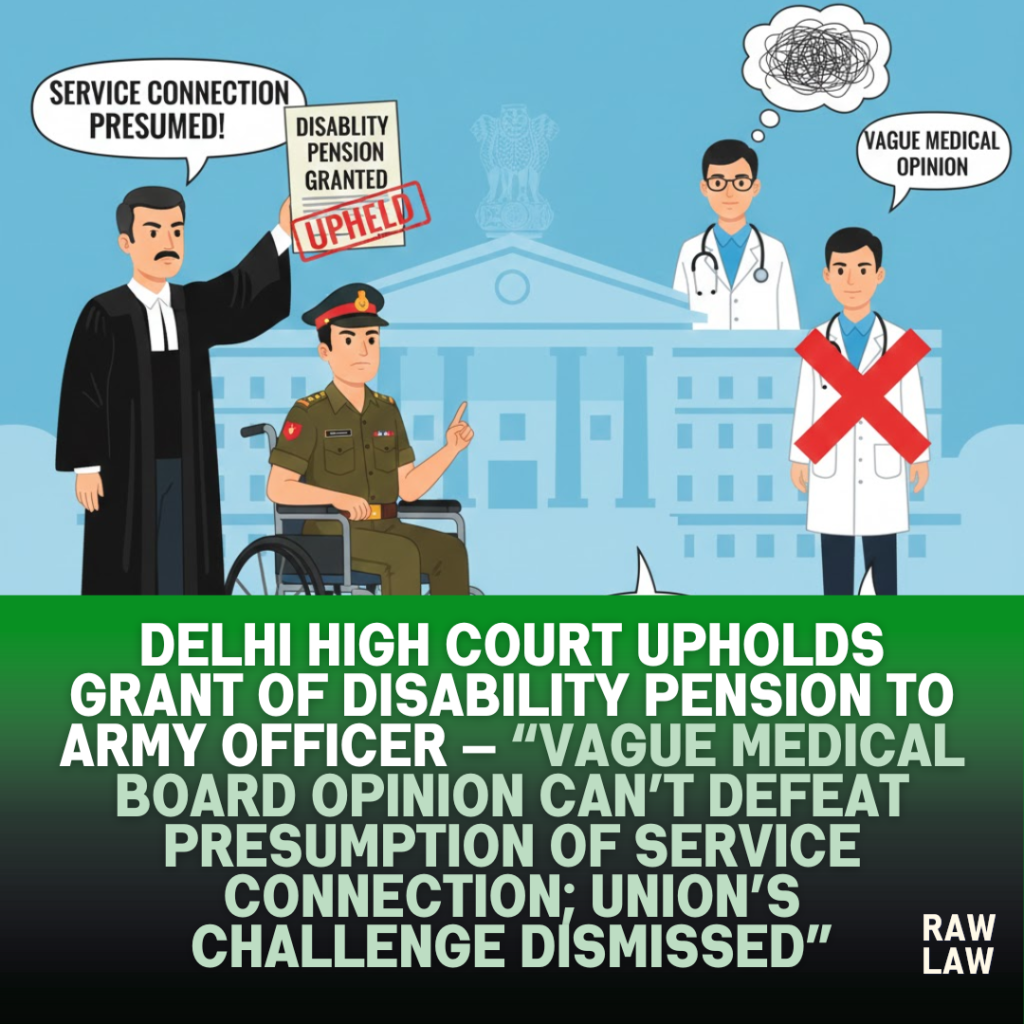
The Delhi High Court dismissed a writ petition filed by the Union of India and upheld the Armed Forces Tribunal’s decision granting disability pension to a retired Army officer suffering from Coronary Artery Disease and Type II Diabetes Mellitus. The Court held that in the absence of clear and cogent reasons from the Release Medical Board to rebut the statutory presumption, the disabilities must be treated as attributable to and aggravated by military service. Reaffirming the beneficial nature of disability pension law, the Court ruled that vague references to “lifestyle disease” or posting in a “peace area” cannot justify denial of pensionary benefits.
Court’s decision
A Division Bench declined to interfere with the Armed Forces Tribunal’s order directing grant of disability element of pension at a composite rate of 50% for life. The Court found that the Tribunal had correctly applied settled law and Supreme Court precedents, and that the Union of India failed to discharge its burden of proving that the officer’s disabilities were neither attributable to nor aggravated by military service. Consequently, the writ petition was held to be devoid of merit and dismissed.
Facts
The respondent officer had served in the Indian Army with extensive exposure to field, high-altitude, and counter-insurgency postings, including repeated tenures in Jammu and Kashmir. Over the course of service, he developed Coronary Artery Disease (post myocardial infarction with stent placement) and Type II Diabetes Mellitus. Upon retirement, the Release Medical Board assessed the disabilities but opined that they were neither attributable to nor aggravated by military service, citing lifestyle factors and noting that the onset was recorded while the officer was in a peace area. Aggrieved by denial of disability pension, the officer approached the Armed Forces Tribunal.
Issues
The key issue before the High Court was whether the Armed Forces Tribunal was justified in granting disability pension despite the Release Medical Board’s opinion that the disabilities were not service-related. The Court also examined whether, under the Entitlement Rules for Casualty Pensionary Awards, 2008, the burden lay on the officer or the Union of India to establish or negate the causal connection between military service and the disabilities, particularly in cases involving diseases like coronary artery disease and diabetes.
Petitioner’s arguments
The Union of India argued that the Tribunal erred in overlooking the medical opinion of the Release Medical Board, which categorically concluded that both Coronary Artery Disease and Type II Diabetes Mellitus were neither attributable to nor aggravated by military service. It was contended that under the Entitlement Rules, 2008, the concept of attributability and aggravation had been diluted, and the Tribunal wrongly relied on earlier precedents. The petitioners further submitted that the onset of the diseases occurred when the officer was posted in a peace area and that diabetes was a lifestyle disorder unrelated to service conditions.
Respondent’s arguments
Although the respondent officer did not enter appearance before the High Court, his case as accepted by the Tribunal was that prolonged service in field and high-altitude areas, coupled with operational stress and strain, materially contributed to the onset and progression of both ailments. The Tribunal relied on the Guide to Medical Officers (Military Pensions), 2008, which recognises stress and strain as precipitating factors for both coronary artery disease and Type II diabetes. It was also urged that there was no material to show hereditary predisposition or pre-existing disease at the time of entry into service.
Analysis of the law
The High Court analysed the evolving jurisprudence on disability pension under the 2008 Entitlement Rules. It reiterated that an officer is presumed to be in sound physical and mental condition at the time of entry into service unless noted otherwise. Any subsequent deterioration resulting in disability ordinarily attracts a presumption of service connection. Even under the 2008 regime, the burden squarely lies on the employer to rebut this presumption by furnishing specific, cogent reasons. A bald or stereotyped medical opinion is insufficient to deny a beneficial statutory entitlement.
Precedent analysis
The Court relied extensively on coordinate Bench judgments and recent Supreme Court rulings which have consistently held that disability pension provisions must be interpreted liberally. It noted that courts have repeatedly rejected “peace area posting” and “lifestyle disease” as standalone grounds for denying service connection. The Court also endorsed the principle that if a medical board fails to explain why a disease could not have been detected at the time of entry or how it is unconnected with service conditions, denial of pension cannot be sustained.
Court’s reasoning
Applying these principles, the Court found that the Release Medical Board had not recorded any clear reasoning to support its conclusion. The opinion merely labelled the diseases as lifestyle-related without explaining alternative causes or excluding service-related stress as a contributing factor. The Court also rejected the argument that onset in a peace area breaks the causal link, noting that cumulative effects of prior field and high-altitude service cannot be ignored. In the absence of a reasoned medical opinion, the Tribunal was justified in granting disability pension.
Conclusion
The High Court concluded that the Armed Forces Tribunal had correctly granted the disability element of pension at a rounded-off rate of 50% for life. Finding no perversity or legal infirmity in the Tribunal’s reasoning, the Court dismissed the Union of India’s writ petition and affirmed the officer’s entitlement to pensionary benefits. All pending applications were also dismissed.
Implications
This judgment further strengthens the protective framework governing disability pensions for Armed Forces personnel. It reiterates that medical boards must provide detailed and reasoned opinions before denying pensionary benefits and that courts will not permit vague labels like “lifestyle disease” to defeat statutory presumptions. The ruling is significant for serving and retired personnel suffering from non-traumatic diseases linked to service stress, reaffirming that the burden of disproving service connection lies with the State.
Case law references
- Presumption of sound health at entry: Armed Forces personnel are presumed fit at induction; deterioration later is presumed service-related unless rebutted. Applied to uphold disability pension.
- Burden on employer under 2008 Rules: The military must furnish cogent reasons to deny attributability or aggravation. Applied to reject the Release Medical Board’s vague opinion.
- Lifestyle disease defence rejected: Courts have held that merely branding a disease as lifestyle-related is insufficient. Applied to Coronary Artery Disease and Type II Diabetes Mellitus.
FAQs
1. Can disability pension be denied by calling a disease “lifestyle-related”?
No. Courts require specific reasons and medical analysis. A vague lifestyle label is insufficient to deny pension.
2. Does posting in a peace area break the link with military service?
No. Courts recognise the cumulative impact of prior field and high-altitude service on health.
3. Who bears the burden of proof under the 2008 Entitlement Rules?
The burden lies on the Union of India to rebut the presumption that the disability is attributable to or aggravated by service.


