Delhi High Court Upholds Robbery Conviction Despite Absence of Independent Witnesses and CCTV; Reduces Sentence from Ten Years to Statutory Minimum of Seven Years

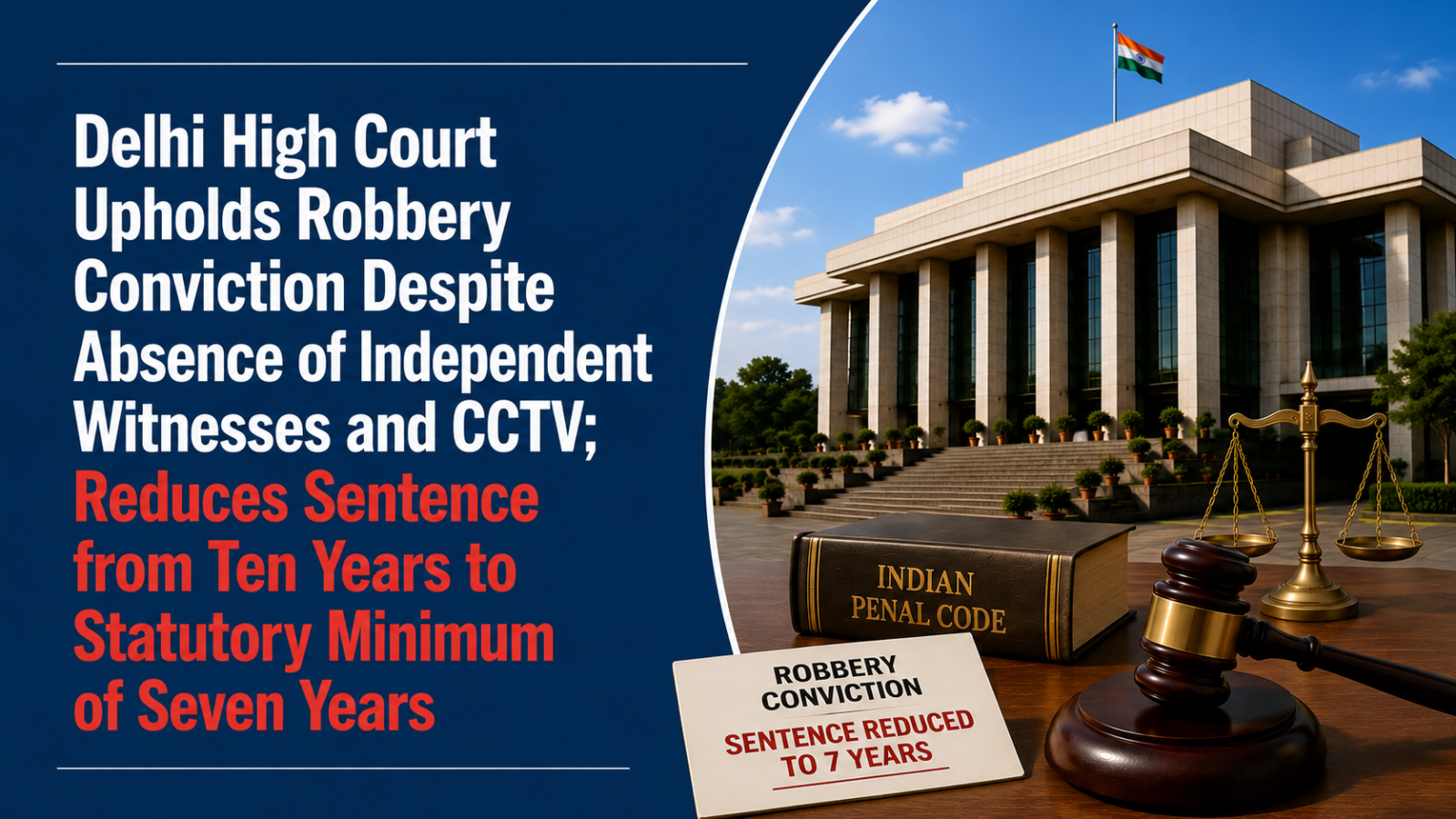
Absence of CCTV Footage Does Not Weaken Reliable Eyewitness Testimony, Rules Delhi High Court While Upholding Robbery Conviction
Facts
The appellant was convicted for robbing a tea vendor at knife-point on 19 August 2022 near the Delhi Jal Board office at Patel Nagar. According to the prosecution, the appellant threatened the complainant with a knife and robbed him of ₹1,200 and a Nokia mobile phone. On the complainant raising an alarm, nearby persons apprehended the appellant at the spot, and the police recovered the knife, cash and mobile phone from his possession.
The Trial Court convicted the appellant under Section 392 read with Section 397 IPC and sentenced him to ten years’ rigorous imprisonment with a fine of ₹10,000. The appellant challenged both the conviction and sentence before the Delhi High Court.
Issues
- Whether the conviction could be sustained when no independent public witness was examined.
- Whether the absence of CCTV footage and alleged contradictions in witness testimonies created reasonable doubt.
- Whether the plea of false implication due to previous enmity was established.
- Whether the sentence of ten years’ imprisonment required interference.
Appellant’s Arguments
The appellant contended that:
- The prosecution relied only on the complainant and his nephew, who were interested witnesses.
- Although several public persons allegedly witnessed the incident, none was examined.
- Material contradictions existed regarding the recovery of the robbed articles.
- CCTV cameras were installed nearby, yet the investigating agency failed to collect the footage.
- The appellant had earlier lodged FIR No. 559/2021 against the complainant’s relatives, and the present case was a counterblast motivated by previous enmity.
Respondent’s Arguments
The State argued that:
- The complainant’s testimony was natural, consistent and fully corroborated.
- The appellant was apprehended immediately after the robbery.
- The knife, cash and mobile phone were recovered from his possession.
- The absence of independent witnesses did not weaken the prosecution where the ocular evidence inspired confidence.
- The Trial Court had correctly rejected the plea of false implication.
Analysis of the Law
The High Court reiterated that while an appellate court may re-appreciate evidence, interference with a conviction is justified only where the Trial Court’s findings are perverse or unsupported by evidence.
The Court held that:
- The complainant’s testimony remained consistent on all material particulars.
- A related witness cannot be discarded merely because of the relationship; the test is credibility.
- Minor inconsistencies regarding procedural aspects of recovery do not affect the core prosecution case.
- Failure to join independent witnesses or collect CCTV footage is not fatal where trustworthy ocular evidence is supported by prompt recovery.
- Section 397 IPC prescribes a minimum sentence of seven years, while permitting a higher sentence depending upon the facts.
Precedent Analysis
The Court relied upon:
- Chandrappa v. State of Karnataka — An appellate court may re-appreciate evidence but should interfere with a conviction only where the Trial Court’s findings are perverse or result in miscarriage of justice.
- Appabhai v. State of Gujarat — Non-examination of independent public witnesses is not by itself sufficient to discard an otherwise reliable prosecution case, as members of the public are often reluctant to participate in criminal proceedings.
Court’s Reasoning
The High Court observed that:
- The complainant consistently narrated the robbery and immediate apprehension of the appellant.
- The nephew’s presence at the scene was satisfactorily explained and his testimony remained reliable.
- Recovery of the knife, stolen cash and mobile phone immediately after the incident strongly corroborated the prosecution case.
- The alleged contradictions related only to procedural details and did not undermine the core prosecution version.
- The plea of previous enmity remained unsubstantiated despite the defence evidence.
- Although the appellant had criminal antecedents and committed the offence while on bail in another case, the Court considered that:
- the value of the robbed property was modest,
- no physical injury was caused to the complainant, and
- the statutory minimum sentence under Section 397 IPC would sufficiently meet the ends of justice.
Conclusion
The Delhi High Court partly allowed the appeal.
It affirmed the appellant’s conviction under Sections 392 read with 397 IPC, but modified the sentence by reducing the term of rigorous imprisonment from ten years to seven years, being the statutory minimum under Section 397 IPC. The fine of ₹10,000, default sentence and all other directions remained unchanged.
Case Details
Case: Rahim @ Puchi v. State (Govt. of NCT of Delhi)
Court: Delhi High Court
Case Number: CRL.A. 234/2026
Judge: Hon’ble Ms. Justice Madhu Jain
Date: 30 July 2026
Result: Appeal partly allowed. The conviction under Sections 392 read with 397 IPC was upheld, but the sentence was reduced from ten years’ rigorous imprisonment to seven years, the statutory minimum prescribed under Section 397 IPC.
Read Also: Delhi High Court Holds Section 96 IBC Moratorium Does Not Stay Section 138 NI Act Proceedings; Restores Cheque Bounce Complaint Despite Insolvency Proceedings