

Court’s decision
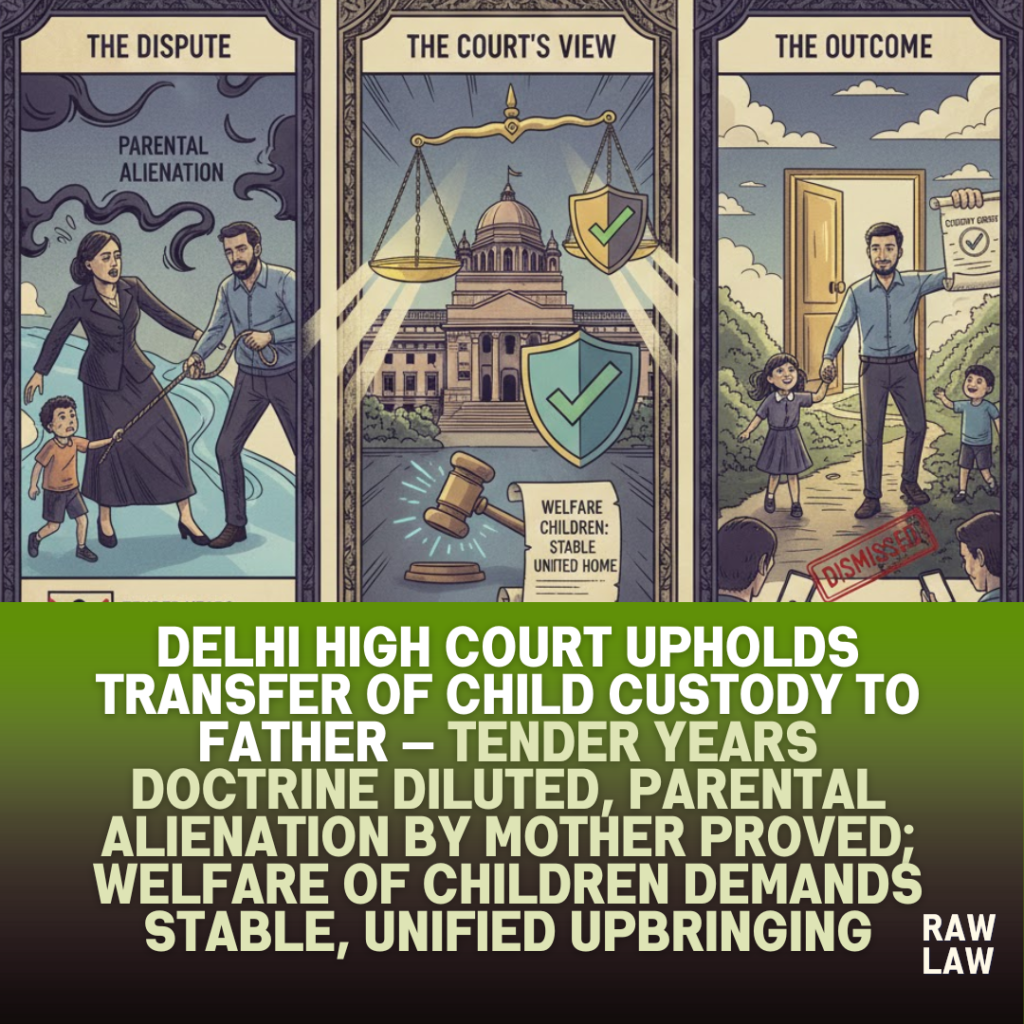
The Delhi High Court dismissed a mother’s matrimonial appeal and upheld the Family Court’s decision granting sole custody of two minor children to the father, holding that sustained parental alienation, repeated relocation of children, and abuse of legal process by the mother outweighed claims based on the tender years doctrine and higher earning capacity. The Court emphatically ruled that child custody must be decided on the touchstone of welfare and best interests, not stereotypical presumptions — “tender years doctrine is no longer apposite in modern custody adjudication”; appeal dismissed, custody with father affirmed.
Court’s decision
A Division Bench of Justice Anil Kshetarpal and Justice Harish Vaidyanathan Shankar disposed of a matrimonial appeal and a connected contempt petition by a common judgment dated 23 January 2026. The Court affirmed the Family Court’s judgment dated 1 July 2024 directing that custody of the two minor children be handed over to the father, while also taking note of the mother’s non-compliance with interim access and communication directions. The High Court declined to interfere with the detailed custody arrangement framed by the Family Court.
Facts
The parties were married in September 2011 and have two children, a son born in 2013 and a daughter born in 2019. The family resided together in West Bengal until September 2018. The father alleged that the mother abruptly left the matrimonial home and later removed the minor son without any court order. The mother, on the other hand, alleged domestic violence and cruelty, leading to criminal and civil proceedings between the parties.
Multiple litigations followed, including guardianship proceedings under the Guardians and Wards Act, criminal cases under the Penal Code and the Domestic Violence Act, and maintenance proceedings. The guardianship case was ultimately transferred to the Family Court at Patiala House, New Delhi, by the Supreme Court. During the pendency of proceedings, the mother relocated with the children across several cities and later moved to the United Kingdom for employment, while the children remained in India with maternal grandparents.
By judgment dated 1 July 2024, the Family Court granted sole custody of both children to the father, recording findings of sustained parental alienation by the mother and adverse impact on the children’s welfare. Aggrieved, the mother preferred the present appeal.
Issues
The core issues before the High Court were whether the Family Court erred in transferring custody of both minor children to the father, whether the tender years doctrine and the mother’s role as primary caregiver should have prevailed, and whether allegations raised by the mother — including late-stage accusations of sexual impropriety — warranted interference with the custody order. The Court also examined whether the welfare and best interests of the children justified appellate intervention.
Appellant’s arguments
The mother contended that the Family Court failed to accord primacy to the welfare of the children and ignored that she had been their consistent primary caregiver since separation. She argued that continuity, emotional bonding, and stability demanded that custody remain with her, particularly given the tender age of the younger child. Heavy reliance was placed on the tender years doctrine and the expressed reluctance of the son to interact with the father.
It was further argued that the mother was financially far better placed to provide for the children’s educational and developmental needs, and that the father’s limited income militated against granting him custody. The mother also alleged that the Family Court overlooked disclosures by the son suggesting sexually inappropriate behaviour by the father and wrongly treated her professional advancement as a negative factor.
Respondent’s arguments
The father supported the impugned judgment, submitting that it was based on a comprehensive appreciation of pleadings, evidence, counselling reports and the conduct of parties over several years. He argued that the mother had deliberately alienated the children from him since 2018, obstructed access despite court orders, and repeatedly relocated the children across jurisdictions without permission, depriving them of stability.
The father contended that serious allegations of sexual abuse were raised belatedly, without pleadings or particulars, and only after custody proceedings progressed against the mother. He also highlighted that several criminal proceedings initiated by the mother had ended in acquittal or quashing, reinforcing findings of abuse of process.
Analysis of the law
The Court reiterated that in custody matters, the paramount consideration is the welfare and best interests of the child, transcending statutory rights, financial superiority, or gender-based presumptions. The Bench expressly questioned the continued relevance of the tender years doctrine, noting that it originated in a bygone era of rigid parental roles and cannot override contemporary, child-centric welfare analysis.
The Court underscored that financial capacity, though relevant, is never decisive, and that custody determinations must evaluate emotional security, psychological stability, continuity, moral development and the child’s right to the love and guidance of both parents.
Precedent analysis
Relying on Supreme Court jurisprudence including decisions emphasising child welfare over parental entitlement, the Court held that a child’s stated preference cannot be treated as determinative where it appears to be the product of sustained parental alienation. The Court also drew upon precedent cautioning against misuse of grave allegations in custody disputes and reiterated that appellate courts should not reopen comprehensive custody adjudications absent compelling reasons.
Court’s reasoning
The High Court found no infirmity in the Family Court’s conclusion that the mother’s conduct reflected sustained and deliberate parental alienation. The Court noted repeated relocations of the children across multiple states, systematic obstruction of access, and the mother’s eventual relocation abroad while leaving the children with grandparents.
The Court was particularly critical of the belated allegations of sexual abuse, observing that such claims were not pleaded earlier despite alleged knowledge years prior, and surfaced only at the stage of evidence. This, the Court held, seriously undermined their credibility.
The Bench also rejected the argument that being a primary caregiver through exclusion could justify custody, cautioning that allowing such reasoning would incentivise unilateral removal and alienation. Emphasising the importance of sibling unity, stability, and reintegration of the father into the children’s lives, the Court held that the father was presently better placed to provide a balanced and inclusive upbringing.
Conclusion
The Delhi High Court dismissed the matrimonial appeal, upheld the Family Court’s custody order in favour of the father, and reinforced the structured visitation and interaction rights granted to the mother. The Court clarified that custody does not diminish the mother’s parental role and emphasised her continuing obligation to contribute meaningfully to the children’s welfare.
Implications
This judgment marks a significant reaffirmation of child-centric custody jurisprudence. By expressly diluting the tender years doctrine and condemning parental alienation, the Delhi High Court has signalled that modern custody decisions will prioritise stability, emotional health and balanced parenting over traditional presumptions. The ruling also serves as a caution against tactical misuse of criminal allegations in custody battles and underscores the judiciary’s intolerance for conduct that weaponises children in matrimonial disputes.
Case law references
- Welfare of the child principle: Welfare overrides parental rights and financial superiority; applied to affirm custody with father.
- Tender years doctrine: Held to be outdated and non-determinative; expressly diluted.
- Parental alienation jurisprudence: Sustained alienation disentitles a parent from custody; relied upon.
- Child’s preference: Relevant but not decisive where influenced by alienation; applied to reject veto claim.
FAQs
1. Is the tender years doctrine still decisive in child custody cases?
No. Courts now prioritise the best interests and welfare of the child over age-based or gender-based presumptions.
2. Can parental alienation affect custody decisions?
Yes. Sustained alienation from one parent can strongly weigh against the alienating parent.
3. Do higher earnings guarantee custody?
No. Financial capacity alone is never determinative; emotional stability and holistic welfare prevail.


