Delhivery Claims ₹51.48 Crore ESOP Deduction and Uses Chartered Accountant Valuation; Delhi High Court Rejects Revenue’s Disallowance, Says Later Merchant-Banker Rule Cannot Apply

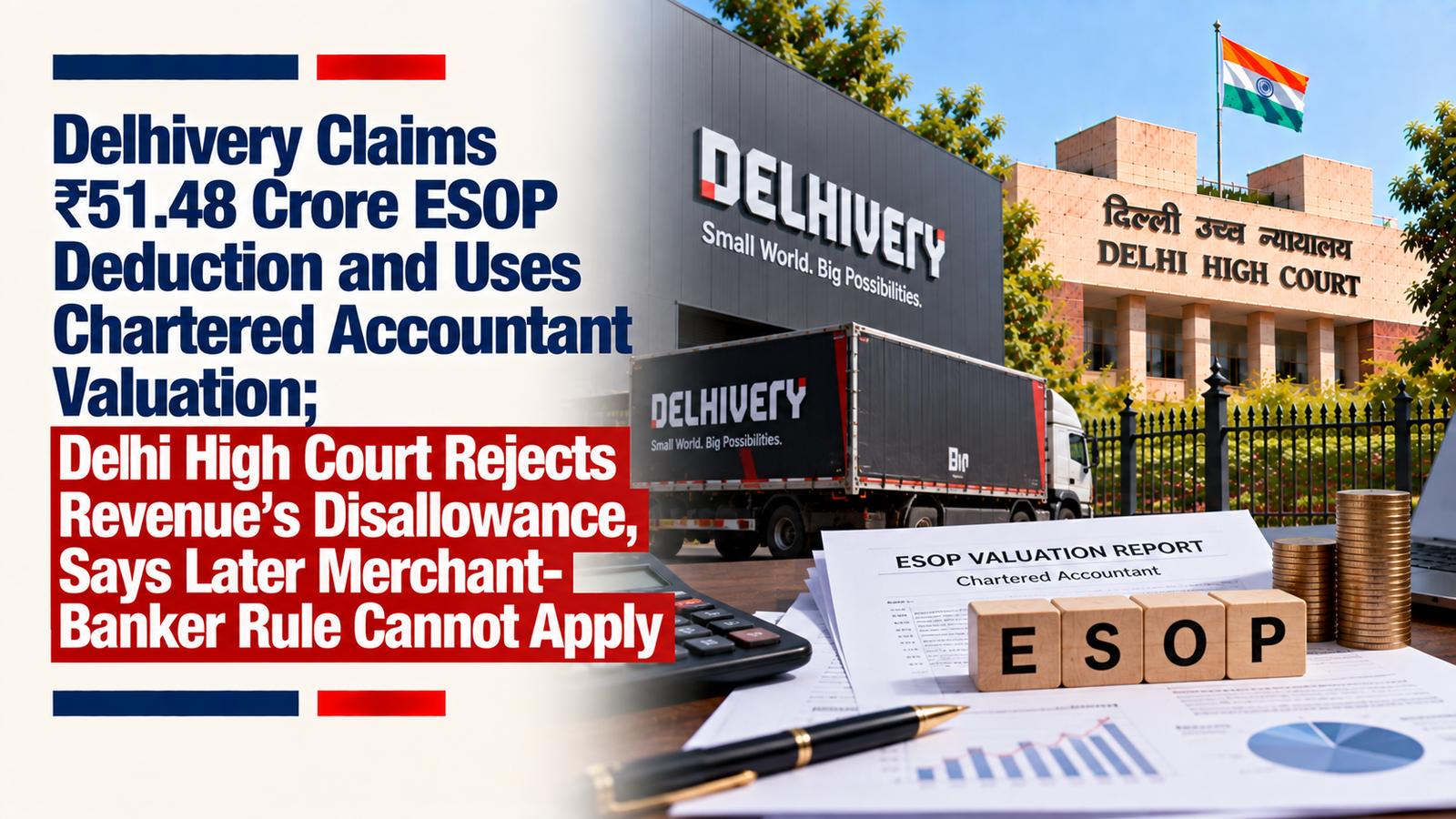
Income Tax Department Challenges Delhivery’s ₹51.48 Crore ESOP Deduction; Delhi High Court Finds Issue Already Settled in Assessee’s Favour
Facts
The Principal Commissioner of Income Tax (Central)-2 challenged relief granted to M/s Delhivery Pvt. Ltd. by the appellate tax authorities. The Delhi High Court had admitted the Revenue’s appeal on two questions of law.
The first concerned whether Delhivery was entitled to deduction of ₹51,48,28,498 towards Employee Stock Option Scheme (ESOP) expenditure.
The second concerned an addition of ₹62,72,719 under Section 56(2)(viib) of the Income Tax Act, 1961, arising from the valuation methodology/report relied upon by the assessee.
The Assessing Officer had objected to the valuation because it had been undertaken by a Chartered Accountant, whereas according to the AO, the valuation ought to have been performed by a Merchant Banker pursuant to CBDT Notification No. 23/2018 dated 24 May 2018.
Appellant – Revenue’s Case
The Revenue sought restoration of the disallowance of the ₹51.48 crore ESOP expenditure and the ₹62.72 lakh addition under Section 56(2)(viib).
On the ESOP issue, however, counsel for the Revenue was unable to dispute that the legal position was already covered by the Delhi High Court’s earlier decision in Commissioner of Income Tax v. Lemon Tree Hotels Ltd.
On valuation, the Assessing Officer’s reasoning was that after the CBDT’s 24 May 2018 notification, valuation by a Chartered Accountant was no longer sufficient and a Merchant Banker’s valuation was required.
Respondent – Delhivery’s Arguments
Delhivery relied principally on Commissioner of Income Tax v. Lemon Tree Hotels Ltd., where the Delhi High Court had already approved the treatment of ESOP cost as expenditure capable of being debited to the profit and loss account.
Regarding Section 56(2)(viib), the assessee’s case was effectively that the relevant Assessment Year was 2018-19, corresponding to Financial Year 2017-18, whereas the CBDT change relied upon by the AO was introduced only on 24 May 2018, i.e. subsequently.
Analysis of the Law
1. ESOP Cost Is an Allowable Deduction
The Court found the first issue directly covered by its earlier judgment in CIT v. Lemon Tree Hotels Ltd.
In that decision, the Delhi High Court had affirmed the ITAT’s view allowing the cost of Employee Stock Options to be debited to the assessee’s profit and loss account.
The Court noted that Lemon Tree Hotels had itself referred to the Madras High Court decision in CIT-III Chennai v. PVP Ventures Ltd., which had similarly answered the ESOP expenditure issue in favour of the assessee.
Since the Revenue could not dispute this settled position, the Court answered the first question in favour of Delhivery.
Thus, the ₹51.48 crore ESOP disallowance could not be sustained.
2. Merchant-Banker Requirement Was Introduced Subsequently
The second issue turned substantially on chronology.
The relevant period was:
Assessment Year: 2018-19
Financial Year: 2017-18
CBDT Notification: 24 May 2018
The Assessing Officer had rejected Delhivery’s valuation because it had been carried out by a Chartered Accountant rather than a Merchant Banker.
However, the High Court found that the CBDT had done away with Chartered Accountant certification only from the subsequent financial year, through the notification issued on 24 May 2018.
Therefore, the later requirement could not be used to invalidate the Chartered Accountant valuation applicable to the preceding Financial Year 2017-18.
3. Assessing Officer Was Not Justified in Discarding CA Valuation
The Court expressly held that because the relevant assessment concerned FY 2017-18:
“the AO was not justified in discarding the valuation report given by or the valuation done by the CA.”
Accordingly, the Commissioner of Income Tax (Appeals) and the ITAT had correctly interfered with the addition.
This resulted in the second question also being answered against the Revenue and in favour of Delhivery.
Precedent Analysis
Commissioner of Income Tax v. Lemon Tree Hotels Ltd.
This was the controlling precedent on the ESOP issue.
The Delhi High Court had previously upheld the ITAT’s deletion of a disallowance relating to ESOP expenditure and accepted that the cost of ESOPs could be debited to the profit and loss account.
The present Bench followed that ruling directly.
CIT-III Chennai v. PVP Ventures Ltd.
The Madras High Court had similarly held that the cost of ESOP could be debited to the profit and loss account. This precedent had also been considered in Lemon Tree Hotels.
CIT v. Oswal Agro Mills Ltd.
The Lemon Tree Hotels judgment had additionally referred to Oswal Agro Mills, where expenditure incurred in connection with issuance of debentures or obtaining loans was treated as revenue expenditure.
Court’s Reasoning
The appeal involved two relatively discrete issues, and both failed against the Revenue.
For the ₹51.48 crore ESOP expenditure, binding Delhi High Court precedent had already settled the issue in favour of the assessee, and Revenue’s counsel could not dispute that position.
For the ₹62.72 lakh Section 56(2)(viib) addition, the Assessing Officer had effectively relied upon a valuation requirement introduced only after the financial year under assessment.
The Court therefore found no infirmity in the orders of the CIT(A) and ITAT granting relief to Delhivery.
Conclusion
The Delhi High Court rejected the Income Tax Department’s appeal in toto.
It held that:
- the ₹51,48,28,498 ESOP expenditure could not be disallowed in view of the binding precedent in Lemon Tree Hotels; and
- the ₹62,72,719 addition under Section 56(2)(viib) could not be sustained merely because the valuation had been undertaken by a Chartered Accountant, since the CBDT’s Merchant-Banker requirement was introduced only subsequently.
Both questions were therefore answered against the Revenue and in favour of Delhivery.
Case Details
Case: Principal Commissioner of Income Tax (Central)-2 v. M/s Delhivery Pvt. Ltd.
Court: Delhi High Court
Case No.: ITA 479/2024
CNR: DLHC010577692024
Coram: Justice Dinesh Mehta and Justice Rajneesh Kumar Gupta
Date of Decision: 17 September 2026
Result: Revenue’s appeal rejected in toto; both tax questions decided in favour of Delhivery.