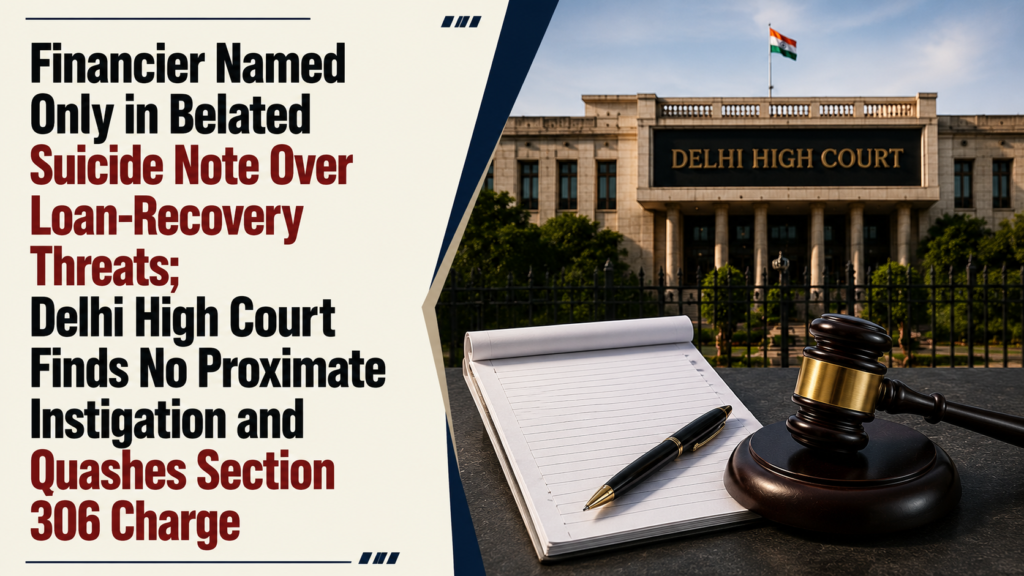
Financier Named Only in Belated Suicide Note Over Loan-Recovery Threats; Delhi High Court Finds No Proximate Instigation and Quashes Section 306 Charge

Man Found Dead in Water Plant After Vehicle and Land Dispute; Delhi High Court Says Vague Threat Allegations Do Not Establish Abetment of Suicide
Facts
- On 12 July 2011, the complainant’s father was found dead, with his body floating inside the Haiderpur Water Treatment Plant.
- The post-mortem report was stated to be inconclusive regarding the cause of death and recorded certain injuries on the body.
- On 1 September 2011, the deceased’s son filed an application under Section 156(3) CrPC alleging that his father had committed suicide because several known and unknown persons were harassing him for recovery of money lent to him.
- Gulshan Kumar was not named in:
- The Section 156(3) application;
- The FIR registered on 15 November 2011; or
- The original charge sheet filed on 26 April 2016.
- During the investigation, a suicide note was reportedly received by the reader at K.N. Katju Marg Police Station.
- The suicide note alleged that Gulshan Kumar and Kashmiri Lal had financed a vehicle for the deceased.
- According to the note:
- They took possession of the vehicle while demanding repayment;
- The vehicle was returned only after the deceased was forced to transfer a portion of land to one Acche Lal for ₹5 lakh;
- When the deceased sought the land-sale amount after two months, no money was given to him;
- Gulshan Kumar and Kashmiri Lal instead demanded repayment of their original loan; and
- They threatened to sell the vehicle to recover their money.
- A Forensic Science Laboratory report dated 4 May 2016 verified the deceased’s signatures on the suicide note. The truth of its contents was not scientifically verified.
- A supplementary charge sheet was filed on 2 December 2018. Gulshan Kumar was mentioned in Column 12 only as a “suspect”.
- By order dated 11 September 2024, the Additional Sessions Judge framed charges against Gulshan Kumar and Kashmiri Lal under Sections 306/34 IPC.
- By the same order, the Trial Court discharged the other persons named in the proceedings, including Arun Kumar.
- The deceased’s wife had allegedly made a complaint against Arun Kumar approximately one week before the death, accusing him of molestation and harassment.
- Gulshan Kumar challenged the framing of charges before the Delhi High Court under Section 397 CrPC.
Issues
- Whether the allegations in the suicide note disclosed the essential ingredients of abetment under Section 107 IPC.
- Whether there was any specific, direct or indirect act by Gulshan Kumar amounting to instigation, conspiracy or intentional aid.
- Whether the alleged threats were sufficiently proximate to the suicide.
- Whether the material disclosed a positive mental process and mens rea to provoke or encourage the deceased to end his life.
- Whether verification of the deceased’s signature on the suicide note was sufficient to justify framing a charge under Section 306 IPC.
- Whether a person not named in the initial complaint, FIR or original charge sheet could be put on trial solely on the basis of vague allegations in a subsequently recovered suicide note.
- Whether the Trial Court could frame charges merely because the allegations required further examination, even when the statutory ingredients were absent.
- Whether the High Court could interfere with the charge order in exercise of revisional jurisdiction.
Petitioner’s Arguments
- Gulshan Kumar was not named in the complainant’s Section 156(3) application or the FIR.
- No complaint had ever been made against him by the deceased or any member of the deceased’s family before the death.
- He was not named in the original charge sheet and appeared only in the supplementary charge sheet filed more than seven years after the death.
- Even in the supplementary charge sheet, he was shown only as a “suspect” in Column 12 and not as an accused.
- The suicide note was recovered under suspicious circumstances much after recovery of the body.
- Although the FSL report verified the deceased’s signature, it could not establish the truth of the allegations contained in the note.
- The post-mortem report did not conclusively establish the cause of death and recorded other injuries on the body.
- The suicide note contained only vague allegations concerning a financial dispute.
- There was no specific act showing that Gulshan Kumar intended, encouraged or compelled the deceased to commit suicide.
- The alleged land transfer was known to the complainant, who was supposedly a witness, yet neither he nor the deceased filed any complaint concerning it.
- The alleged threats were approximately two months before the death and lacked the necessary proximity.
- The allegations did not disclose any active role, positive act or mens rea necessary under Sections 107 and 306 IPC.
Respondents’ Arguments
- The State and complainant supported the Trial Court’s order framing charges.
- The deceased’s signatures on the suicide note had been confirmed by the FSL.
- The petitioner could challenge the authenticity and evidentiary value of the note during trial, but not at the stage of framing charges.
- The suicide note specifically referred to Gulshan Kumar and Kashmiri Lal.
- It alleged that they:
- Used force to secure transfer of the deceased’s land;
- Failed to pay him the sale amount;
- Continued demanding repayment of the vehicle loan; and
- Threatened to sell the vehicle.
- These allegations prima facie disclosed pressure and threats sufficient to require a trial under Sections 306/34 IPC.
- At the charge stage, the Court was not required to evaluate the evidence as if conducting a full trial.
Analysis of the Law
Abetment under Section 107 IPC
A person abets an act if he:
- Instigates another person to do it;
- Engages in a conspiracy for doing it, followed by an act or illegal omission; or
- Intentionally aids the act through an act or illegal omission.
For Section 306 IPC, the prosecution must therefore show a legally recognised form of abetment.
Requirements of Section 306 IPC
- The accused must play an active role in the commission of suicide.
- There must be material showing:
- Instigation;
- Intentional aid;
- Participation in a conspiracy; or
- Conduct directly resulting in the suicide.
- Mere harassment, financial pressure or general allegations are insufficient without a specific act and clear mens rea.
- Instigation requires a positive mental process involving intentional:
- Provocation;
- Incitement;
- Goading;
- Urging;
- Encouragement; or
- Forwarding of the suicidal act.
- The act or omission must ordinarily be proximate to the suicide and of such gravity that it leaves the deceased with no reasonable alternative.
Mens rea
- Section 306 requires an intention that the deceased should commit suicide or knowledge of circumstances demonstrating deliberate incitement.
- The fact that an accused was involved in a financial or property dispute with the deceased does not automatically establish such intention.
- The Court must identify the specific conduct from which the necessary mental element can reasonably be inferred.
Standard at the stage of framing charges
- A court should not conduct a mini-trial or determine the final truth of the prosecution’s evidence at the charge stage.
- However, it may sift the material to determine whether the statutory ingredients are disclosed.
- If the prosecution’s own material does not establish the basic ingredients of the offence, the Court is not obligated to frame charges.
- A person should not be put through a criminal trial merely because allegations exist or because the Court wishes to “play safe”.
Precedent Analysis
- Mahendra Awase v. State of Madhya Pradesh, (2025) 4 SCC 801
- Mere allegations without a specific direct or indirect act and clear mens rea are insufficient for Section 306 IPC.
- Courts should not frame an abetment-of-suicide charge casually or merely as a precaution.
- The material must be tested against the statutory threshold before subjecting a person to trial.
- This precedent directly supported Gulshan Kumar’s discharge.
- Gangula Mohan Reddy v. State of Andhra Pradesh, (2010) 1 SCC 750
- Instigation requires a positive mental process involving intentional provocation, incitement or encouragement.
- Ordinary harassment or a strained relationship does not automatically amount to abetment.
- The suicide note did not disclose any such intentional mental process on Gulshan Kumar’s part.
- S.S. Chheena v. Vijay Kumar Mahajan, (2010) 12 SCC 190
- It is neither just nor fair to put a person through a criminal trial for abetment of suicide without credible material establishing the offence.
- There must be a clear link between the accused’s conduct and the suicide.
- The High Court found that such a link was absent.
- Sanju alias Sanjay Singh Sengar v. State of Madhya Pradesh, (2002) 5 SCC 371
- Words, threats or quarrels must be examined in their context and proximity to the suicide.
- A remote statement or dispute, without the necessary intention and causal connection, does not amount to abetment.
- The alleged threats in the present case were not shown to have directly triggered the death.
- Amalendu Pal v. State of West Bengal, (2010) 1 SCC 707
- The accused’s act or omission must be proximate to the suicide and must leave the deceased with no other option but to take his own life.
- A general course of harassment, without a direct and proximate act, does not satisfy Section 306.
- The alleged financial dispute from two months earlier failed this test.
- Prabhu v. State, Supreme Court order dated 30 January 2024 in SLP (Criminal) No. 39981 of 2022
- Liability for abetment requires an active role in the deceased’s suicide through instigation, conspiracy or intentional aid.
- The accused’s conduct must have a direct relationship with the suicidal act.
- No comparable active role was identified against Gulshan Kumar.
- State of Rajasthan v. Ashok Kumar Kashyap, (2021) 11 SCC 191
- At the charge stage, the Court does not weigh evidence as it would after trial.
- However, it may sift the record sufficiently to determine whether the ingredients of the alleged offence are disclosed.
- The High Court applied this limited scrutiny without determining the final authenticity of the suicide note.
- P. Vijayan v. State of Kerala, (2010) 2 SCC 398
- A court deciding whether to frame charges can examine whether the material creates the required level of suspicion.
- The Court need not accept every allegation at face value where the legal ingredients are missing.
- Suspicion concerning a financial dispute did not become grave suspicion of intentional abetment.
- Shashikant Sharma v. State of Uttar Pradesh, 2023 SCC OnLine SC 1599
- Where the prosecution material does not disclose the ingredients of an offence, the Court is not required to frame a charge.
- The absence of instigation, mens rea and proximity justified discharge in the present case.
- Suresh alias Pappu Bhudharmal Kalani v. State of Maharashtra, (1998) 7 SCC 337
- Framing of charges requires material capable of creating grave suspicion concerning the accused’s involvement.
- Mere suspicion or conjecture is insufficient.
- The suicide note’s vague allegations did not satisfy this threshold.
Court’s Reasoning
- Gulshan Kumar was absent from every initial version of the case:
- He was not named in the Section 156(3) application;
- He was not named in the FIR;
- No prior complaint existed against him; and
- He did not figure in the original charge sheet.
- The only material against him was the suicide note received by the police after recovery of the body.
- In the supplementary charge sheet, he was listed only as a suspect.
- The FSL report established that the signature on the note belonged to the deceased. It did not establish that every allegation in the note was true.
- The Trial Court stated that Gulshan Kumar had played a positive role and had left the deceased with no option but suicide.
- However, it failed to identify:
- Any particular act of instigation;
- Any intentional aid;
- Any conspiracy;
- Any conduct immediately preceding the suicide;
- Any encouragement to end life; or
- Any mens rea that the deceased should commit suicide.
- The alleged financial threats were approximately two months before the incident.
- Neither the deceased nor his family filed a complaint or pursued any legal remedy concerning those alleged threats.
- There was no material showing that the deceased had communicated suicidal thoughts to Gulshan Kumar or that the petitioner knew of any such vulnerability.
- The Trial Court’s conclusion that the deceased had “no other option” but to commit suicide was therefore far-fetched.
- The inconsistency in the Trial Court’s treatment of the accused was also significant:
- Arun Kumar was named as an accused in the supplementary charge sheet;
- The deceased’s wife had filed a complaint against him one week before the incident; yet
- He was discharged for lack of mens rea.
- In contrast, Gulshan Kumar, who was named only later as a suspect and faced no previous complaint, was charged under Section 306.
- Even without undertaking a mini-trial, the material did not create the grave suspicion necessary for an abetment-of-suicide charge.
Conclusion
The Delhi High Court held that vague allegations of financial pressure or loan-recovery threats, without a specific and proximate act of instigation and the necessary mens rea, cannot support a charge for abetment of suicide.
Although the deceased’s signature on the suicide note was verified, the note did not disclose any active role, intentional aid or direct incitement by Gulshan Kumar that caused the suicide.
The Court accordingly:
- Allowed the revision petition;
- Set aside the order dated 11 September 2024 framing charges;
- Discharged Gulshan Kumar from the offences under Sections 306/34 IPC; and
- Disposed of the petition in those terms.
Case Details
Case: Gulshan Kumar v. State (Government of NCT of Delhi)
Court: High Court of Delhi at New Delhi
Case Number: Criminal Revision Petition No. 1268 of 2024 with Criminal M.A. No. 33349 of 2024
FIR: FIR No. 463 of 2011 dated 15 November 2011, Police Station K.N. Katju Marg
Judge: Justice Saurabh Banerjee
Reserved on: 10 July 2026
Pronounced on: 22 July 2026
Result: Revision allowed; charge under Sections 306/34 IPC set aside; petitioner discharged.