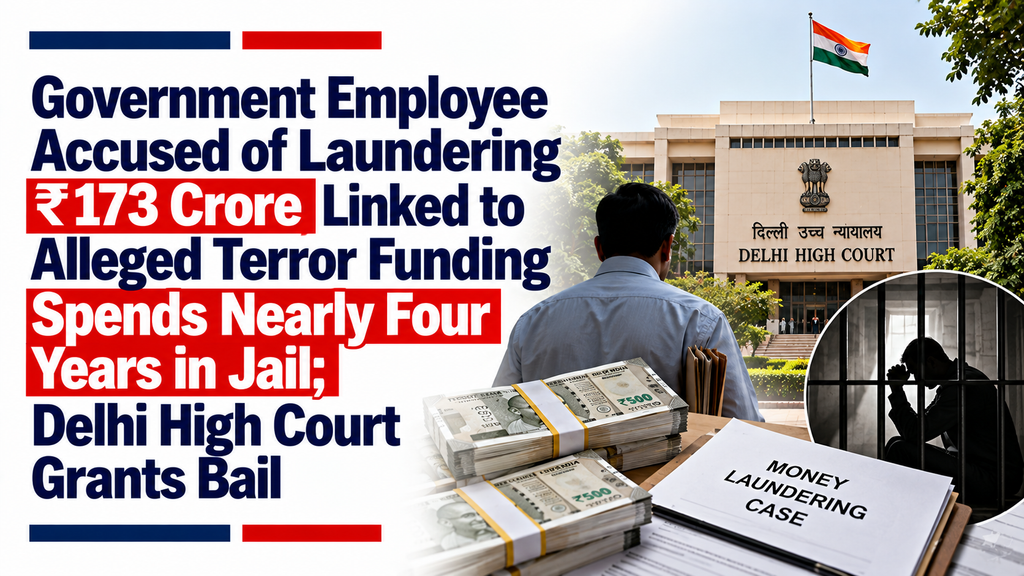
Government Employee Accused of Laundering ₹173 Crore Linked to Alleged Terror Funding Spends Nearly Four Years in Jail; Delhi High Court Grants Bail

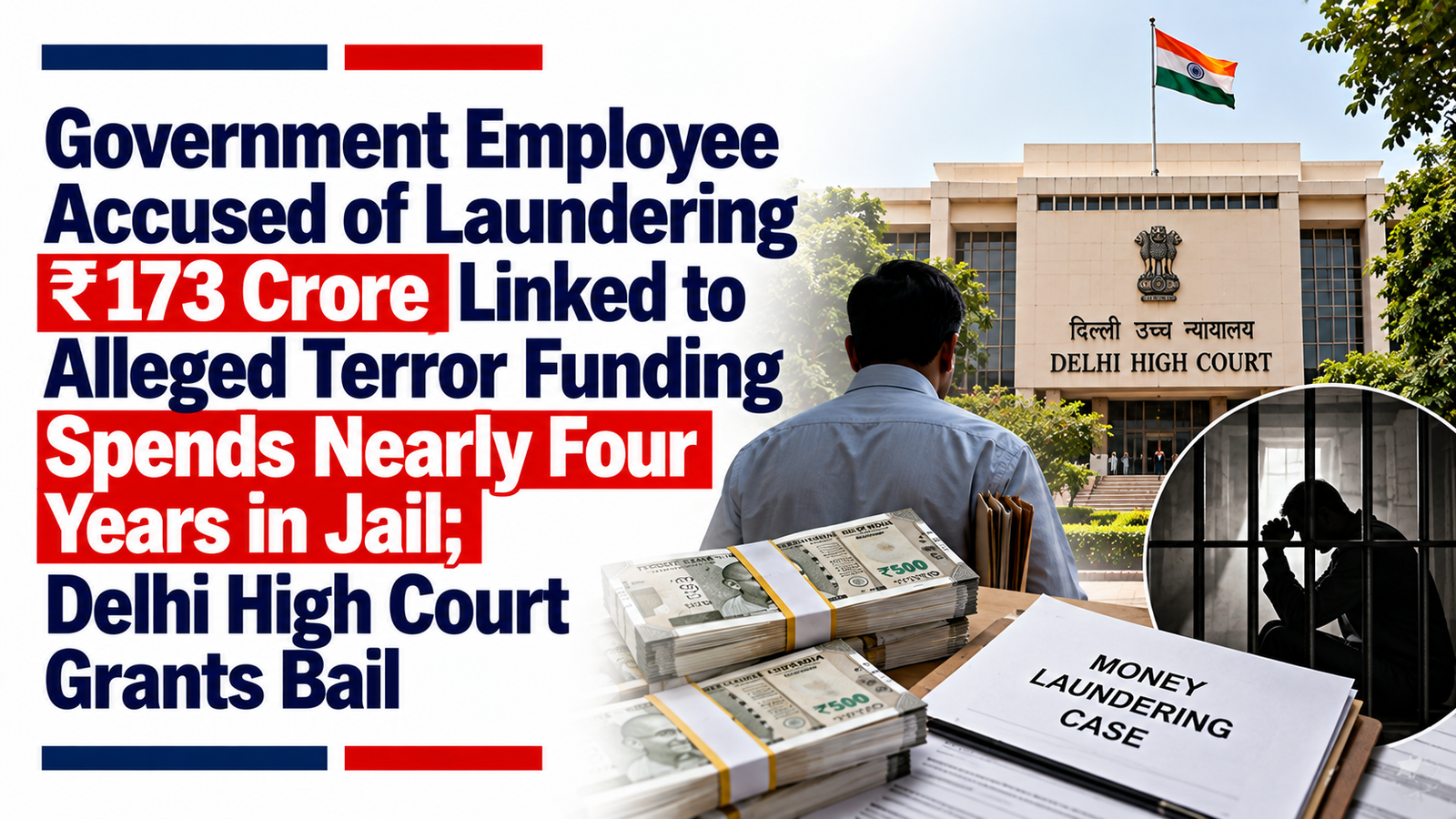
Money Passed Through Accused’s Bank Account but Was It Knowing Laundering? Delhi High Court Grants Bail After Nearly Four Years in Custody
Facts
The applicant, Masasasong Ao, sought regular bail in a prosecution arising from an Enforcement Directorate ECIR for offences under Sections 3 and 4 of the Prevention of Money Laundering Act, 2002 (PMLA). His earlier bail application had been rejected by the Special Judge on 16 March 2026.
The predicate proceedings originated from a 2019 FIR after co-accused Alemla Jamir was intercepted at Delhi Airport carrying ₹72 lakh in cash. The prosecution alleged that the money was intended for NSCN(IM) and represented funds raised through extortion and illegal taxation. The NIA subsequently took over the investigation and invoked various IPC and UAPA offences.
On the basis of the scheduled offences, ED registered the ECIR and arrested the applicant on 18 October 2022, while he was already in custody in the NIA proceedings.
ED alleged that approximately ₹173.24 crore was deposited and routed through 59 bank accounts belonging to Alemla Jamir, her relatives and associated entities, including inter-account transactions, for allegedly projecting the funds as untainted.
Allegations Against the Applicant
ED’s case was not confined to the fact that accounts standing in the applicant’s name were allegedly used.
According to ED:
- approximately ₹4.20 crore was paid over three years into accounts of A.J. Agency and the applicant in connection with uninterrupted vehicle movement;
- substantial amounts were advanced as loans from his account;
- ₹70 lakh was transferred from his Axis Bank account to A.J. Agency;
- after Alemla Jamir’s arrest, he withdrew ₹54.71 lakh on 2 January 2020 and another ₹57 lakh on 4 January 2020;
- he received ₹2.5 lakh from Eastern Motors; and
- P. Impty allegedly stated that the applicant instructed him to deposit ₹1.18 crore into specified accounts.
The applicant maintained that several accounts standing in his or his wife’s name were actually controlled by Alemla Jamir, a close relative, and that signed cheque books had been handed over to her.
Applicant’s Arguments
The applicant argued that ED had exaggerated his role.
He contended that movement of money through accounts bearing his name did not establish that he knew the funds represented proceeds of crime or that he consciously participated in money laundering.
He emphasised that he was a serving government employee; the investigation was complete; the prosecution complaint and supplementary complaint had already been filed; and the financial records were already in the investigating agencies’ possession.
Most importantly, he had remained incarcerated since 18 October 2022, crossing one-half of the maximum sentence prescribed for the PMLA offence, while the trial was progressing slowly.
ED’s Arguments
ED argued that this was not a case of a passive account holder.
The applicant himself had allegedly made substantial withdrawals and deposits after Alemla Jamir’s arrest and had directed movement of ₹1.18 crore. These circumstances, according to ED, demonstrated active and knowing participation in handling proceeds of crime.
ED further argued that he failed to satisfy the stringent twin conditions under Section 45 PMLA, that the predicate offences concerned serious allegations of extortion and terror funding, and that completion of half the maximum sentence did not create an automatic right to bail.
Analysis of the Law
1. Section 45 Twin Conditions Remain Mandatory
The Delhi High Court began by recognising that the twin conditions under Section 45 PMLA remain mandatory.
However, at the bail stage the court is not required to conduct a mini-trial or meticulously determine whether the accused is innocent. The inquiry is based upon broad probabilities and whether reasonable grounds exist for believing that the accused is not guilty.
2. Money Passing Through an Account Is Not, By Itself, Money Laundering
One of the judgment’s important observations is that the offence under Section 3 PMLA is not established merely because allegedly tainted money has passed through an account standing in the accused’s name.
The prosecution must establish the accused’s direct or indirect involvement in a process or activity connected with proceeds of crime.
Here, ED undoubtedly had material against the applicant. But whether he knew the criminal source of the funds and consciously participated in laundering was not self-evident merely from the movement of money and required testing at trial.
3. Court Found Second Section 45 Condition Satisfied
The second limb concerns whether the accused is likely to commit an offence while on bail.
The transactions relied upon by ED dated back to 2019–20. The Court held that those transactions, without more, did not establish that after nearly four years in custody the applicant was presently likely to commit another offence.
Apart from the connected NIA proceedings, no other criminal involvement was shown. He was a government employee with permanent residence, satisfactory jail conduct, and the relevant banking records were already secured by the agencies.
The Court therefore found the second Section 45 condition satisfied.
Half of Maximum Sentence and Section 436A CrPC
This became a decisive factor.
The maximum punishment applicable under Section 4 PMLA was seven years. The applicant crossed one-half of that period on 18 April 2026.
By 23 July 2026, he had already undergone three years, nine months and six days in custody and was approaching four years of incarceration.
The Court clarified that Section 436A CrPC does not create an absolute entitlement comparable to default bail merely because half the maximum sentence has been completed.
Nevertheless, it is a beneficial provision founded upon the constitutional right to a speedy trial under Article 21, and once half of the maximum sentence has been undergone while trial remains pending, continued detention requires serious justification.
Importantly, the delay was not attributable to the applicant.
Trial Was Nowhere Near Completion
The prosecution proposed to examine 27 witnesses—18 under the original complaint and nine under the supplementary complaint.
As of July 2026, only five witnesses had been examined. Nothing suggested that the trial was approaching completion.
The High Court held that this is where Section 45’s restrictions must be balanced against Article 21.
Pre-trial incarceration cannot become punitive merely because the statute imposes stringent bail conditions. Where the trial is unlikely to conclude within a reasonable period, constitutional protection of personal liberty remains operative even in PMLA cases.
UAPA Predicate Offence Did Not End the Article 21 Inquiry
The Court expressly recognised the seriousness of the predicate prosecution under the UAPA and the allegations concerning terror funding.
However, it stressed that the UAPA prosecution and PMLA prosecution were distinct. For the PMLA case before it, the maximum punishment remained seven years.
The Court therefore held that seriousness of the allegation cannot be a complete answer to prolonged incarceration and that Article 21 is not eclipsed merely by the nature of the accusation.
Multiple Proceedings Are Relevant, Not an Absolute Bar
The Court also considered Section 479(2) BNSS.
The existence of multiple proceedings is relevant while considering bail, but does not automatically eliminate protection against excessive undertrial detention once the prescribed custody period has been undergone.
Precedent Analysis
The Court relied principally upon:
Union of India v. Kanhaiya Prasad — Section 45 twin conditions are mandatory and cannot be disposed of through a cursory bail order.
Prem Prakash v. Union of India through Directorate of Enforcement — Section 45 does not require a mini-trial; “reasonable grounds for believing” operates on broad probabilities.
Vijay Madanlal Choudhary v. Union of India — Section 436A does not create an absolute right to bail but protects against excessive undertrial detention.
Ajay Ajit Peter Kerkar v. Directorate of Enforcement — the Supreme Court granted bail to a PMLA accused who had undergone one-half of the maximum prescribed imprisonment.
Arvind Dham v. Directorate of Enforcement and V. Senthil Balaji v. Enforcement Directorate — prolonged incarceration can justify bail in PMLA cases where the maximum sentence is seven years and trial is unlikely to conclude within a reasonable period.
Court’s Reasoning
The High Court carefully avoided holding that ED’s case was weak or that the applicant was innocent.
It expressly recognised that ED had material requiring trial.
However, several circumstances cumulatively favoured bail:
the evidence was substantially documentary and already secured; investigation against the applicant was complete; there was no material indicating a present likelihood of reoffending; risks of flight or witness interference could be controlled through bail conditions; he had spent nearly four years in custody against a seven-year maximum sentence; he had crossed the statutory halfway mark; and the trial still had substantial ground to cover.
The Court crystallised its reasoning in a significant observation:
Continued detention until an uncertain end of trial would allow pre-trial custody to assume a punitive character.
It held that Section 45 did not require such a result and Article 21 did not permit it.
Conclusion
The Delhi High Court allowed the bail application and directed Masasasong Ao’s release on a ₹50,000 personal bond with one surety of the same amount, subject to conditions including surrender of passport, restriction on leaving India without permission, cooperation with investigation, regular appearance before the Trial Court and non-interference with witnesses or evidence.
The Court clarified that the order concerned only custody in the PMLA proceedings. If the applicant was required to remain in custody in the predicate NIA proceedings or another case, his release would depend upon orders passed in those proceedings.
Case: Masasasong Ao v. Directorate of Enforcement & Anr.
Court: Delhi High Court
Case No.: Bail Application No. 2564 of 2026
Judge: Justice Sanjeev Narula
Date: 24 September 2026
Result: Regular bail granted in the PMLA case after nearly four years’ incarceration, with the Court holding that prolonged pre-trial detention cannot be allowed to become punitive