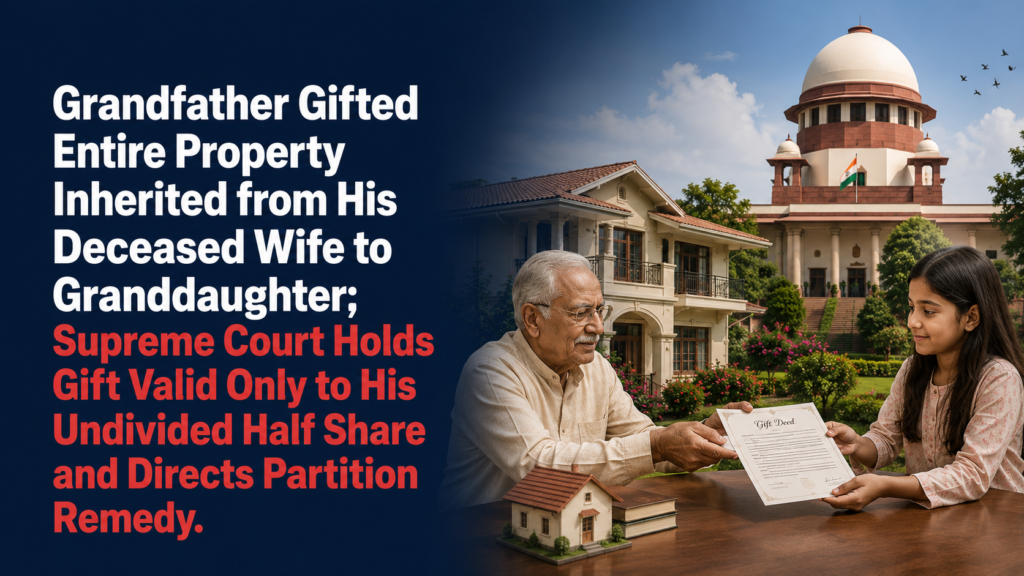
Grandfather Gifted Entire Property Inherited from His Deceased Wife to Granddaughter; Supreme Court Holds Gift Valid Only to His Undivided Half Share and Directs Partition Remedy.

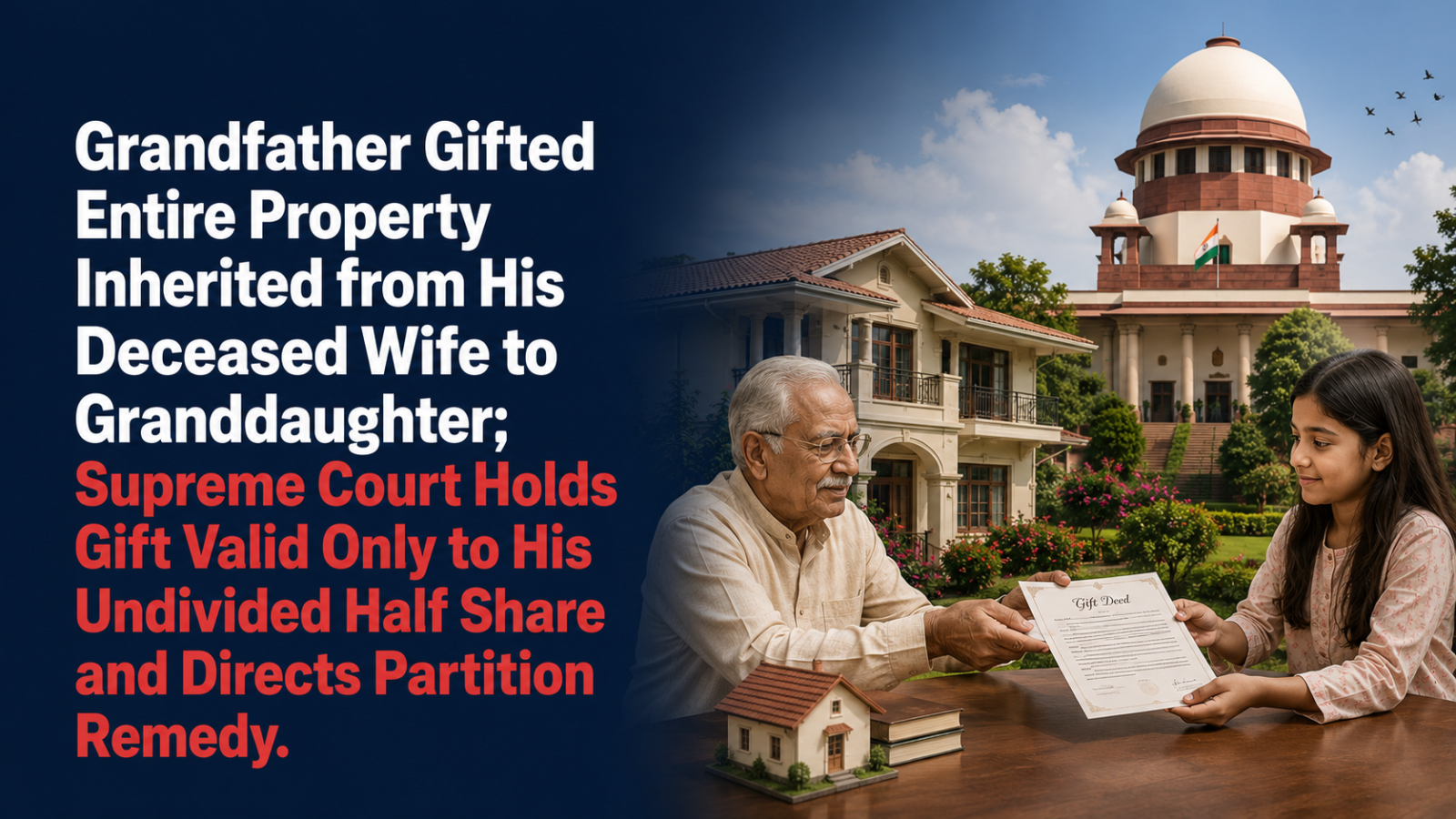
Woman Claimed Entire Property Under Grandfather’s Gift Deed; Supreme Court Holds Donor Could Transfer Only His Half Share and Leaves Partition Open.
Facts
The dispute concerned agricultural land originally owned by Muniyammal. She had acquired the properties through a sale deed and a gift settlement executed by her father in 1949. After her death, her husband, Kuttiyappa Goundar, executed a registered gift settlement deed dated December 13, 1990 in favour of his granddaughter, Maragadham, purporting to transfer the entire extent of the suit properties. Maragadham claimed that possession had also been delivered to her under the gift deed. However, according to her, in 1995 the defendants dispossessed her and inducted another person to cultivate the lands. She therefore instituted a suit seeking declaration of title, recovery of possession and consequential reliefs.
The defendants contested the suit, asserting that Kuttiyappa Goundar was not the exclusive owner of the properties after the death of his wife. They argued that the properties devolved jointly upon Kuttiyappa Goundar and his daughter, Muniammal, under the Hindu Succession Act, 1956. Consequently, they contended that Kuttiyappa Goundar lacked authority to gift the entire property to the plaintiff. The Trial Court decreed the suit in favour of Maragadham, holding that Kuttiyappa Goundar had absolute ownership. However, the First Appellate Court reversed that decision, holding that he owned only an undivided half share. The Madras High Court affirmed the appellate decision, prompting the appeal before the Supreme Court.
Issues
The Supreme Court considered the following issues:
- Whether Kuttiyappa Goundar could validly gift the entire suit property to his granddaughter after inheriting only an undivided half share from his deceased wife.
- Whether the consent of the other co-owner was necessary before gifting an undivided share.
- Whether the plaintiff was entitled to declaration of ownership and recovery of possession over the entire property.
- Whether the Court could grant a lesser relief under Order VII Rule 7 CPC despite the plaintiff having claimed ownership over the entire property.
Appellant’s Arguments
The appellant contended that the registered gift settlement deed executed by Kuttiyappa Goundar validly transferred title over the suit properties. She argued that she had been placed in possession under the gift deed and was illegally dispossessed by the defendants. It was further argued that even if the Court found she was not entitled to ownership of the entire property, the Court should grant an appropriate lesser relief under Order VII Rule 7 CPC, including recognition of her rights in the property.
Respondents’ Arguments
The respondents argued that the suit properties belonged to Muniyammal and, after her death, devolved equally upon her husband and daughter under Section 15 of the Hindu Succession Act, 1956. Since Kuttiyappa Goundar owned only an undivided half share, he could not execute a gift deed covering the entire property. They further disputed the plaintiff’s claim that possession had been delivered under the gift deed and maintained that the gift deed was ineffective insofar as it purported to transfer property beyond the donor’s own share.
Analysis of the Law
The Supreme Court examined the scheme of succession under Section 15(1)(a) of the Hindu Succession Act, 1956. It held that upon the intestate death of Muniyammal, her husband and daughter inherited the property equally. Accordingly, Kuttiyappa Goundar acquired only an undivided half share in the suit properties.
The Court clarified the distinction between coparcenary property and jointly owned property inherited under the Hindu Succession Act. It held that Kuttiyappa Goundar’s undivided half share became his absolute property and did not assume the character of coparcenary property. Consequently, he possessed full authority to transfer or gift his undivided share to any person, including a stranger, without obtaining the consent of the other co-owner.
However, the Court emphasised that ownership of an undivided share does not automatically entitle the donee to exclusive possession of any defined portion of the property. Until partition by metes and bounds, the donee merely steps into the shoes of the donor as a co-owner. Therefore, although the gift deed remained valid with respect to the donor’s half share, it could not confer exclusive ownership or possession over the entire property.
Precedent Analysis
Although the judgment primarily turned on statutory interpretation rather than extensive reliance on precedent, the Court interpreted Section 15(1)(a) of the Hindu Succession Act together with the settled principles governing co-ownership and transfer of undivided interests.
The Court also analysed Order VII Rule 7 CPC and clarified that while courts may grant a lesser relief than what is claimed, they cannot grant an altogether different relief founded on a completely different cause of action. Since the plaintiff had approached the Court claiming absolute ownership over the entire property, the Court could not convert the suit into one for partition. The appropriate remedy would be an independent partition suit.
Court’s Reasoning
The Supreme Court found that both the First Appellate Court and the High Court correctly held that Muniyammal’s property devolved equally upon her husband and daughter. However, both courts committed an error in concluding that Kuttiyappa Goundar required the consent of the other co-owner before gifting his undivided share.
The Court explained that a co-owner has unrestricted rights to transfer his own undivided interest because such property belongs to him absolutely. The requirement of consent would arise only in relation to coparcenary property and not in respect of property inherited individually under the Hindu Succession Act.
Nevertheless, the Court held that the plaintiff’s claim for declaration of ownership over the entire property and recovery of possession could not succeed because the donor himself owned only an undivided half share. Further, the plaintiff failed to establish that possession of the entire property had been delivered under the gift deed. Since no partition had taken place, her right had not crystallised into ownership over any specific portion of the land.
While recognising the validity of the gift deed to the extent of Kuttiyappa Goundar’s undivided half share, the Court held that actual enjoyment of that share could be secured only through separate partition proceedings. The Court therefore granted a declaration only in respect of the donor’s undivided half share and left it open to the plaintiff to institute a partition suit. It requested the jurisdictional court to dispose of such proceedings expeditiously.
Conclusion
The Supreme Court partly allowed the appeal. It held that Kuttiyappa Goundar was legally competent to gift his undivided half share in the suit properties without obtaining the consent of the other co-owner. However, since he could not transfer property beyond his own share and the plaintiff had neither established exclusive possession nor sought partition, she was not entitled to declaration of ownership over the entire property or recovery of possession.
Accordingly, the Court recognised the plaintiff’s title only to the donor’s undivided half share, set aside the contrary findings of the courts below to that extent, and granted liberty to the plaintiff to institute separate partition proceedings for crystallisation of her rights.
Case Details
Case: Maragadham v. Periyaraja & Ors.
Court: Supreme Court of India
Case Number: Civil Appeal No. 12190 of 2025
Judge: Justice Sanjay Kumar and Justice Sanjeev Sachdeva
Date: July 29, 2026
Result: Appeal partly allowed. Gift deed upheld only to the extent of the donor’s undivided half share. Plaintiff granted declaration over that share and liberty to institute partition proceedings; claim over the entire property and possession rejected.