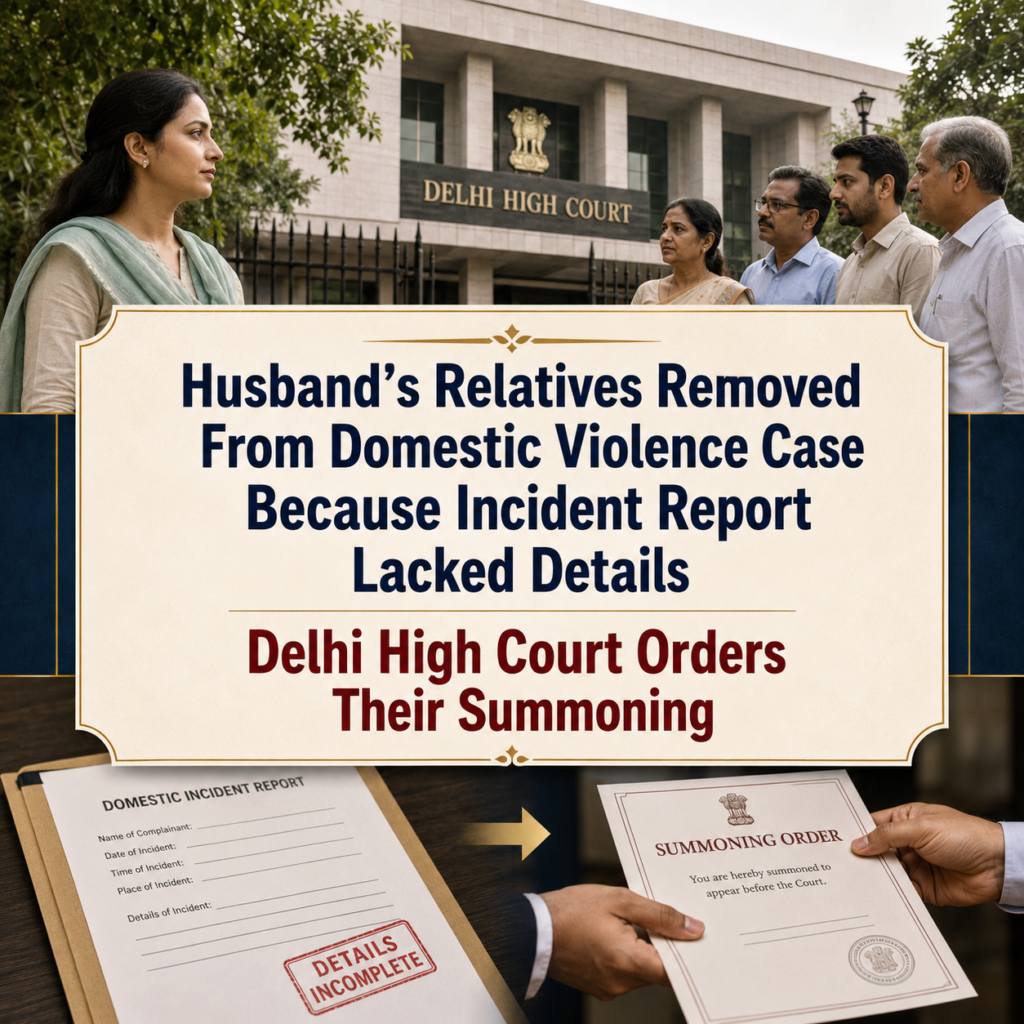
Husband’s Relatives Removed From Domestic Violence Case Because Incident Report Lacked Details; Delhi High Court Orders Their Summoning

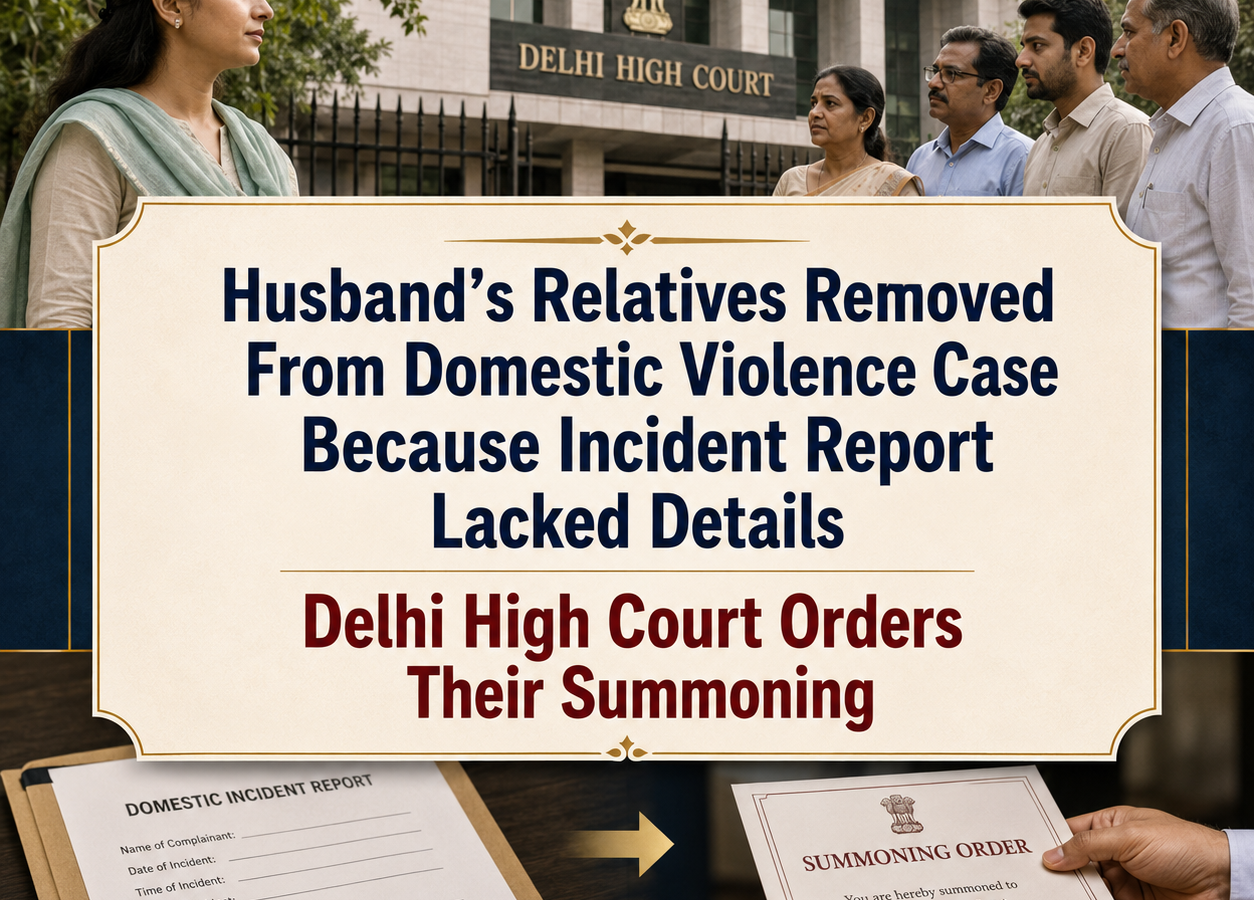
Magistrate Must Examine Entire Domestic Violence Complaint, Not Only Domestic Incident Report, Before Deleting Family Members: Delhi High Court
Facts
Vandana Aggarwal married the third pro forma respondent on 26 December 2016 according to Hindu rites and ceremonies.
With time, the matrimonial relationship deteriorated. Vandana alleged that she was compelled to leave her matrimonial home in December 2019 and thereafter began residing separately.
She filed an application under Section 12 of the Protection of Women from Domestic Violence Act, 2005, seeking reliefs including:
- Protection orders;
- Residence orders; and
- Maintenance.
On 8 April 2021, the Metropolitan Magistrate examined the Domestic Incident Report and issued summons to some respondents.
However, the Magistrate deleted two of the husband’s relatives from the proceedings on the ground that Vandana had not made specific allegations against them in the Domestic Incident Report.
Vandana challenged the deletion before the Sessions Court under Section 29 of the Domestic Violence Act.
On 21 October 2021, the Appellate Court dismissed her appeal. It agreed that there were no specific allegations against the two relatives in the Domestic Incident Report.
The Appellate Court also noted that Vandana had not made earlier allegations concerning dowry until January 2020 and that the domestic violence complaint was filed in July 2020.
Vandana approached the Delhi High Court under Article 227 of the Constitution and Section 482 of the Code of Criminal Procedure.
She argued that both lower courts had mechanically confined themselves to the Domestic Incident Report and ignored detailed allegations contained in her principal complaint.
Issues
- Whether a Magistrate can decide whom to summon in a domestic violence case solely from the Domestic Incident Report.
- Whether the main complaint under Section 12 must also be examined before deleting a respondent.
- Whether Vandana’s complaint contained specific allegations against the two relatives who were removed from the proceedings.
- Whether the allegations fell within the broad definition of domestic violence under Section 3 of the Act.
- Whether the lower courts acted mechanically by treating the Domestic Incident Report as conclusive.
- Whether issuing summons would unfairly subject the respondents to criminal prosecution.
- Whether a Magistrate could subsequently drop proceedings if the respondents’ replies showed that no case was made out.
Petitioner’s Arguments
Vandana argued that the Magistrate and Appellate Court passed their orders mechanically and without properly examining the record.
The two respondents were deleted merely because the lower courts believed that the Domestic Incident Report contained no specific allegations against them.
She submitted that this finding was factually incorrect. Paragraph 4(ii) of the Domestic Incident Report, under the heading “Verbal and Emotional Abuse,” referred to the role of all respondents in:
- Insulting her for allegedly bringing insufficient dowry; and
- Ridiculing and humiliating her.
Vandana further argued that a Domestic Incident Report is prepared in a standardised format. It requires short responses under specified categories and cannot contain every detail of the matrimonial dispute.
It cannot be treated as an exhaustive account or an encyclopaedia of all allegations.
The Magistrate was required to examine:
- The application under Section 12;
- The detailed complaint;
- The Domestic Incident Report; and
- The remaining documents and material on record.
Her principal complaint contained specific allegations of:
- Pressure to obtain money from her parents’ property;
- Dowry-related humiliation;
- Verbal abuse;
- Threats;
- Ridicule concerning her appearance and complexion;
- Economic deprivation;
- Interference with household facilities; and
- Participation in creating a hostile matrimonial environment.
Deleting the respondents without considering these allegations defeated the beneficial purpose of the Domestic Violence Act.
Respondent’s Arguments
The respondents argued that the complaint contained only vague, omnibus and general allegations without material particulars.
They supported the lower courts’ conclusion that no specific allegations had been made against the two deleted respondents in the Domestic Incident Report.
They further alleged that Vandana left the matrimonial home voluntarily and returned only after her husband filed proceedings for restitution of conjugal rights.
According to them, she had not made any contemporaneous complaint of domestic violence during the earlier period.
They also argued that the domestic violence proceedings were filed as a counterblast to the matrimonial litigation initiated by the husband and were intended to settle personal scores.
On this basis, they sought dismissal of Vandana’s petition.
Analysis of the Law
Domestic Violence Is Broadly Defined
Section 3 of the Domestic Violence Act gives the expression “domestic violence” a wide and inclusive meaning.
It covers acts, omissions and conduct that harm or endanger a woman’s:
- Physical health;
- Mental health;
- Safety;
- Life;
- Limb; or
- Overall well-being.
Domestic violence includes:
- Physical abuse;
- Sexual abuse;
- Verbal and emotional abuse;
- Economic abuse;
- Harassment connected with dowry demands;
- Threats; and
- Other conduct causing physical or mental harm.
Therefore, the absence of an allegation of physical assault does not mean that domestic violence is not disclosed.
Overall Circumstances Must Be Considered
Explanation II to Section 3 requires the court to consider the overall facts and circumstances.
A Magistrate cannot isolate a single document and ignore the remainder of the complainant’s case.
The complaint must be examined holistically to determine whether the allegations, taken at face value, require a response from the named persons.
Role of the Domestic Incident Report
The Domestic Incident Report is an important document, but it is not the sole or conclusive basis for issuing summons.
It is prepared in a standard format and records information under predetermined categories. It may not reproduce every event narrated in the main complaint.
The Magistrate must consider both:
- The Domestic Incident Report; and
- The detailed application or complaint under Section 12.
A respondent cannot be deleted merely because a specific incident is absent from the Domestic Incident Report when the main complaint contains detailed allegations.
Nature of Proceedings
Proceedings under Section 12 of the Domestic Violence Act are not strictly criminal proceedings.
Issuing summons does not establish that the allegations are true or that the respondent is guilty.
It merely requires the respondent to appear and answer the allegations.
After considering the response and material produced, the Magistrate may pass appropriate orders if no case is ultimately established against a particular respondent.
Precedent Analysis
The Delhi High Court’s decision primarily turned on the language and beneficial object of the Domestic Violence Act rather than on a separately discussed judicial precedent.
The Court applied the following statutory principles:
- Domestic violence includes verbal, emotional and economic abuse;
- The overall facts and circumstances must be considered under Explanation II to Section 3;
- The Domestic Incident Report is not exhaustive;
- The principal Section 12 complaint cannot be ignored; and
- Summoning is a preliminary procedural step and not a finding of guilt.
Court’s Reasoning
The High Court found that both the Magistrate and Appellate Court proceeded on the assumption that the Domestic Incident Report contained no specific allegations against the two respondents.
They failed to properly examine the detailed complaint under Section 12.
The complaint contained several allegations attributed to the respondents, including:
- Pressuring Vandana to obtain money from her parents after they sold property;
- Asking that money be arranged for purchasing an adjoining plot;
- Participating in or encouraging verbal abuse;
- Humiliating her over dowry and gifts;
- Threatening and ridiculing her;
- Creating a hostile atmosphere in the matrimonial home;
- Insulting her appearance and complexion;
- Restricting access to household resources; and
- Supporting or remaining involved in incidents of alleged cruelty.
The Domestic Incident Report also referred collectively to all respondents under “Verbal and Emotional Abuse” for insulting Vandana over dowry and subjecting her to ridicule.
These allegations, taken at face value, were sufficient to fall within the broad scope of Section 3 and required the respondents to answer the complaint.
The High Court clarified that it was not deciding whether the allegations were true.
After summons were issued and replies were filed, the Magistrate remained free to determine whether proceedings should continue against each respondent.
The lower courts therefore erred in deleting the two respondents at the threshold.
Conclusion
The Delhi High Court allowed Vandana Aggarwal’s challenge and set aside the Appellate Court’s judgment dated 21 October 2021.
It also set aside the Magistrate’s order dated 8 April 2021 to the extent that it deleted the two respondents from the array of parties.
The Magistrate was directed to issue summons to both respondents after Vandana completed the requisite procedural steps.
The Court clarified that:
- The Domestic Incident Report could not be considered in isolation;
- The detailed Section 12 complaint disclosed sufficient allegations;
- Issuing summons did not amount to a finding of guilt; and
- The Magistrate could pass appropriate orders later if the respondents’ replies and evidence showed that no case was made out.
Case Details
Case: Vandana Aggarwal v. Pratik Goyal & Others
Court: High Court of Delhi at New Delhi
Case Number: Criminal Miscellaneous Case No. 1132 of 2022
Judge: Justice Saurabh Banerjee
Reserved On: 9 July 2026
Date: 17 July 2026
Result: Petition allowed. The orders deleting two respondents from the domestic violence proceedings were set aside, and the Metropolitan Magistrate was directed to issue summons to them.