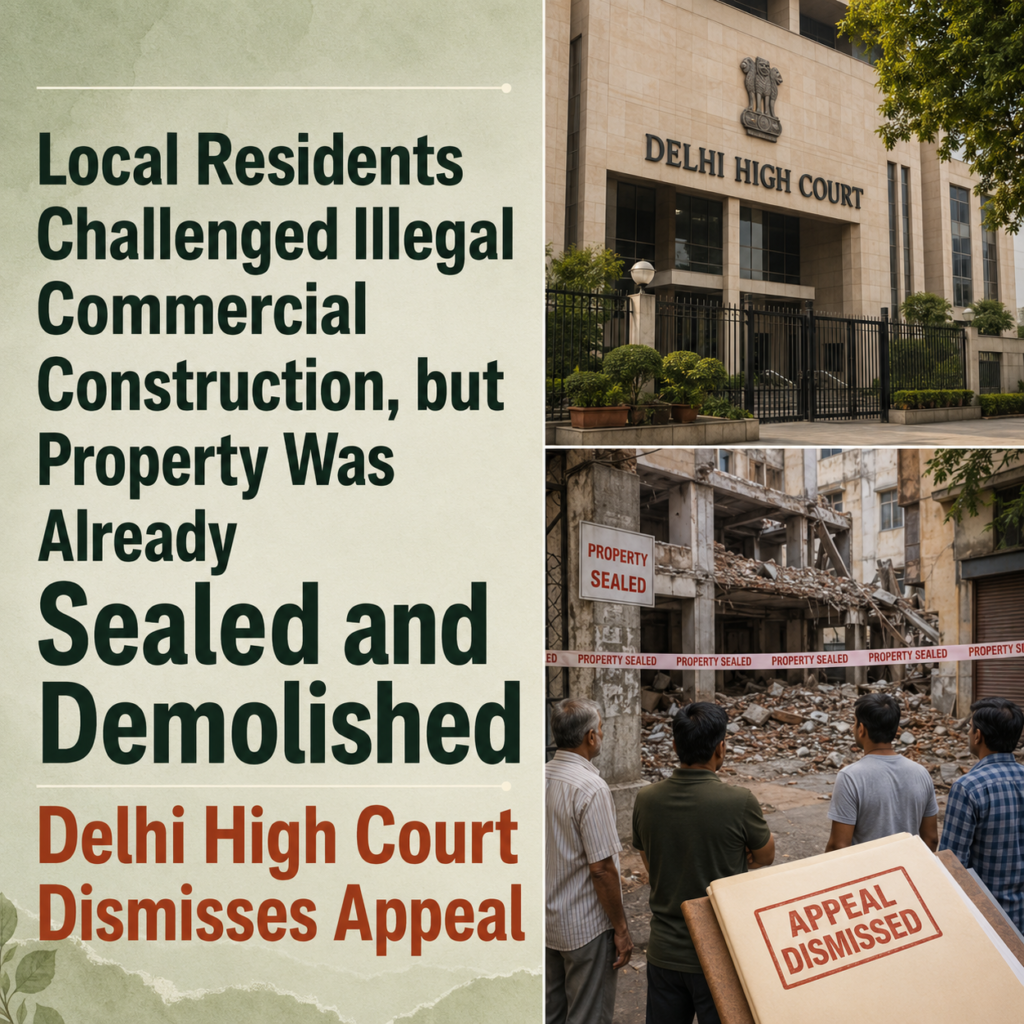
Local Residents Challenged Illegal Commercial Construction, but Property Was Already Sealed and Demolished; Delhi High Court Dismisses Appeal

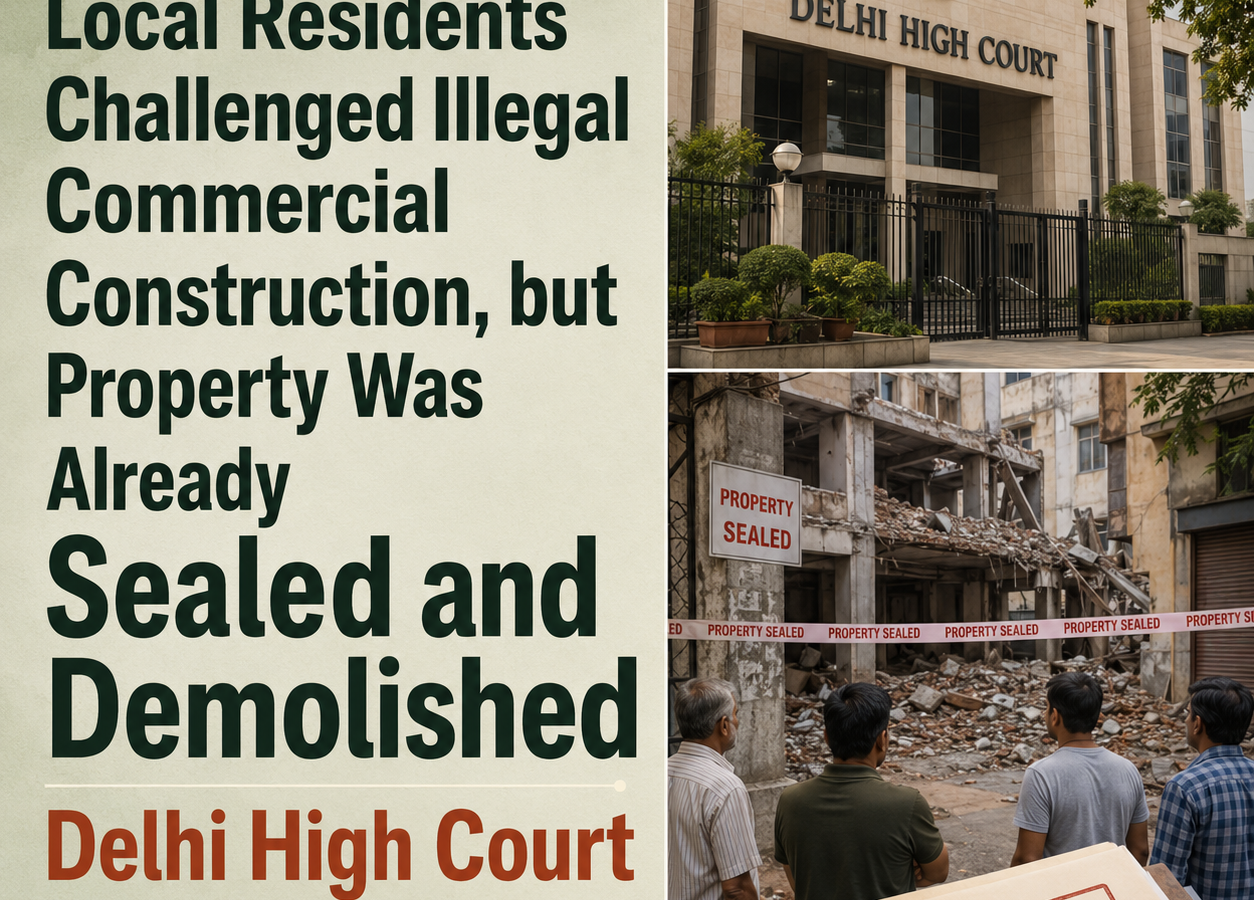
Residents Alleged Illegal Multi-Storey Complex Would Cause Parking and Traffic Problems; Delhi High Court Finds No Personal Legal Injury
Facts
Ravinder Soni and three other residents of the Nabi Karim and Paharganj locality filed a civil suit alleging unauthorised construction at Property No. 6893, Qila Kadam Sharif, Nabi Karim, New Delhi.
The property belonged to or was controlled by Sanatan Dharam Sabha Hari Mandir and its office bearers. The appellants alleged that the private respondents, in collusion with municipal and police officials, were constructing an unauthorised multi-storey commercial complex consisting of shops and several floors.
The appellants described themselves as long-standing residents and social workers in the locality. They contended that the area was already densely populated and congested. According to them, the proposed commercial complex would:
- Increase the number of occupants and property owners.
- Cause parking problems.
- Create obstructions in the street.
- Make it unsafe and inconvenient for residents to use the road.
They claimed to have submitted several complaints to the Municipal Corporation and the police, but alleged that effective action was not taken.
The appellants filed Civil Suit No. 873/2018 seeking:
- A permanent injunction restraining the private defendants from raising illegal construction.
- A mandatory injunction directing demolition of the unauthorised construction.
- A direction to the Municipal Corporation and police not to permit further illegal construction.
The Municipal Corporation stated that its field staff inspected the property on March 7, 2018, and found unauthorised construction on the ground and first floors. Proceedings were initiated under Sections 343 and 344 of the Delhi Municipal Corporation Act, and a show-cause notice was issued to the owner or builder.
Sealing proceedings were also initiated under Section 345A. When municipal officers executed the sealing action, they found further unauthorised construction on the second and third floors. Demolition action was taken against those floors, and the property was sealed at 12 points.
After the seals were found to have been tampered with, the Municipal Corporation sealed the premises again on March 11, 2019. According to its status report, the premises remained sealed.
On February 12, 2020, the Civil Judge dismissed the suit. The Court found that the Municipal Corporation had already demolished the unauthorised construction and sealed the property. The reliefs seeking demolition and restraint against ongoing construction had therefore been satisfied.
The Civil Judge further held that an injunction against any construction that might be raised in the future was premature.
The appellants filed a first appeal. The Additional Senior Civil Judge dismissed it on April 19, 2023, holding that:
- None of the appellants lived adjacent to the property.
- They had not demonstrated infringement of any personal right.
- The suit had not been instituted under Section 91 of the Code of Civil Procedure as a public-nuisance action.
- The suit was barred under Section 41(j) of the Specific Relief Act because the appellants had no personal interest in the matter.
The residents then filed a second appeal before the Delhi High Court.
Issues
- Whether residents of the same locality had legal standing to seek demolition of allegedly unauthorised construction.
- Whether concerns about traffic, parking and congestion constituted infringement of a personal legal right.
- Whether the appellants were required to establish interference with their easementary rights to light and air.
- Whether a suit concerning alleged public nuisance had to comply with Section 91 of the Code of Civil Procedure.
- Whether the suit was barred under Section 41(j) of the Specific Relief Act because the appellants lacked a personal interest.
- Whether any relief survived after the Municipal Corporation had demolished the unauthorised portions and sealed the premises.
- Whether an injunction could be issued against construction that might or might not be undertaken in the future.
- Whether the appellants raised any substantial question of law necessary for maintaining a second appeal under Section 100 of the Code of Civil Procedure.
Petitioner’s Arguments
The appellants argued that the lower courts incorrectly treated their reliefs as having been satisfied merely because the property was reportedly sealed and some demolition action had been undertaken.
They alleged that only a small portion of the unauthorised structure had been demolished and that most of the illegal construction remained standing.
The appellants pointed out that the original seals had been tampered with and that further construction was undertaken before the building was sealed again. According to them, this demonstrated a continuing threat of illegal construction.
They alleged collusion between the private respondents, municipal officials and police officers. They claimed that the municipal status reports falsely suggested that the entire illegal construction had been removed.
They contended that no sanctioned building plan had been produced. Therefore, the entire structure should have been treated as unauthorised and ordered to be demolished.
The appellants questioned the first appellate court’s reliance on Section 91 of the Code of Civil Procedure because the respondents had allegedly not specifically pleaded that provision.
They also argued that Section 41(j) of the Specific Relief Act should not defeat a suit filed for a public cause.
The appellants maintained that the courts below failed to properly apply Sections 15 and 33 of the Indian Easements Act, 1882.
They therefore sought restoration and decreeing of their suit for permanent and mandatory injunctions.
Respondent’s Arguments
The Municipal Corporation contended that statutory action had already been taken against the unauthorised construction.
It stated that:
- The property was inspected.
- The unauthorised portions were formally booked.
- A show-cause notice was issued.
- Demolition action was undertaken against the upper floors.
- The property was sealed at several points.
- After the original seals were tampered with, the premises were sealed again.
- The building remained under seal.
The Municipal Corporation argued that there was no ongoing construction and that no cause of action survived.
The private respondents supported the concurrent decisions dismissing the suit. Their position was that the appellants had no personal interest in the property and had not shown that any individual legal or easementary right was affected.
The respondents also maintained that an injunction against hypothetical future construction could not be granted.
Analysis of the Law
Scope of a second appeal
Under Section 100 of the Code of Civil Procedure, a second appeal is maintainable only where the case involves a substantial question of law.
The High Court does not ordinarily reconsider concurrent factual findings merely because another view may be possible. The appellant must establish a significant legal error affecting the decision.
Findings concerning municipal action, demolition, sealing and the absence of personal injury were essentially factual findings concurrently recorded by the two lower courts.
Legal standing in unauthorised construction cases
The fact that a construction is unauthorised does not automatically confer upon every resident of the locality a private right to seek an injunction.
Municipal authorities possess statutory power to inspect, seal and demolish illegal construction. A private person must separately show that the construction infringes a legal right belonging to that person.
A neighbour may have a cause of action where construction substantially interferes with an established right to light, air, access or enjoyment of property. Merely residing in the general locality or describing oneself as a social worker is insufficient.
Public nuisance under Section 91
Section 91 of the Code of Civil Procedure provides a specific procedure for filing a suit concerning public nuisance or another wrongful act affecting the public.
Such a suit may be instituted by:
- The Advocate General; or
- Two or more persons with the permission of the Court, even if no special damage has been caused to them.
The appellants had not filed the suit under Section 91 or obtained the required leave. Their general complaints about congestion, parking and inconvenience therefore did not establish a properly constituted public-nuisance action.
Section 41(j) of the Specific Relief Act
Section 41(j) provides that an injunction cannot be granted where the plaintiff has no personal interest in the matter.
The appellants did not own or occupy property adjoining the disputed building. They also failed to plead any direct interference with their personal rights.
Their concerns about increased traffic, parking problems or pressure on public resources were speculative and insufficient to establish the personal interest required for an injunction.
Easementary rights under Sections 15 and 33
Section 15 of the Indian Easements Act deals with acquisition of easementary rights by prescription. A right to light or air generally must have been peaceably enjoyed, without interruption, for the prescribed period of 20 years.
Section 33 further requires substantial damage resulting from disturbance of the easement. The interference must materially reduce the value of the dominant property or materially affect the occupier’s physical comfort.
The appellants neither pleaded nor proved:
- A 20-year prescriptive right to light or air.
- Interference with such a right.
- Substantial damage to their property.
- Material impact on their personal comfort.
Infructuous and premature reliefs
An injunction addresses an existing or reasonably imminent legal injury. Where the municipal authority has already demolished the offending construction and sealed the property, a prayer seeking the same action may become infructuous.
A court also cannot ordinarily restrain an uncertain future act that may never occur. The appellants’ request to prevent any possible future construction was therefore premature.
Precedent Analysis
Rajinder Motwani v. Municipal Corporation of Delhi, Regular Second Appeal No. 243/2017, decided October 16, 2017
The Delhi High Court held that illegal construction, by itself, does not create a private right in favour of every neighbour to seek an injunction.
Unauthorised construction gives municipal authorities the power to take statutory action. A neighbour acquires an independent right to sue only where the construction affects a recognised personal right, such as an easementary right to light or air.
For a prescriptive easement under Section 15 of the Indian Easements Act, the claimant must demonstrate enjoyment of the relevant right for 20 years.
Further, Section 33 requires the claimant to show substantial damage. The interference must materially diminish the value of the claimant’s property or materially interfere with physical comfort.
The High Court applied this precedent because the appellants had not pleaded any infringement of light, air or another easementary right. Their case rested only on their residence in the locality and general concerns about congestion.
Court’s Reasoning
The High Court first noted that the proceedings were a second appeal. It could therefore examine only substantial questions of law arising from the first appellate judgment.
The municipal status report showed that the unauthorised construction had been booked, demolition action had been undertaken and the premises had been sealed. When the seals were tampered with, the building was sealed again.
The reliefs seeking restraint against ongoing construction and demolition of the offending portions had therefore already been addressed through municipal action. Nothing further survived for adjudication on those prayers.
The request to restrain any unauthorised construction in the future was premature. Courts cannot issue an injunction based entirely on an uncertain apprehension that illegal construction might be attempted later.
On legal standing, the appellants did not reside adjacent to the disputed property. They did not allege that the building obstructed light or air reaching their homes or interfered with any other right attached to their properties.
Their concerns about future traffic, parking difficulties and congestion were speculative. Even lawful construction could increase pressure on local infrastructure, but that possibility did not create a private cause of action.
The appellants had also not brought the suit under Section 91 of the Code of Civil Procedure as an action concerning public nuisance. No public nuisance was adequately established from the plaint.
The High Court reiterated that illegal construction may justify statutory action by municipal authorities, but it does not automatically permit an unaffected resident to maintain a civil injunction suit.
Since the appellants had no demonstrated personal interest, Section 41(j) of the Specific Relief Act barred the injunction.
The lower courts’ conclusions were factual, consistent with the municipal record and free from legal infirmity. The appellants failed to identify any substantial question of law.
Conclusion
The Delhi High Court held that merely living in the same locality or working there as a social worker did not give the appellants legal standing to seek demolition of allegedly unauthorised construction.
The appellants failed to show that the construction infringed their personal, proprietary or easementary rights. Their concerns about parking, congestion and inconvenience were speculative.
The Municipal Corporation had already demolished the unauthorised portions and sealed the premises. Accordingly, the principal reliefs had become infructuous. An injunction against uncertain future construction was also premature.
Since no substantial question of law arose, the second appeal was dismissed along with the pending application.
Case Details
Case: Ravinder Soni and Others v. Sanatan Dharam Sabha Hari Mandir (Registered) and Others
Court: High Court of Delhi at New Delhi
Case Number: Regular Second Appeal 198/2023 with CM Application 30826/2025
Judge: Justice Neena Bansal Krishna
Date: July 17, 2026
Result: Second appeal dismissed; concurrent dismissal of the residents’ suit for permanent and mandatory injunction upheld