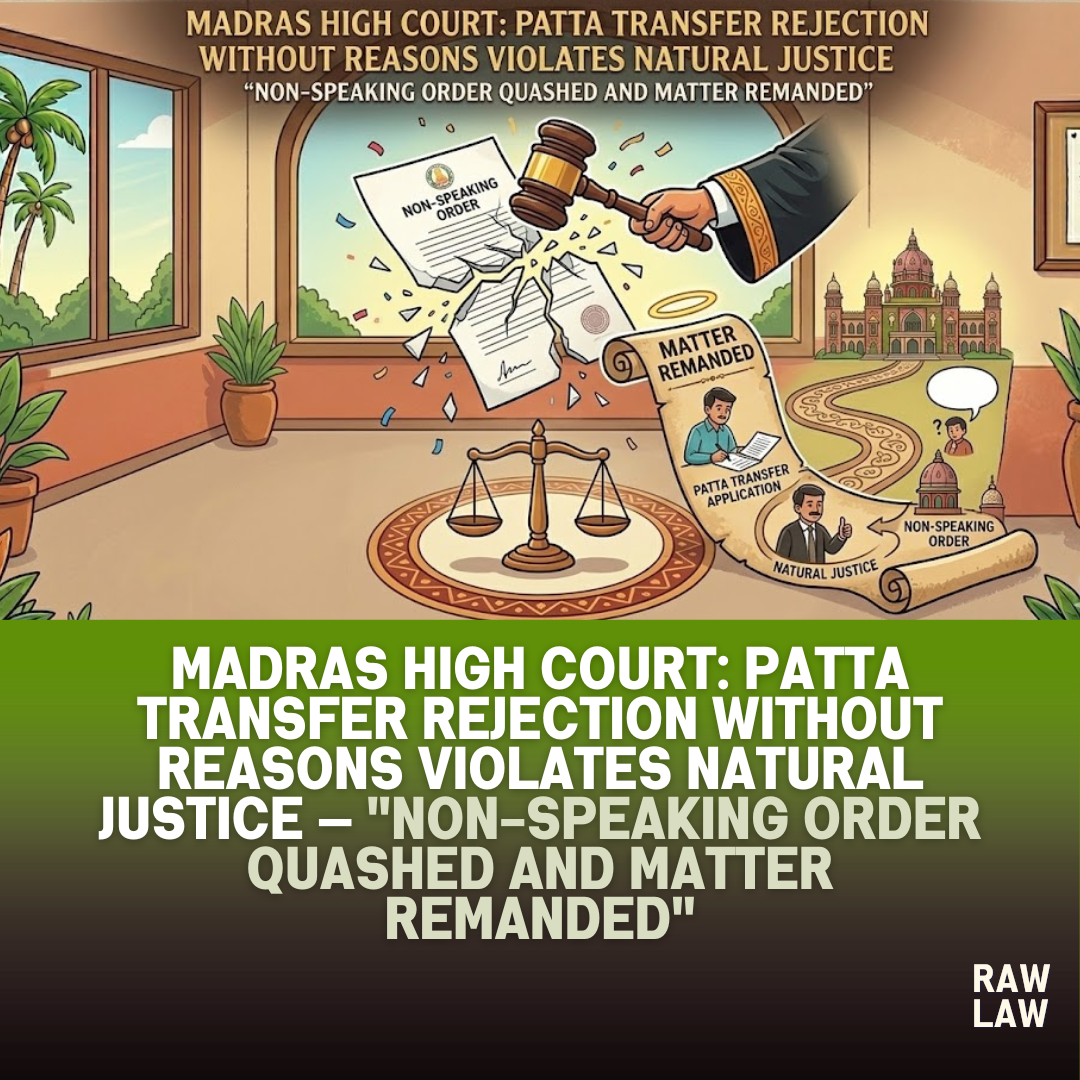
Madras High Court: Patta transfer rejection without reasons violates natural justice — “Non-speaking order quashed and matter remanded”

1. Court’s decision
The Madras High Court allowed a writ petition challenging the rejection of a patta transfer application and held that the impugned order suffered from fundamental procedural defects. The Court observed that the revenue authority issued a non-speaking order without providing reasons or evaluating the documents submitted by the applicant.
Recognizing that such an order violates the principles of natural justice, the Court quashed the rejection order and remitted the matter to the competent authority for reconsideration. The authority was directed to reconsider the patta transfer application after providing an opportunity of hearing and pass a reasoned decision in accordance with law.
2. Facts
The dispute arose from a patta transfer application filed by the petitioner before the revenue authorities seeking transfer of patta in respect of certain survey numbers located in a village within Soolgiri Taluk of Krishnagiri district. The petitioner relied on her application and supporting documents to request that the revenue records be updated to reflect her rights over the property.
However, the Zonal Deputy Tahsildar rejected the patta transfer request through an administrative order dated 8 January 2026. The order did not provide any explanation or reasoning for the rejection. The relevant column in the order merely contained the word “rejected” without discussing the evidence or legal basis for the decision.
Aggrieved by this rejection, the petitioner approached the High Court invoking its writ jurisdiction and sought quashing of the order and a direction to consider the patta transfer application in accordance with law.
3. Issues
The Court framed the central legal issues arising in the case.
The first issue was whether an administrative authority can reject a patta transfer application without providing reasons for the decision. The Court also examined whether failure to provide an opportunity of hearing before rejecting the application violated the principles of natural justice.
A related issue was whether such a non-speaking order could legally stand scrutiny under judicial review when the authority had not considered the documents submitted by the applicant.
The Court therefore had to determine whether the rejection order was legally sustainable or whether it warranted interference and remand for fresh consideration.
4. Petitioner’s arguments
The petitioner argued that the impugned rejection order was illegal and arbitrary because it did not contain any reasons explaining why the patta transfer request had been denied. It was contended that the absence of reasoning made the order a non-speaking order, thereby rendering it invalid under administrative law principles.
The petitioner also submitted that the authority had passed the order without granting her an opportunity of hearing. According to the petitioner, the failure to provide such an opportunity violated the basic principles of natural justice, which require authorities to hear affected parties before taking adverse decisions.
Further, the petitioner asserted that the authority had failed to examine the documents submitted along with the patta transfer application. This failure to consider relevant materials demonstrated non-application of mind and warranted judicial intervention.
5. Respondent’s arguments
The respondents, represented by the Government Advocate, accepted notice in the proceedings but defended the administrative action. The respondents relied on the authority’s power to examine patta transfer applications under the applicable revenue laws.
However, the respondents were unable to demonstrate from the impugned order that the authority had provided reasons for the rejection or that the petitioner had been afforded an opportunity of hearing before the order was issued.
The Court therefore examined the impugned order and the procedural framework governing administrative decision-making to determine whether the authority’s action complied with the requirements of law.
6. Analysis of the law
The Court emphasized that administrative authorities exercising statutory powers must follow the principles of natural justice. A fundamental requirement of these principles is that a person affected by an adverse decision must be given an opportunity of hearing before such a decision is taken.
Another equally important principle is that decisions affecting rights must be supported by reasons. A reasoned order demonstrates that the authority has applied its mind to the facts and evidence presented before it.
The Court observed that a non-speaking order fails to disclose the reasoning process of the authority and therefore becomes susceptible to judicial review. Such orders also prevent the affected party from understanding the basis of the decision and hinder effective appellate or judicial scrutiny.
7. Precedent analysis
Indian administrative law has consistently emphasized the necessity of reasoned orders. Courts have repeatedly held that recording reasons is an essential component of fairness and transparency in decision-making.
Judicial precedents recognize that speaking orders serve multiple purposes. They ensure accountability of administrative authorities, enable affected parties to understand the grounds of the decision, and facilitate effective review by higher forums.
Courts have therefore consistently set aside orders where authorities failed to record reasons or ignored the principles of natural justice while exercising statutory powers.
8. Court’s reasoning
Upon examining the impugned order, the Court found that the authority had simply stated “rejected” in the column meant for reasons. No explanation was provided to justify the rejection of the patta transfer application.
The Court also noted that the petitioner had not been given an opportunity of hearing before the order was passed. Furthermore, the documents submitted by the petitioner had not been evaluated or discussed in the order.
These deficiencies led the Court to conclude that the order suffered from both procedural and substantive defects. The absence of reasoning and denial of hearing clearly violated the principles of natural justice and rendered the order legally unsustainable.
9. Conclusion
The Court held that the impugned order rejecting the patta transfer application was a non-speaking order passed in violation of natural justice. Since the authority failed to provide reasons or consider the petitioner’s documents, the order could not be sustained in law.
Accordingly, the Court quashed the rejection order and remanded the matter to the concerned authority for fresh consideration. The petitioner was directed to submit a written explanation along with supporting documents within two weeks, after which the authority must pass a reasoned decision within twelve weeks.
10. Implications
The judgment reinforces a fundamental principle of administrative law: government authorities must provide reasons when rejecting applications that affect property rights or legal interests. Non-speaking orders undermine transparency and fairness in administrative decision-making.
For revenue administration, the decision underscores that patta transfer applications must be examined on merits after considering all documents and providing the applicant an opportunity of hearing. Authorities cannot simply reject such applications without explanation.
The ruling therefore strengthens procedural safeguards for citizens dealing with revenue authorities and reiterates the judiciary’s commitment to enforcing natural justice in administrative processes.
Case Law References
- Principle of Natural Justice – Reasoned Orders
Courts have consistently held that administrative decisions affecting rights must contain reasons. Speaking orders enable transparency and accountability and are essential for judicial review. - Audi Alteram Partem Principle
The doctrine that no person should be condemned unheard requires authorities to provide an opportunity of hearing before taking adverse decisions affecting rights or interests. - Doctrine of Reasoned Decision-Making
Indian courts have emphasized that reasons form the backbone of judicial and administrative decisions, ensuring fairness, preventing arbitrariness, and facilitating appellate scrutiny.
FAQs
1. Can a patta transfer application be rejected without giving reasons?
No. Courts have repeatedly held that rejection orders must provide clear reasons. A non-speaking order without explanation violates principles of natural justice and can be set aside by courts.
2. What is a non-speaking order in administrative law?
A non-speaking order is a decision that does not provide reasons or explain the basis of the authority’s conclusion. Such orders are often quashed by courts because they show non-application of mind.
3. What should authorities do before rejecting a patta transfer application?
Authorities must examine the documents submitted by the applicant, provide an opportunity of hearing, and issue a reasoned order explaining why the request is accepted or rejected.