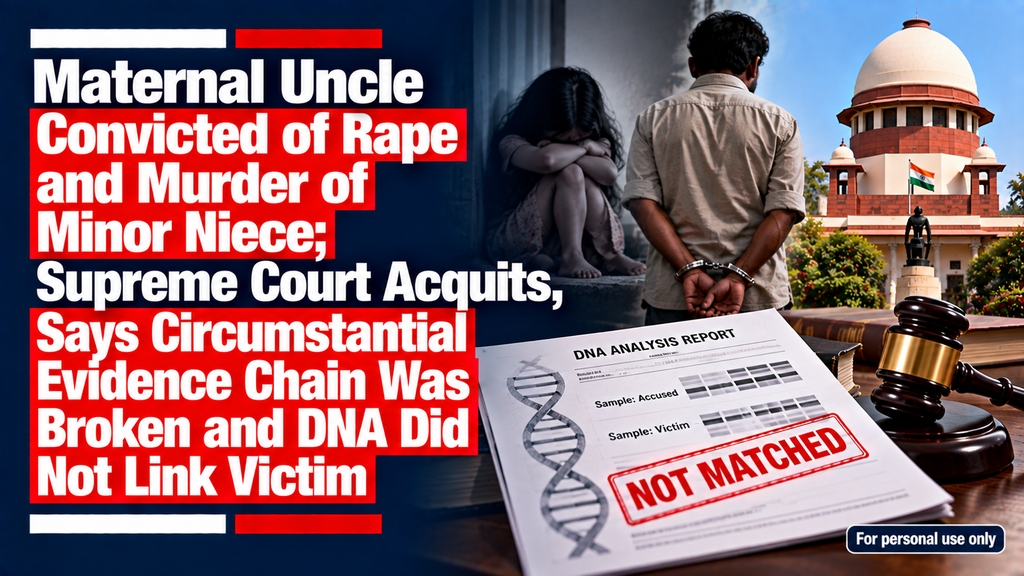
Maternal Uncle Convicted of Rape and Murder of Minor Niece; Supreme Court Acquits, Says Circumstantial Evidence Chain Was Broken and DNA Did Not Link Victim

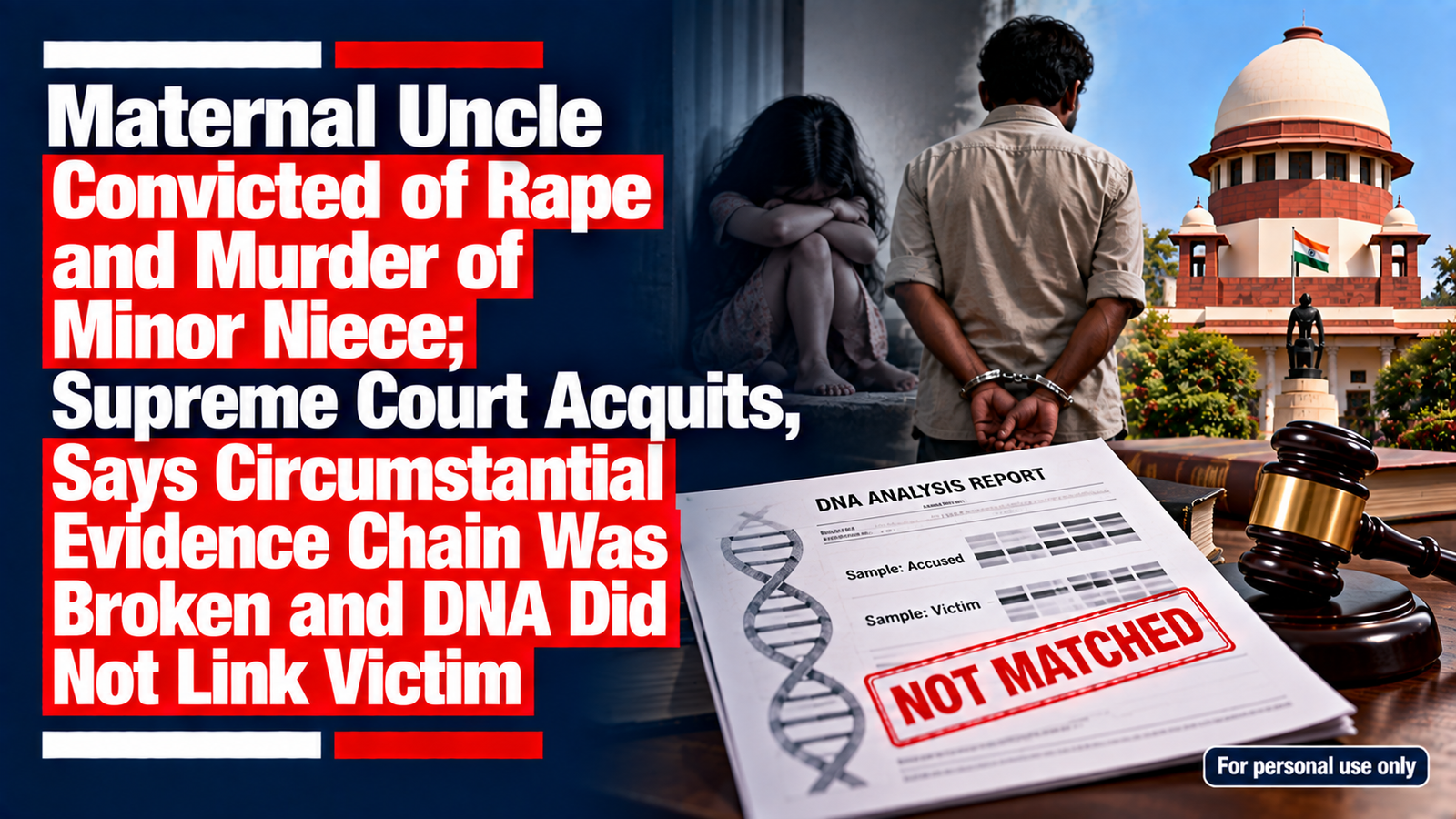
Sessions Court and High Court Award Life Imprisonment in Child Rape-Murder Case; Supreme Court Finds Last-Seen, Recovery, DNA and FSL Evidence Unreliable
Facts
On 6 November 2013 at about 9:00 a.m., Santosh Gurung was asked by his mother to purchase vegetables. He asked his maternal niece, the minor victim, to accompany him, but his mother did not permit him to take her. According to the prosecution, however, Santosh subsequently took the child from the house.
When Santosh and the victim did not return, the family searched for them. A missing report was ultimately lodged at Rongli Police Station on 12 November 2013. Santosh was traced at Siliguri several months later.
According to the FIR dated 13 May 2014, while Santosh was being brought back from Siliguri to Rongli, he allegedly stated that he had raped the victim and thereafter throttled her to death on 6 November 2013. Investigation followed and a charge-sheet was filed.
The prosecution examined sixteen witnesses and sought to establish guilt entirely through circumstantial evidence. The principal circumstances relied upon were: the theory that Santosh was last seen with the victim; recoveries allegedly made pursuant to his disclosure under Section 27 of the Evidence Act; DNA analysis of bones and teeth recovered during investigation; FSL examination of recovered articles; a brown shawl allegedly connected with the offence; and Santosh’s answers under Section 313 CrPC.
The Sessions Court convicted Santosh under Sections 376(2)(i), 302 and 201 IPC and Sections 4 and 6 of the POCSO Act, and sentenced him to life imprisonment. The High Court of Sikkim affirmed the conviction. Santosh then approached the Supreme Court.
Issue
The central issue before the Supreme Court was whether the prosecution had proved a complete and unbroken chain of circumstantial evidence which excluded every reasonable hypothesis except the guilt of Santosh Gurung.
The Court was also required to examine whether the last-seen evidence, Section 27 recoveries, DNA and FSL reports, alleged brown shawl, and the accused’s Section 313 statement could legally and factually sustain the conviction.
Appellant’s Arguments
Santosh argued that both the Sessions Court and the High Court had erred in convicting him solely on circumstantial evidence when the individual circumstances themselves were doubtful.
He submitted that the prosecution witnesses were not certain that he had been last seen with the victim. He also relied upon the substantial delay between the missing report dated 12 November 2013 and registration of the FIR on 13 May 2014.
The recoveries under Section 27 of the Evidence Act were challenged because the place of recovery was accessible to and frequented by members of the public, including cattle herders and persons collecting fodder.
The appellant further argued that neither the FSL report nor the DNA report connected him with the alleged crime or established that the recovered remains belonged to the victim. He therefore sought acquittal.
State’s Arguments
The State of Sikkim supported the concurrent findings of the Sessions Court and High Court. It argued that, in the absence of an eyewitness, the prosecution was entitled to establish the case through a chain of clinching circumstances.
The State submitted that each circumstance pointed towards Santosh’s involvement and that his answers under Section 313 CrPC failed to satisfactorily explain the incriminating material. According to the State, those answers strengthened the prosecution’s chain of circumstances.
The State therefore urged the Supreme Court not to interfere with the concurrent conviction.
Circumstantial Evidence Must Exclude Every Hypothesis of Innocence
The Supreme Court reiterated the classic principles governing circumstantial evidence, relying on Hanumant v. State of Madhya Pradesh. Each circumstance from which guilt is sought to be inferred must first be fully established; all established facts must be consistent only with guilt; the circumstances must be conclusive; and the chain must exclude every reasonable hypothesis consistent with innocence.
The Court cautioned that in circumstantial-evidence cases there is a particular danger of suspicion or conjecture being used to supply a missing link. A court cannot complete an incomplete prosecution chain by assumption.
Applying these principles, the Supreme Court found that the chain relied upon against Santosh was broken at several material places.
Last-Seen Theory Was Not Proved
The prosecution’s first major circumstance was that Santosh was allegedly last seen with the victim. The Supreme Court found the evidence insufficient.
PW-2, the victim’s grandmother, was not certain whether Santosh and the victim left the house together or separately. She also acknowledged that two other persons from the village had visited the house. PW-1, a Head Constable, admitted that no witness had actually seen Santosh taking the victim from the house. The victim’s mother also could not say whether the child had left with Santosh or with the two persons who had visited.
The Investigating Officer similarly admitted that no person had seen Santosh taking the victim away. The Supreme Court therefore found a grave doubt as to whether Santosh was in fact the person last seen with the victim.
The Court additionally noted the enormous time gap: the victim allegedly disappeared on 6 November 2013, whereas bones and teeth were recovered only in May 2014. Referring to State of U.P. v. Satish, the Court reiterated that the last-seen theory becomes unsafe where the time gap is so large that intervention by another person cannot be excluded.
Section 27 Recovery Required Caution
The prosecution relied upon the alleged recovery on 15 May 2014 of clothes and other articles pursuant to Santosh’s disclosure statement.
However, the recovery witnesses admitted that the location was not a thick jungle or secluded place. There was an old road and footpath; cattle herders and persons collecting fodder regularly visited the area; a water channel was nearby; and the recovery spot was easily visible to persons visiting the place.
The Supreme Court clarified, with reference to State of Himachal Pradesh v. Jeet Singh, that recovery from a place accessible to the public is not automatically inadmissible under Section 27. The crucial question is whether the concealed object was ordinarily visible to others.
On the facts, however, the public and visible character of the recovery spot meant that the alleged discovery had to be evaluated with considerable caution and could not operate as a strong standalone link against the accused.
DNA Report Undermined Rather Than Supported the Prosecution
The DNA analysis was a particularly important part of the prosecution case because bones and hair recovered during investigation were sought to be linked to the missing child.
The DNA report recorded that the two pieces of bone examined were of human male origin and were not biologically related to the blood samples of the victim’s mother and sister. Autosomal STR analysis could not be carried out on the bunch of black hair.
The medical witness also could not conclusively state whether certain suspected bones were human or animal, whether a tooth was human, or even whether a suspected nail was actually a nail or a piece of wood. The Investigating Officer admitted that he could not say whether the bones and teeth recovered belonged to the victim.
The Supreme Court found this fatal to the prosecution’s reliance on the DNA evidence. The victim was female, whereas the tested bone pieces were of male origin. Consequently, the DNA report could not be used as an incriminating circumstance against Santosh.
FSL Report Did Not Connect the Accused to the Crime
The Regional FSL examined the articles recovered during investigation. The analyst could not determine whether the dried blood found on the brown shawl was human or animal blood.
The age of the human scalp hair found on the shawl and other hair strands could not be ascertained. Human remains were also not detected in the soil sample.
The Supreme Court therefore held that the FSL report did not advance the prosecution case or supply a reliable link in the chain of circumstances.
Brown Shawl Was Not Reliably Connected With the Offence
The prosecution alleged that Santosh had taken a brown shawl from his sister’s house, laid the victim upon it and thereafter covered her with his black jacket.
The victim’s mother could not identify the brown shawl produced in court and stated that she did not know to whom it belonged. The Investigating Officer admitted that the shawl did not belong to Santosh’s mother even though Santosh was alleged to have said that it did. No witness had seen Santosh going to obtain the shawl.
Further, the FSL could not determine the origin or blood group of the blood found on it. The Supreme Court therefore found this circumstance doubtful and incapable of supporting the conviction.
Section 313 CrPC Cannot Fill Gaps in the Prosecution Case
The State sought to rely upon Santosh’s answers under Section 313 CrPC as an additional link. Santosh admitted that he had wanted to take the victim with him, that he had been standing near the house while the victim was near the door, and that he had later gone to another residence while heavily intoxicated. He nevertheless maintained that he had gone to the shop alone and had been falsely implicated.
The Supreme Court found no failure on his part to explain any circumstance that had otherwise been conclusively established against him.
The Court reiterated that an accused’s silence or inadequate explanation under Section 313 can operate only as an additional link after the prosecution has first established the incriminating circumstances. It cannot shift the primary burden of proof and cannot be used to fill gaps left by deficient prosecution evidence.
Relying on Raj Kumar Singh @ Raju @ Batya v. State of Rajasthan, the Court emphasised that a Section 313 statement is not substantive evidence and cannot itself become the basis of conviction when the prosecution evidence is insufficient.
Court’s Reasoning
On an overall evaluation, the Supreme Court found the prosecution evidence ‘woefully short’ of establishing Santosh’s guilt.
The witnesses were uncertain whether Santosh was last seen with the victim. The Section 27 recovery was from a place ordinarily visible and frequented by others. The DNA evidence showed that the recovered bones were of male origin although the victim was female. The FSL report provided no incriminating linkage. The brown shawl was not reliably identified or connected to the offence. The Section 313 statement could not cure these evidentiary defects.
The Court held that the Sessions Court had failed to appreciate these material infirmities and that the High Court had also failed to correct them. The circumstances did not combine into a complete chain pointing only towards Santosh’s guilt.
The Court acknowledged the tragic fate of the victim but held that the gravity of the alleged offence could not substitute for legal proof beyond reasonable doubt.
Conclusion
The Supreme Court held that the prosecution had failed to establish the guilt of Santosh Gurung beyond reasonable doubt. The circumstantial evidence did not form a complete chain and substantial doubt remained regarding his involvement.
The judgments of the Sessions Court and the High Court of Sikkim were therefore quashed and set aside.
Santosh Gurung was acquitted of all offences for which he had been tried and convicted, and the Supreme Court directed that he be released forthwith unless required in any other case. The criminal appeal was allowed.
Case Details
Case: Santosh Gurung v. State of Sikkim
Citation: 2026 INSC 1073
Court: Supreme Court of India
Proceeding: Criminal Appeal No. 107 of 2018
Bench: Justice Ujjal Bhuyan and Justice Atul S. Chandurkar
Judgment authored by: Justice Atul S. Chandurkar
Date: 1 October 2026
Offences: Sections 376(2)(i), 302 and 201 IPC; Sections 4 and 6 of the POCSO Act
Nature of case: Child rape and murder prosecution based entirely on circumstantial evidence Result: Appeal allowed; concurrent conviction set aside; appellant acquitted and ordered to be released forthwith unless required in another case