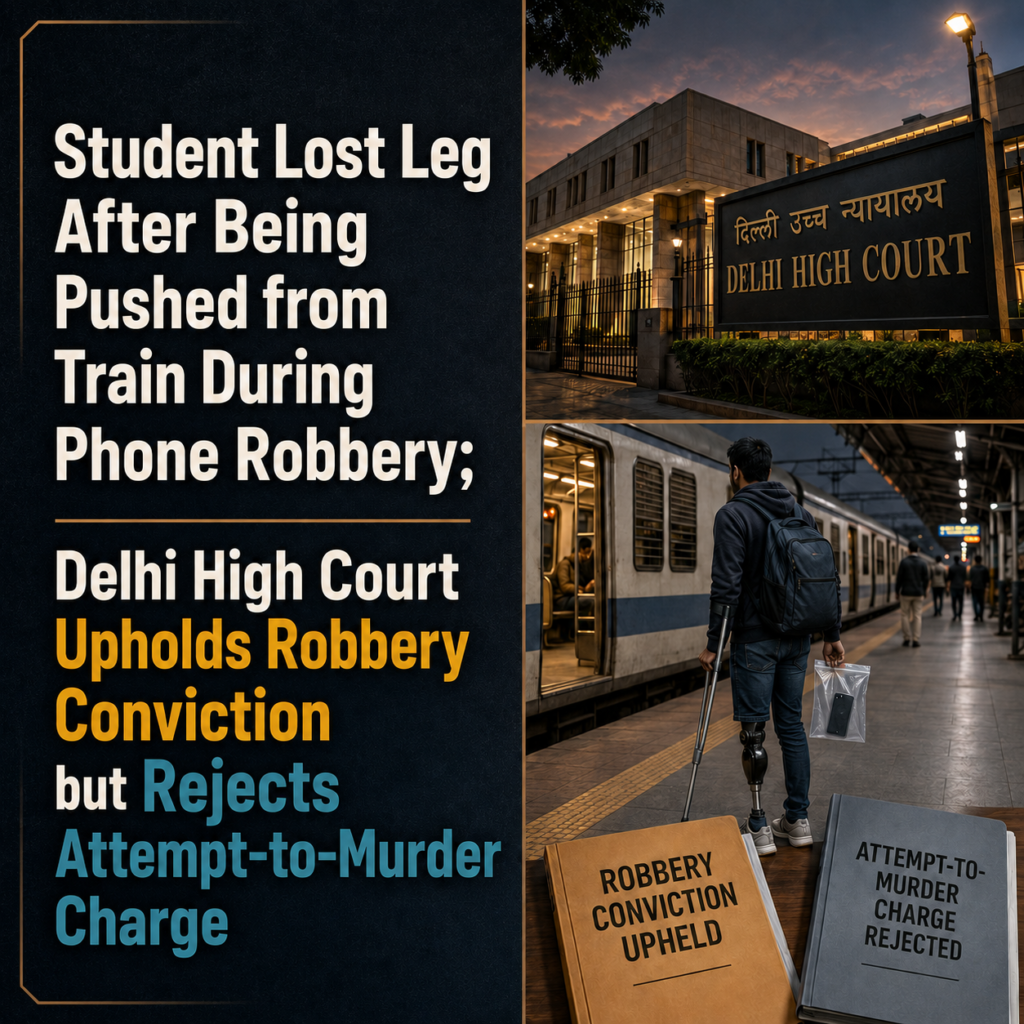
Student Lost Leg After Being Pushed from Train During Phone Robbery; Delhi High Court Upholds Robbery Conviction but Rejects Attempt-to-Murder Charge


Pushing Passenger from Moving Train to Snatch Phone Was Robbery, Not Attempted Murder Without Intent to Kill: Delhi High Court
Facts
Aman, a student of Hansraj College, regularly travelled by train between Sonipat and Delhi.
On September 14, 2018, at approximately 11:40 a.m., Aman boarded the Paschim Vihar Express to return home after attending college. He was standing near the entrance of the train and using his mobile phone.
According to Aman, Ashish Kumar, who was travelling in the same coach, suddenly attempted to snatch the phone from his hand. Aman resisted and held the phone tightly. Ashish then pushed him.
Aman fell from the moving train, and his right leg came under its wheels. The injury ultimately resulted in the amputation of his leg. His mobile phone also fell from his hand, and Ashish allegedly picked it up and fled.
The police initially received information that a person had been run over by a train near Sanjay Nagar, Gulabi Bagh. Aman had already been taken to the Trauma Centre at Civil Lines when the investigating officer reached the location.
As Aman was in severe pain and unfit to make a statement, his statement was recorded at his residence in Sonipat on September 19, 2018. First Information Report No. 24/2018 was then registered at Police Station Subzi Mandi Railway Station under Sections 392 and 394 of the Indian Penal Code, 1860.
On September 22, 2018, Aman accompanied police officers towards the scene of the incident. He spotted Ashish near a shrine close to Hanuman Mandir Subway, Gulabi Bagh, and identified him as the offender. Ashish was arrested, although nothing was recovered from his possession.
The trial court framed charges under Sections 392 and 394 and, in the alternative, Section 307 of the Indian Penal Code.
On January 10, 2020, the Additional Sessions Judge convicted Ashish for robbery and voluntarily causing hurt while committing robbery under Sections 392 and 394. He was acquitted of attempted murder under Section 307.
Ashish was sentenced to five years’ rigorous imprisonment for each of the offences under Sections 392 and 394, along with a fine of ₹5,000 for each offence. The judgment indicates that the sentences arose from the same incident.
The State appealed against the acquittal under Section 307, arguing that pushing a person from a moving train demonstrated knowledge that death could result.
Issues
- Whether pushing the student from a moving train during a mobile-phone robbery constituted attempted murder under Section 307 of the Indian Penal Code.
- Whether the accused possessed the intention or knowledge necessary to attract Section 307.
- Whether the Court should infer murderous intention from the dangerous nature of the act and the resulting amputation.
- Whether the accused’s purpose was limited to snatching the mobile phone or extended to causing death.
- Whether grievous injury sustained during robbery was sufficiently covered by Sections 392 and 394.
- Whether the trial court erred in acquitting the accused of attempted murder while convicting him for robbery and causing hurt.
Petitioner’s Arguments
The State argued that the prosecution had proved the charge of attempted murder beyond reasonable doubt.
All prosecution witnesses supported the prosecution’s version, and the injured student gave direct evidence that the accused had pushed him from a moving train.
The State submitted that Section 307 does not require proof of an express desire to kill in every case. Knowledge that the act was likely to cause death can also satisfy the provision.
According to the State, any person pushing another passenger from a moving train would know that the act could cause death. The respondent must therefore be presumed to have possessed the necessary knowledge.
The fact that Aman survived should not reduce the seriousness of the offence. His leg was run over by the train and had to be amputated, showing the grave and potentially fatal nature of the act.
Relying on Raj Kumar Singh alias Raju v. State of Rajasthan, the State argued that the accused should also have been convicted under Section 307.
Respondent’s Arguments
Ashish Kumar supported the trial court’s decision and submitted that it was a well-reasoned judgment requiring no interference.
He maintained that the prosecution had not established any intention to murder the student.
The incident arose from an attempt to snatch the mobile phone. The push was allegedly given during the struggle for possession of the phone and not as an independent act intended to kill or cause a potentially fatal injury.
The respondent contended that the robbery and the injury resulting from it were already covered by his convictions under Sections 392 and 394.
The severity of the unfortunate consequence could not substitute proof of the particular intention or knowledge required for attempted murder.
Analysis of the Law
Ingredients of attempted murder
Section 307 of the Indian Penal Code applies where a person commits an act with such intention or knowledge, and in such circumstances, that if death had resulted, the act would have amounted to murder.
The essential requirements are:
- An act directed towards commission of the offence.
- Intention or knowledge of the kind associated with murder.
- Circumstances showing that the act went beyond mere preparation.
Actual injury is not essential for conviction under Section 307. Conversely, even a severe or life-threatening injury does not automatically establish attempted murder.
The decisive consideration is the accused’s mental state at the time of the act.
Intention and knowledge
Intention refers to the conscious objective of bringing about a particular result. Knowledge concerns awareness that the act is so dangerous that death is a probable consequence.
The Court must infer intention or knowledge from the complete circumstances, including:
- The motive behind the act.
- The nature and manner of the assault.
- The weapon, if any.
- The part of the body targeted.
- Words spoken by the accused.
- Whether the act was repeated or pre-planned.
- The events immediately before and after the incident.
The result of the act is relevant but not conclusive.
Distinction between Sections 307 and 394
Section 394 punishes a person who voluntarily causes hurt while committing or attempting to commit robbery.
Therefore, when force is used to complete a robbery and injury results, Section 394 directly addresses that conduct.
For the additional offence of attempted murder, the prosecution must prove a separate and higher degree of intention or knowledge associated with causing death. The mere fact that the force used during robbery produced grievous consequences does not dispense with this requirement.
Consequence cannot replace mens rea
Aman’s injury was extremely serious and resulted in the loss of his leg. Nevertheless, criminal liability under Section 307 could not be determined solely from that consequence.
The Court had to examine why the accused pushed him. If the proved purpose was to dislodge the phone from his hand and complete the robbery, that established the mental element for robbery with hurt. It did not necessarily prove an intention to kill.
Precedent Analysis
Hari Singh v. Sukhbir Singh, (1988) 4 SCC 551
The Supreme Court held that intention or knowledge is an essential precondition for an offence under Section 307.
The accused’s mental state must be gathered from all the circumstances and not merely from the consequences of the act.
The Delhi High Court applied this principle and looked beyond the amputation to determine the purpose behind the push.
Sarju Prasad v. State of Bihar, 1964 SCC OnLine SC 236
This judgment establishes that conviction under Section 307 cannot be sustained unless the prosecution proves the requisite intention contemplated by the provision.
A dangerous act or serious injury, without proof of the necessary mental element, is insufficient.
Vasant Vithu Jadhav v. State of Maharashtra, AIR 2004 SC 2678
The Supreme Court explained that the Court must determine whether the act, irrespective of its ultimate result, was committed with the intention or knowledge necessary to murder a person.
The Delhi High Court relied on this result-independent assessment and found that the purpose of the act was to obtain the mobile phone.
Raj Kumar Singh alias Raju v. State of Rajasthan, (2013) 8 SCC 599
The State relied on this judgment to argue that knowledge of the likely fatal consequence could attract Section 307 even without an expressly stated intention to kill.
The High Court did not accept its application to the facts because the evidence established that the push was given during the effort to snatch the phone. It did not prove the murderous intention or knowledge required for Section 307 beyond reasonable doubt.
Court’s Reasoning
The injured student was the only eyewitness to the incident. His testimony established that the accused approached him and attempted to take his mobile phone.
Aman resisted and held the phone tightly. The accused then pushed him, causing him to fall from the moving train. When the phone also fell, the accused picked it up and escaped.
The sequence showed that the accused’s immediate and dominant purpose was to take the mobile phone.
The push was used to overcome Aman’s resistance and separate him from the phone. There was no evidence of a previous dispute, murderous motive or independent attempt to cause death.
The Court acknowledged the extraordinary seriousness of the injury. Aman’s leg was run over and amputated. However, the gravity of the result did not establish that Ashish intended to murder him.
The trial court had correctly found that the proved intention was to commit robbery. Hurt caused in the course of that robbery was punishable under Sections 392 and 394.
To sustain a separate conviction under Section 307, the prosecution had to prove intention or knowledge of causing death. That mental element was not established merely from the fact that the victim was pushed while standing near the train’s entrance.
The acquittal under Section 307 therefore contained no legal or factual infirmity.
Conclusion
The Delhi High Court held that pushing Aman during the struggle for his mobile phone was an act committed to complete the robbery.
Although the push caused Aman to fall from the moving train and suffer amputation of his right leg, the severe consequence did not automatically prove an intention or knowledge to commit murder.
The evidence established the offences of robbery and causing hurt during robbery under Sections 392 and 394. It did not establish the separate mental element required for attempted murder under Section 307.
The State’s appeal was dismissed, and Ashish Kumar’s acquittal under Section 307 was upheld. His convictions and five-year sentences under Sections 392 and 394 remained undisturbed.
Case Details
Case: State, Government of National Capital Territory of Delhi v. Ashish Kumar
Court: High Court of Delhi at New Delhi
Case Number: Criminal Appeal 305/2021
Judge: Justice Neena Bansal Krishna
Date: July 17, 2026
Result: State’s appeal dismissed; acquittal for attempted murder under Section 307 upheld, while convictions and sentences under Sections 392 and 394 remained undisturbed.