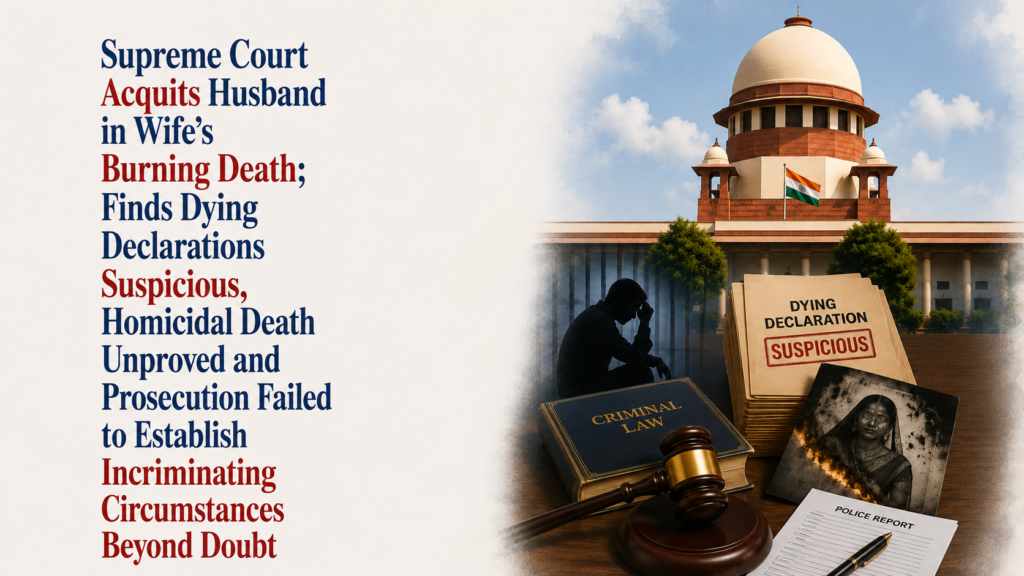
Supreme Court Acquits Husband in Wife’s Burning Death; Finds Dying Declarations Suspicious, Homicidal Death Unproved and Prosecution Failed to Establish Incriminating Circumstances Beyond Doubt

Supreme Court Overturns Concurrent Murder Conviction in Wife’s Burning Death; Says Prosecution Failed to Prove Even a Single Incriminating Circumstance
Facts
Jupudi Suresh was prosecuted for allegedly murdering his wife by pouring kerosene over her and setting her ablaze in their matrimonial home. The prosecution relied primarily upon the couple’s alleged marital quarrels, the post-mortem evidence, two dying declarations and the husband’s alleged failure to explain the circumstances of his wife’s death. The Trial Court convicted him and sentenced him to life imprisonment, and the Andhra Pradesh High Court affirmed the conviction.
The incident occurred on 6 May 2013. According to the prosecution, the appellant was habituated to alcohol and had taken money kept by his wife while she was away for work. When she returned and questioned him about the missing money, he allegedly became enraged, poured kerosene over her and set her on fire.
The deceased suffered approximately 96% burn injuries. The burns extended over her scalp, face, neck, chest, limbs, abdomen and genitalia, with only limited unburnt patches.
The prosecution relied upon two purported dying declarations: one allegedly recorded by a Head Constable and another by an Executive Magistrate. The deceased’s sister, cousin and mother were also examined as prosecution witnesses.
The Supreme Court was called upon to determine whether these circumstances were sufficient to sustain the husband’s conviction for murder.
Issues
The principal issues were:
- Whether the prosecution had established that the wife’s death from burn injuries was homicidal rather than suicidal.
- Whether the two dying declarations were sufficiently reliable to form the basis of the appellant’s conviction.
- Whether inconsistencies concerning the timing, recording and motive stated in the dying declarations created reasonable doubt.
- Whether the testimony of the deceased’s sister, cousin and mother could be discarded merely because the courts believed they had been “won over” by the accused.
- Whether previous statements under Section 161 Cr.P.C. could be relied upon against prosecution witnesses without confronting them with those statements and proving the contradictions through the Investigating Officer.
- Whether an adverse inference against the husband for failing to explain the death could compensate for the prosecution’s failure to first establish incriminating circumstances against him.
Appellant’s Arguments
The appellant argued that the two dying declarations contained material inconsistencies regarding the alleged motive for the crime.
He also questioned the first dying declaration because the Head Constable who allegedly recorded it had died and therefore could not prove the statement. The timing shown in the two declarations also rendered their authenticity doubtful.
The appellant emphasised that the deceased’s immediate relatives—her sister, cousin and mother—did not implicate him in their testimony. They were not declared hostile by the prosecution.
He further relied upon the post-mortem evidence showing 96% burns. The doctor stated during cross-examination that a person sustaining burns between 80% and 90% could speak properly, which according to the appellant cast doubt on whether the deceased, with 96% burns, could have reliably given the alleged declarations.
He therefore sought acquittal on the ground that the prosecution had failed to prove its case beyond reasonable doubt.
Respondent’s Arguments
The State of Andhra Pradesh supported the concurrent conviction.
It argued that the discrepancies concerned events preceding the crime rather than the core allegation. Both dying declarations, according to the State, clearly stated that the appellant had poured kerosene over his wife and set her ablaze.
Although the Head Constable who recorded the first declaration was unavailable, the Sub-Inspector had confirmed receipt of the statement.
The State further argued that the Trial Court was justified in disregarding the testimony of the deceased’s relatives because they had been won over by the accused.
According to the State, the circumstantial evidence and dying declarations were sufficient to establish guilt even without supporting testimony from the relatives.
Analysis of the Law
The Supreme Court examined whether the prosecution had first established the foundational circumstances necessary to sustain a conviction based upon circumstantial evidence.
The Court found serious uncertainty at the very threshold as to whether the death was homicidal.
The post-mortem showed extensive burns, including burns over the deceased’s scalp. The Supreme Court observed that this pattern itself created doubt about the prosecution theory that the appellant had poured kerosene upon her, noting that the pattern appeared more consistent with the possibility that the deceased had doused herself with kerosene.
The Court clarified that the cause of death being “burns” did not itself establish that the burns were homicidally inflicted. The prosecution had failed to clearly bring out through the medical evidence whether the death resulted from suicide or murder.
Section 161 Statements
The Supreme Court also reiterated an important evidentiary principle concerning previous police statements.
A witness’s Section 161 Cr.P.C. statement cannot itself be relied upon to convict an accused. What matters is the testimony given before the Court.
If the prosecution seeks to rely upon contradictions between the witness’s testimony and an earlier Section 161 statement, the earlier statement must first be put to the witness and the contradiction must thereafter be duly proved through the Investigating Officer.
That procedure had not been followed in the present case.
Precedent Analysis
The judgment does not substantially turn upon or analyse any named Supreme Court precedent. Its reasoning is primarily an evidence-based reassessment of the prosecution case, particularly the medical evidence, dying declarations, testimony of prosecution witnesses and the evidentiary treatment of their previous Section 161 statements.
The Court applied established principles governing criminal trials: the prosecution must prove its case beyond reasonable doubt; circumstantial evidence must establish incriminating circumstances against the accused; and previous police statements cannot substitute substantive testimony before the Court.
Accordingly, no independent named precedent forms the central basis of the decision.
Court’s Reasoning
1. Homicidal Death Was Not Clearly Established
The Supreme Court found that the medical evidence did not unequivocally establish homicide.
The extensive burn pattern, particularly burns over the scalp, generated a plausible doubt regarding whether the deceased might have poured kerosene upon herself.
The Court therefore found that the possibility of suicide had not been satisfactorily excluded.
2. Deceased’s Relatives Did Not Incriminate the Husband
PW1, PW2 and PW3—the deceased’s sister, cousin and mother—had reached the scene after hearing her cries.
Importantly, PW2 testified that the appellant was present and attempted to save the deceased by helping extinguish the fire.
The Court found nothing in their examination-in-chief establishing a motive for murder or directly implicating the appellant in setting the deceased ablaze.
The High Court had brushed aside their testimony on the assumption that they had been “won over.”
The Supreme Court held that this approach was erroneous. The witnesses had never been declared hostile, nor were they re-examined after their cross-examination supported the theory of suicide.
Their alleged earlier Section 161 statements had neither been properly put to them nor proved through the Investigating Officer. The High Court therefore could not use those previous versions to undermine their testimony before the Court.
3. First Dying Declaration Was Doubtful
The first dying declaration was allegedly recorded by a Head Constable who was unavailable because he had died.
The Sub-Inspector who produced it merely stated that he had received the statement and registered the case. He did not identify or prove the Head Constable’s signature, nor was the statement itself properly confronted to him as the document received.
There was also a serious timing discrepancy.
The declaration purportedly recorded on the morning of 7 May 2013 was used to register the FIR only at 1:00 a.m. on 8 May 2013, creating an unexplained delay exceeding fifteen hours. The Supreme Court regarded this as a crucial circumstance affecting its reliability.
4. Two Dying Declarations Had Overlapping Timings
The second declaration was allegedly recorded by an Executive Magistrate beginning at 8:55 a.m.
However, that was approximately the same time during which the Head Constable was supposedly recording the first dying declaration.
The Court found this overlap inherently suspicious.
The deceased had also suffered between 95% and 100% burns, while the post-mortem doctor had stated that a victim suffering burns between 80% and 90% could speak well. This added to the Court’s concern about the reliability of the declarations.
5. Different Motives in the Dying Declarations
The two dying declarations also attributed different reasons or motives for the appellant allegedly setting the deceased ablaze.
The Supreme Court held that it was unnecessary to dwell extensively on those discrepancies because the declarations were already rendered suspicious by their recording, timing and surrounding circumstances.
6. No Adverse Inference Could Rescue the Prosecution Case
The prosecution also relied upon the husband’s failure to explain how his wife sustained the burns inside the matrimonial home.
The Supreme Court rejected this circumstance as a basis for conviction because the prosecution had itself failed to first establish incriminating circumstances against him.
Moreover, the deceased’s relatives had testified that the appellant was present and attempted to extinguish the fire. Therefore, the Court found no unexplained incriminating circumstance capable of operating against him.
Conclusion
The Supreme Court held that there was “absolutely no reason” to sustain the conviction recorded by the Trial Court and affirmed by the High Court.
The prosecution had failed to prove even a single incriminating circumstance against the appellant. A reasonable doubt persisted regarding whether the deceased’s death was homicidal at all, with the possibility of suicide remaining unresolved.
The dying declarations were suspicious, the alleged motive was not established, the deceased’s close relatives did not support the prosecution, and the appellant’s presence at the scene was accompanied by evidence that he had attempted to extinguish the fire.
Accordingly, the Supreme Court acquitted Jupudi Suresh, directed that he be released if still in custody and not required in any other case, and cancelled his bail bonds if he had already been released.
Case Details
Case: Jupudi Suresh v. State of Andhra Pradesh
Court: Supreme Court of India
Citation: 2026 INSC 832
Case Number: Criminal Appeal No. 4849 of 2025
Judges: Hon’ble Mr. Justice J. B. Pardiwala and Hon’ble Mr. Justice K. Vinod Chandran
Date: 11 August 2026
Result: Appeal allowed; concurrent conviction and life sentence set aside; appellant acquitted of the murder charge and directed to be released if not required in any other case.