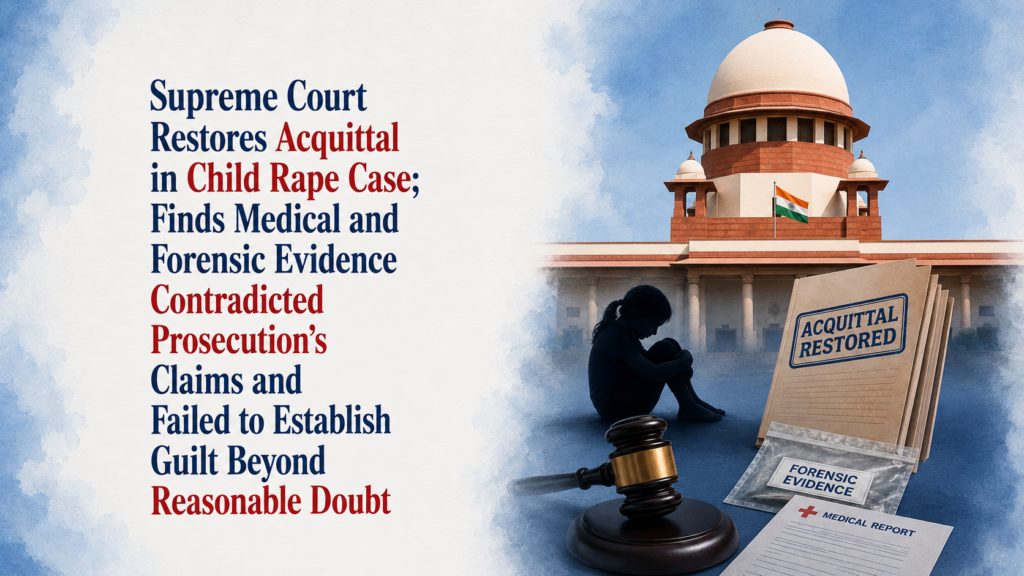
Supreme Court Restores Acquittal in Child Rape Case; Finds Medical and Forensic Evidence Contradicted Prosecution’s Claims and Failed to Establish Guilt Beyond Reasonable Doubt

Medical Examination Within Twelve Hours Found No Injury: Supreme Court Restores Acquittal After High Court Failed to Consider Crucial Forensic Evidence
Facts
Ram Singh was prosecuted under Section 376 of the Indian Penal Code for allegedly raping the approximately four-and-a-half-year-old daughter of the informant on 28 June 2009. The Trial Court acquitted him on 12 January 2010 after finding the prosecution evidence insufficient. However, the Himachal Pradesh High Court reversed the acquittal on 3 June 2016, convicted him and sentenced him to ten years’ rigorous imprisonment with a fine of ₹50,000.
According to the prosecution, the child went to the house where the appellant was residing at around 8:30 a.m. and returned approximately half an hour later. Her mother claimed that the child began crying while being undressed for a bath and disclosed that the appellant had sexually assaulted her. The mother further claimed that there were bloodstains on the child’s clothes, which she washed before lodging the FIR later that day.
The child was medically examined at 9:05 p.m. the same day. The doctor found no injury, inflammation, redness, bruising or laceration, no seminal stain or blood, and found the hymen intact. The final medical opinion subsequently concluded that there was no evidence suggesting penetration.
The seized clothes, articles from the alleged place of occurrence, vaginal samples and other exhibits were also sent to the Forensic Science Laboratory (“FSL”). The FSL found no blood or semen on the child’s clothes, the alleged place-of-occurrence articles or relevant biological samples.
Issues
The principal issues before the Supreme Court were:
- Whether the Himachal Pradesh High Court was justified in reversing the Trial Court’s acquittal.
- Whether the oral testimony of the victim and prosecution witnesses could sustain the conviction when significant aspects of their version were contradicted by medical and forensic evidence.
- Whether the alleged presence of bloodstains could be accepted despite the FSL’s negative Benzidine test.
- Whether contradictions concerning the place and manner of occurrence were material enough to create reasonable doubt.
- Whether the prosecution had ultimately established the Section 376 IPC charge beyond reasonable doubt.
Appellant’s Arguments
The appellant argued that the High Court had wrongly reversed a well-reasoned acquittal without properly addressing the material discrepancies identified by the Trial Court.
He contended that the prosecution witnesses had attempted to improve their case after the medical examination failed to reveal injuries supporting the allegation.
Particular reliance was placed upon the FSL report. Despite the mother and child consistently claiming that there had been blood on the child’s clothes, the Benzidine test detected no blood on those clothes. No blood or semen was detected on the mat and other articles seized from the alleged place of occurrence either.
The appellant therefore argued that the High Court had overlooked crucial scientific evidence while reversing the acquittal.
Respondent’s Arguments
The State of Himachal Pradesh supported the High Court’s judgment.
It argued that the Trial Court had failed to appreciate the prosecution evidence in its proper perspective and that the child victim had herself narrated the alleged incident.
According to the State, there was no reason to disbelieve the victim merely because the medical evidence did not corroborate every aspect of her testimony. It argued that medical evidence could not automatically override ocular evidence.
The State therefore maintained that the Trial Court’s acquittal was perverse and that the High Court was justified in reversing it.
Analysis of the Law
The Supreme Court examined the prosecution evidence cumulatively rather than in isolation.
The Court did not lay down a proposition that absence of injuries or negative forensic findings by themselves necessarily disprove sexual assault. Instead, it examined whether the particular prosecution narrative in this case remained reliable when tested against the contemporaneous medical and scientific evidence.
The mother and victim had specifically asserted the presence of blood on the child’s clothes. Yet the medical examination conducted within approximately twelve hours revealed no injury whatsoever on or around the private parts.
The doctor further stated that in the case of penetration involving a child of such tender age, redness would persist for approximately twenty-four hours and some injury would ordinarily be expected. No such injury was present.
The FSL findings provided an additional contradiction. No blood was detected on the child’s clothes despite the specific prosecution allegation of bloodstaining. The Court considered this a relevant circumstance that could not simply be ignored.
Precedent / Evidentiary Analysis
The judgment primarily turned on an evaluation of the medical, forensic and ocular evidence, rather than an extensive discussion of prior judicial precedents.
An important part of the Court’s analysis concerned the reliability of the Benzidine test for detecting blood.
The appellant relied upon a study published in the Indian Journal of Modern Research and Reviews, Volume 2, Issue 6, June 2024, according to which blood could be detected through the Benzidine test even after repeated washing, up to the tenth wash irrespective of detergent use.
The Court also referred to Modi’s A Textbook of Medical Jurisprudence and Toxicology, 28th Edition, which states that negative screening results are reliable and that negative areas need not ordinarily undergo further examination.
Thus, the mother’s explanation that she had washed the child’s clothes did not render the negative forensic result irrelevant.
Court’s Reasoning
Medical Evidence
The Court placed considerable importance on the fact that the child was medically examined within twelve hours of the alleged occurrence.
The examination disclosed:
- no injury;
- no inflammation or redness;
- no bruising or laceration;
- no blood or seminal stain;
- an intact hymen; and
- ultimately, no medical evidence suggesting penetration.
These findings directly undermined specific components of the prosecution narrative concerning pain, injury and bleeding.
Forensic Evidence
The prosecution consistently asserted that blood was present on the child’s clothes. However, the FSL’s Benzidine test detected no blood on those clothes.
The FSL also detected neither blood nor semen on the mat and baithak seized from the alleged place of occurrence.
The Supreme Court held that when the oral statements were read together with the final medical report and FSL report, they created a grave doubt regarding the prosecution version.
Contradiction Regarding Place of Occurrence
There was also a significant inconsistency concerning where the alleged assault occurred.
The victim stated that the incident took place on a cot on which Jaidev Sharma used to sleep. The Investigating Officer, however, stated that the incident occurred in the kitchen and that the victim had also identified the kitchen as the location.
Critically, the Investigating Officer admitted that there was no cot or bed in the kitchen.
The Supreme Court held that this contradiction further created doubt about the place of occurrence.
High Court’s Error in Reversing Acquittal
The Trial Court had considered these discrepancies and found the prosecution witnesses unreliable.
The High Court, however, treated the contradiction concerning the place of occurrence as immaterial and proceeded to accept the prosecution evidence without adequately considering either the final medical report or the FSL report.
The Supreme Court held that the prosecution evidence had to be considered as a whole.
When the oral evidence was tested against the medical examination and FSL findings, a serious doubt emerged regarding the prosecution’s account. The material therefore fell short of establishing guilt beyond reasonable doubt.
Conclusion
The Supreme Court held that the Trial Court had rightly acquitted Ram Singh.
The High Court erred in reversing that acquittal without properly considering the medical and forensic evidence, which materially undermined the prosecution’s version.
The Supreme Court found that the evidence was insufficient to establish the offence under Section 376 IPC beyond reasonable doubt and instead created a serious doubt regarding the prosecution case.
Accordingly, the Court allowed the appeal, set aside the Himachal Pradesh High Court’s judgment dated 3 June 2016 and restored the Trial Court’s acquittal. Since Ram Singh was already on bail, his bail bonds were cancelled.
Case Details
Case: Ram Singh v. State of Himachal Pradesh
Court: Supreme Court of India
Citation: 2026 INSC 830
Case Number: Criminal Appeal No. 1052 of 2016
Judges: Hon’ble Mr. Justice Ujjal Bhuyan and Hon’ble Mr. Justice Atul S. Chandurkar
Date: 11 August 2026
Result: Appeal allowed; High Court conviction and ten-year sentence set aside; Trial Court’s acquittal under Section 376 IPC restored.