Supreme Court Acquits Two Friends of Murder; Holds Medical Evidence Supported Accidental Drowning and Last-Seen Theory, Suspicious Conduct Failed to Prove Homicide

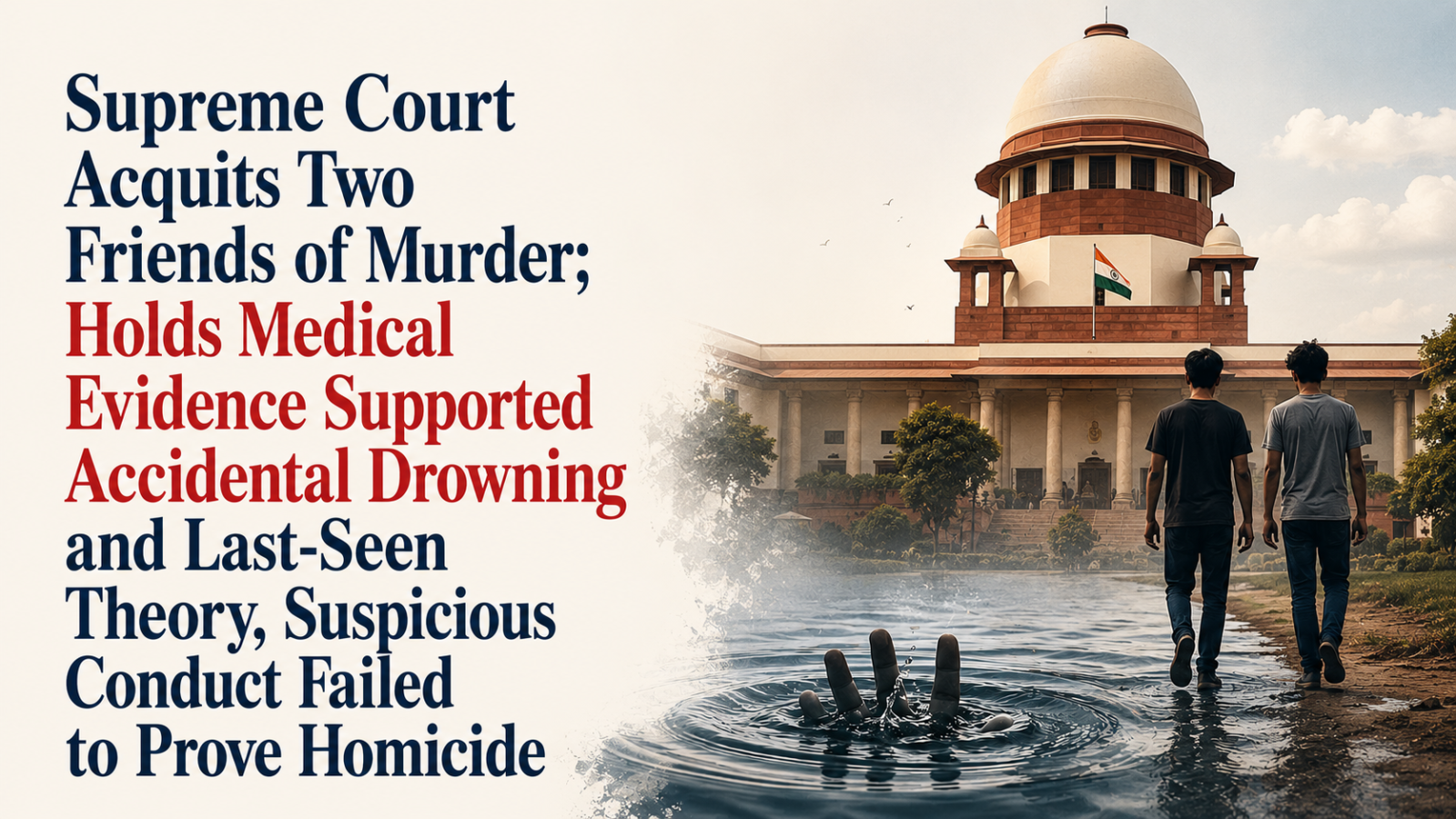
Supreme Court Acquits Accused in 2006 Drowning Case; Holds Suspicious Conduct, Last-Seen Theory and Belated Motive Failed to Prove Premeditated Murder
Facts
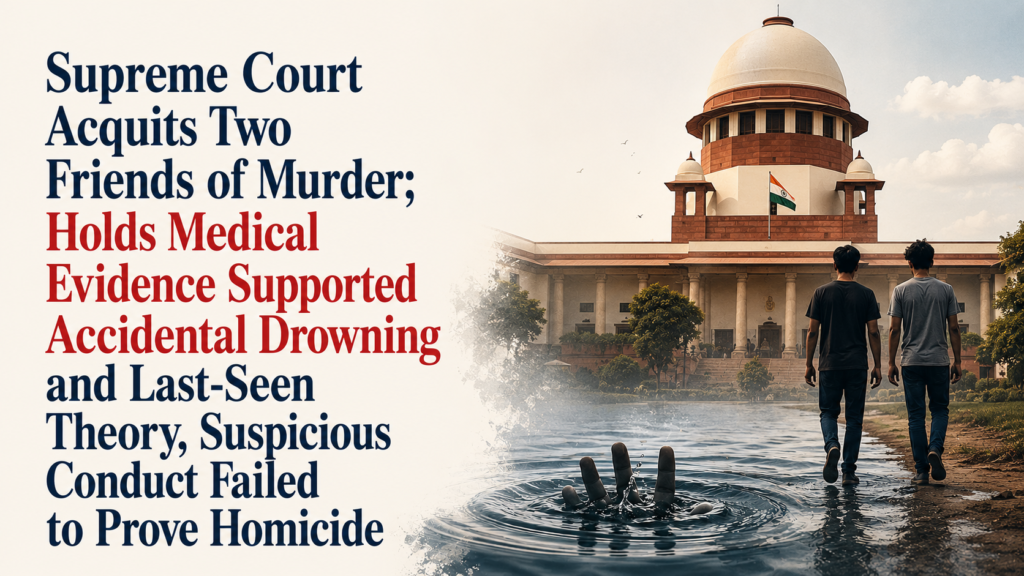
The appellants, Taher Vajiyuddin Rangwala and another, were accused of murdering their friend, whose body was subsequently recovered from a river. On the morning of 17 July 2006, the deceased left his house with the two appellants, ostensibly to go to Ankleshwar to play volleyball. When he did not return, his family began searching for him. His clothes and belongings were eventually discovered on the riverbank.
The appellants later voluntarily came to the deceased’s house and stated that the three had gone swimming in the river, where the deceased accidentally drowned. According to them, they panicked, fled from the spot and subsequently went to watch a movie. The deceased’s body was recovered the following morning. The post-mortem recorded the cause of death as asphyxia due to drowning.
Significantly, allegations of murder were not immediately made. An FIR alleging motive and murder was registered approximately four months later, on 3 November 2006.
The prosecution relied principally upon motive, the last-seen-together theory, the appellants’ presence at the river, their subsequent conduct, their alleged false statements to the deceased’s family, and certain admissions allegedly contained in their bail application.
The Trial Court convicted both appellants under Sections 302, 34 and 201 read with Section 120B IPC, sentencing them to life imprisonment for murder along with other substantive sentences. The High Court affirmed the convictions.
Issues
The principal issues before the Supreme Court were:
- Whether the prosecution had proved that the deceased’s death was homicidal rather than an accidental drowning.
- Whether the chain of circumstantial evidence was complete enough to establish the appellants’ guilt beyond reasonable doubt.
- Whether the last-seen circumstance, alleged motive and subsequent conduct of the appellants could sustain a murder conviction.
- Whether the medical evidence supported the prosecution’s allegation that the deceased was assaulted and thereafter deliberately drowned.
- Whether the Trial Court and High Court were justified in rejecting the defence hypothesis of accidental drowning.
Petitioner’s/Appellants’ Arguments
The appellants contended that there was no evidence establishing homicidal death. Their consistent explanation was that the deceased accidentally drowned while the three friends were bathing in the river and that they fled because they panicked.
They emphasised that the prosecution’s alleged motive was fabricated and had surfaced only after an unexplained delay of approximately four months in registration of the FIR.
The appellants further relied heavily upon the medical evidence. The doctor had acknowledged that the injuries found on the deceased could have been caused while bathing or as the body was carried by the river and came into contact with hard objects such as stones.
Thus, while the appellants admitted being with the deceased, they argued that this circumstance was equally consistent with their defence of accidental drowning and could not establish murder.
Respondent’s Arguments
The State sought affirmation of the conviction, arguing that the circumstances relied upon by the prosecution collectively established the appellants’ culpability.
The State particularly relied upon evidence concerning four soda bottles allegedly purchased before the incident. Only three bottles were subsequently returned, and the appellants were allegedly wet and intoxicated when they returned them.
It was argued that the deceased had been assaulted with the missing soda bottle and that the surrounding circumstances indicated premeditation.
The State also relied upon the appellants’ conduct after the incident, including their failure immediately to inform the deceased’s family, their allegedly false explanation regarding where they had left him, and their decision to go to a movie after the drowning.
Analysis of the Law
The Supreme Court approached the case fundamentally as one resting upon circumstantial evidence.
The Court first examined whether the foundational circumstance necessary for a murder prosecution — namely, that the deceased suffered a homicidal death — had itself been established.
The medical evidence did not support such a conclusion. The cause of death was cardio-respiratory arrest due to asphyxia caused by drowning. Although three injuries were found on the body, they were not grievous, and the doctor accepted that they could have occurred while bathing or when the body came into contact with stones while being carried by the river.
Crucially, the Court found that the post-mortem evidence could not establish the prosecution theory that the deceased had first been hit on the head, rendered unconscious and thereafter deliberately drowned. Instead, the medical evidence leaned towards accidental drowning.
The Court further examined the prosecution’s remaining circumstances individually rather than permitting suspicion arising from the appellants’ behaviour to substitute for proof.
Precedent Analysis
The judgment does not undertake an extensive discussion of separately identified precedents governing circumstantial evidence. Instead, the Supreme Court applies the settled criminal-law requirement that circumstances relied upon against an accused must establish guilt and exclude a reasonable hypothesis consistent with innocence.
The Court particularly cautioned against drawing rigid presumptions from human behaviour. Addressing the High Court’s reliance upon the appellants going to a movie and returning soda bottles after the incident, the Supreme Court observed that human responses to adversity cannot necessarily be predicted.
Accordingly, abnormal, foolish or reprehensible conduct could not, without supporting evidence, bridge gaps in the prosecution’s case and establish murder beyond reasonable doubt.
Court’s Reasoning
The Supreme Court identified several fundamental deficiencies in the prosecution case.
First, homicidal death itself was not established. Medical evidence instead supported the possibility of accidental drowning.
Second, the alleged motive was considered an afterthought. Despite the alleged hostility, the deceased’s family had apparently permitted him to leave with the appellants, and the evidence indicated a friendly relationship between them.
Third, the appellants themselves admitted being last seen with the deceased. Therefore, the last-seen circumstance did not undermine their defence because their case was precisely that all three had gone to the river and the deceased accidentally drowned.
Fourth, the witnesses concerning the purchase of soda bottles could not materially advance the murder case. Their dock identification was unreliable because they were not previously acquainted with the appellants and no test identification parade had been conducted.
Fifth, another prosecution witness had seen the three men together at the river, drinking before entering the water. Rather than establishing murder, his testimony showed that the riverbank was frequented by other people. The Court considered it unlikely that the appellants would select such a public location in broad daylight to carry out a premeditated murder.
Finally, the Court refused to treat the appellants’ subsequent conduct as proof of murder. Their fleeing without attempting to rescue their friend and thereafter going to a movie was undoubtedly reprehensible, but reprehensible behaviour was not equivalent to an incriminating circumstance proving homicide.
The Supreme Court concluded that the hypothesis of accidental drowning was substantially more plausible than premeditated murder, and the hypothesis of innocence remained clearly available.
Conclusion
The Supreme Court held that the prosecution had failed to establish the circumstances necessary to sustain the appellants’ conviction for murder.
The evidence did not establish that the death was homicidal; the medical evidence supported accidental drowning; the alleged motive appeared belated; the last-seen circumstance was consistent with the defence case; and the appellants’ suspicious or reprehensible conduct after the incident could not substitute for proof beyond reasonable doubt.
Accordingly, the Supreme Court reversed the judgments of both the Trial Court and the High Court, acquitted the appellants, and directed their immediate release if they were not required in any other case. The appeal was allowed.
Case Details
Case: Taher Vajiyuddin Rangwala & Anr. v. State of Gujarat
Court: Supreme Court of India
Case Number: Criminal Appeal No. 76 of 2020; 2026 INSC 859
Judge: Justice J.B. Pardiwala and Justice K. Vinod Chandran
Date: 13 August 2026
Result: Appeal allowed; Trial Court and High Court judgments reversed; appellants acquitted and directed to be released forthwith if not required in any other case.