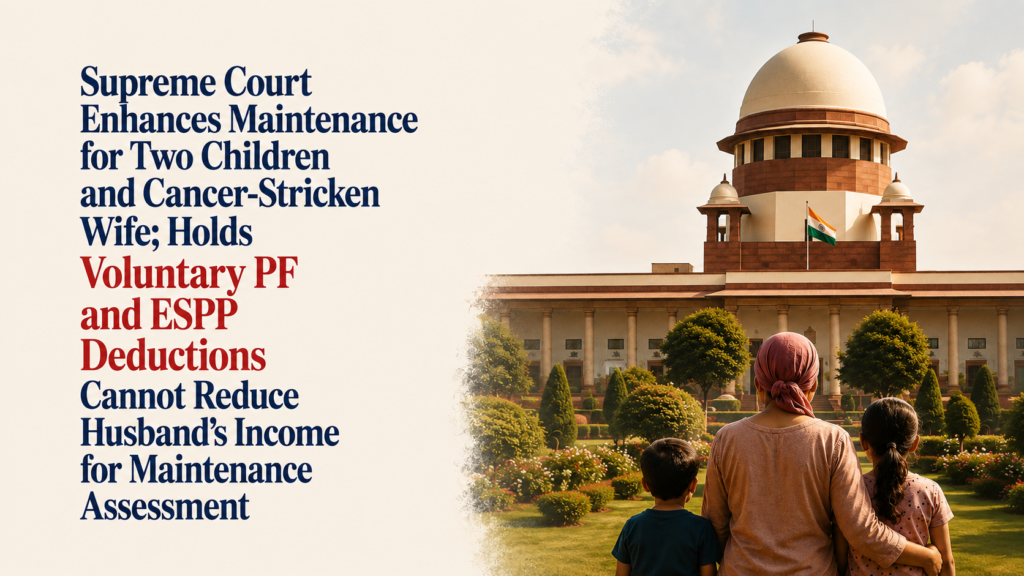
Supreme Court Enhances Maintenance for Two Children and Cancer-Stricken Wife; Holds Voluntary PF and ESPP Deductions Cannot Reduce Husband’s Income for Maintenance Assessment

Supreme Court Raises Child Maintenance to ₹1.5 Lakh Monthly; Holds PF and Employee Stock Contributions Cannot Be Treated Like Mandatory Tax Deductions
Facts
The appeals arose from a matrimonial dispute between Harpreet Sawhney, the appellant-wife, and Puneet Sharma, the respondent-husband. Their marriage was solemnised on 9 December 2004 according to Sikh rites in New Delhi, and two sons were born from the marriage in 2011 and 2014.
Their matrimonial relationship subsequently deteriorated, and on 21 June 2018 the husband left the wife and their two children. The wife instituted divorce proceedings under Section 13(1)(ia) of the Hindu Marriage Act, 1955 before the Family Court at Tis Hazari, Delhi. Along with the divorce petition, she sought ₹2 lakh per month as interim maintenance for herself and the two minor children under Sections 24 and 26 of the HMA.
In January 2021, the Family Court declined maintenance to the wife but awarded ₹37,000 per child per month from 17 September 2019 to 31 December 2020 and ₹40,000 per child thereafter. The Court recorded the wife’s net monthly income at ₹91,000 and the husband’s at ₹2.70 lakh.
The Delhi High Court affirmed that order, observing that maintenance is determined through reasonable approximation rather than mathematical exactitude and noting substantial school fees, mortgage payments, tuition, sports and extracurricular expenses.
In October 2022, the wife sought enhancement from ₹40,000 to ₹85,000 per child, relying upon documented monthly expenditure of ₹1,66,847 for the children and increased school fees.
In July 2024, the Family Court enhanced maintenance to ₹50,000 per child per month from April 2024. The wife challenged this before the Delhi High Court. During the appeal, she was diagnosed with aggressive breast cancer, following which the High Court directed the husband to pay her an additional ₹20,000 per month from December 2024.
On 14 August 2025, the High Court enhanced combined maintenance for the children to ₹1,25,000 per month from April 2024 and recorded the husband’s undertaking to transfer the vehicle to the wife.
The wife approached the Supreme Court seeking reconsideration of the maintenance quantum.
Issues
The principal issues before the Supreme Court were:
- Whether the ₹1,25,000 monthly maintenance for both children fixed by the Delhi High Court adequately reflected their actual expenses and the financial capacity of the parents.
- Whether deductions towards Provident Fund (PF) and Employee Stock Purchase Plans (ESPPs) could be treated as compulsory deductions while determining the husband’s disposable income.
- Whether such deductions should be treated differently from mandatory liabilities such as income tax and professional tax.
- Whether the wife’s aggressive breast cancer and consequent treatment expenses justified enhancement of her personal maintenance.
- Whether the ₹20,000 monthly interim maintenance earlier granted to the wife survived or required reconsideration after it was omitted from the High Court’s final order.
- Whether the maintenance awarded to the children should be enhanced in light of their documented expenditure and the husband’s financial position.
Appellant-Wife’s Arguments
The wife argued that the combined monthly expenditure of the two children was ₹1,66,847, independent of other household expenses borne by her.
She contended that the High Court had incorrectly treated various deductions from the husband’s salary as compulsory deductions.
In particular, deductions towards ESPPs and similar investments were voluntary contributions and could not legitimately be used to reduce his income for calculating maintenance.
The wife further relied upon her deteriorating health after being diagnosed with aggressive breast cancer. Since both children resided with her and she was responsible for their day-to-day care, her treatment expenditure substantially affected her ability to meet the shortfall between the maintenance received and the children’s actual expenses.
Respondent-Husband’s Arguments
The judgment does not separately reproduce detailed oral submissions advanced by the husband before the Supreme Court.
The record, however, reflects his earlier position that the expenditure claimed by the wife was excessive and that certain deductions had to be taken into account while assessing his actual disposable income.
Before the High Court, his salary was stated to be approximately ₹4 lakh per month with an average annual bonus of ₹6 lakh, resulting in an estimated monthly income of ₹4.5 lakh. The High Court had deducted ₹1,64,856 towards what it characterised as compulsory deductions and treated his remaining monthly income as approximately ₹2.8 lakh.
Analysis of the Law
Maintenance Must Reflect Real Financial Capacity
The Supreme Court’s analysis demonstrates that maintenance cannot be calculated merely by accepting the employee’s salary after every deduction appearing on the payslip.
The Court examined the true character of each deduction to determine whether it genuinely reduced the husband’s financial resources or merely redirected part of his earnings into assets or benefits ultimately accruing to him.
This distinction was decisive in reassessing his effective income.
Mandatory Taxes Distinguished From Accumulating Investments
The Court specifically differentiated income tax and professional tax from deductions towards Provident Fund and ESPPs.
Income tax and professional tax constitute mandatory outgoings that permanently reduce the employee’s available income.
PF and ESPP contributions, however, are fundamentally different because the amounts ultimately accrue for the employee’s own benefit and may be withdrawn or realised in the future.
Accordingly, such contributions cannot simply be equated with compulsory statutory taxes for the purpose of artificially reducing disposable income in a maintenance proceeding.
Children’s Maintenance Must Reflect Their Actual Needs
The record showed that the children’s documented monthly expenditure was approximately ₹1.66 lakh.
The Supreme Court therefore found the High Court’s combined award of ₹1.25 lakh per month insufficient and requiring reconsideration.
The Court ultimately fixed maintenance at ₹75,000 per child per month, totalling ₹1.5 lakh.
Medical Circumstances of Custodial Parent Are Relevant
The Court separately considered the wife’s aggressive breast cancer and the medical expenditure arising from her treatment.
The wife was also the parent with whom both children resided and who bore their day-to-day care.
The Court therefore treated her medical condition as a relevant circumstance in fixing maintenance rather than viewing the children’s maintenance and her own financial circumstances in complete isolation.
Precedent Analysis
The Supreme Court judgment does not undertake any detailed discussion or application of earlier reported precedents on maintenance.
The decision is primarily based upon the financial material and factual circumstances of the parties, including:
- the husband’s actual income;
- the nature of deductions claimed against that income;
- documented expenditure on the children;
- the wife’s medical condition;
- the prior maintenance orders; and
- the respective financial responsibilities of the parties.
The judgment’s principal legal significance therefore lies in its treatment of PF and ESPP contributions while assessing disposable income for maintenance, rather than in the application of a particular earlier precedent.
Court’s Reasoning
The Supreme Court first held that the maintenance quantum fixed by the Delhi High Court required reconsideration.
The High Court had estimated the husband’s monthly income at approximately ₹4.5 lakh, including his annual bonus, but had deducted ₹1,64,856 towards what it described as compulsory deductions, leaving approximately ₹2.8 lakh per month.
The Supreme Court found that this approach did not adequately distinguish between genuine compulsory outgoings and contributions that continued to constitute assets or financial benefits of the husband.
In particular, Provident Fund and ESPP deductions ultimately benefited the husband. Unlike income tax and professional tax, these amounts were not permanent charges because they accrued to his account and could be withdrawn or realised in future.
The Court also took specific notice of the wife’s cancer treatment expenses and the fact that she was looking after both children.
The Delhi High Court had previously granted her ₹20,000 per month as interim maintenance in December 2024. However, this amount was not mentioned in the High Court’s final judgment of August 2025.
The Supreme Court therefore considered it appropriate to enhance her personal maintenance from ₹20,000 to ₹30,000 per month, particularly considering her medical expenditure.
For the children, the Court enhanced the combined maintenance from ₹1,25,000 to ₹1,50,000 per month, i.e., ₹75,000 per child, with effect from 1 January 2025.
Importantly, the Court clarified that this would not prevent the wife from seeking a further enhancement if circumstances subsequently changed.
Conclusion
The Supreme Court disposed of the appeals by enhancing the maintenance payable by the husband.
The maintenance for the two children was increased to ₹1,50,000 per month in total—₹75,000 per child—with effect from 1 January 2025.
The wife’s personal maintenance was enhanced from ₹20,000 to ₹30,000 per month, particularly considering the expenses associated with her cancer treatment.
The Court held that deductions such as Provident Fund and ESPPs cannot be treated in the same manner as mandatory taxes, since they ultimately accrue for the employee’s own benefit and are capable of being withdrawn in future.
The husband was also required to honour his undertaking concerning transfer of the vehicle, and the Court directed him to do the needful within three months.
Case Details
Case: Harpreet Sawhney v. Puneet Sharma
Court: Supreme Court of India
Case Number: Civil Appeals arising out of SLP (C) Nos. 31815–31816 of 2025; 2026 INSC 822
Judges: Justice Sanjay Karol and Justice Nongmeikapam Kotiswar Singh
Date: 10 August 2026
Result: Maintenance enhanced to ₹75,000 per month for each child and ₹30,000 per month for the wife; husband directed to comply with consequential obligations within three months.