Supreme Court Holds Single Composite Appeal Maintainable Against Common Judgment Deciding Suit and Counterclaim; Restores Property Appeal Rejected by Courts for Want of Two Appeals

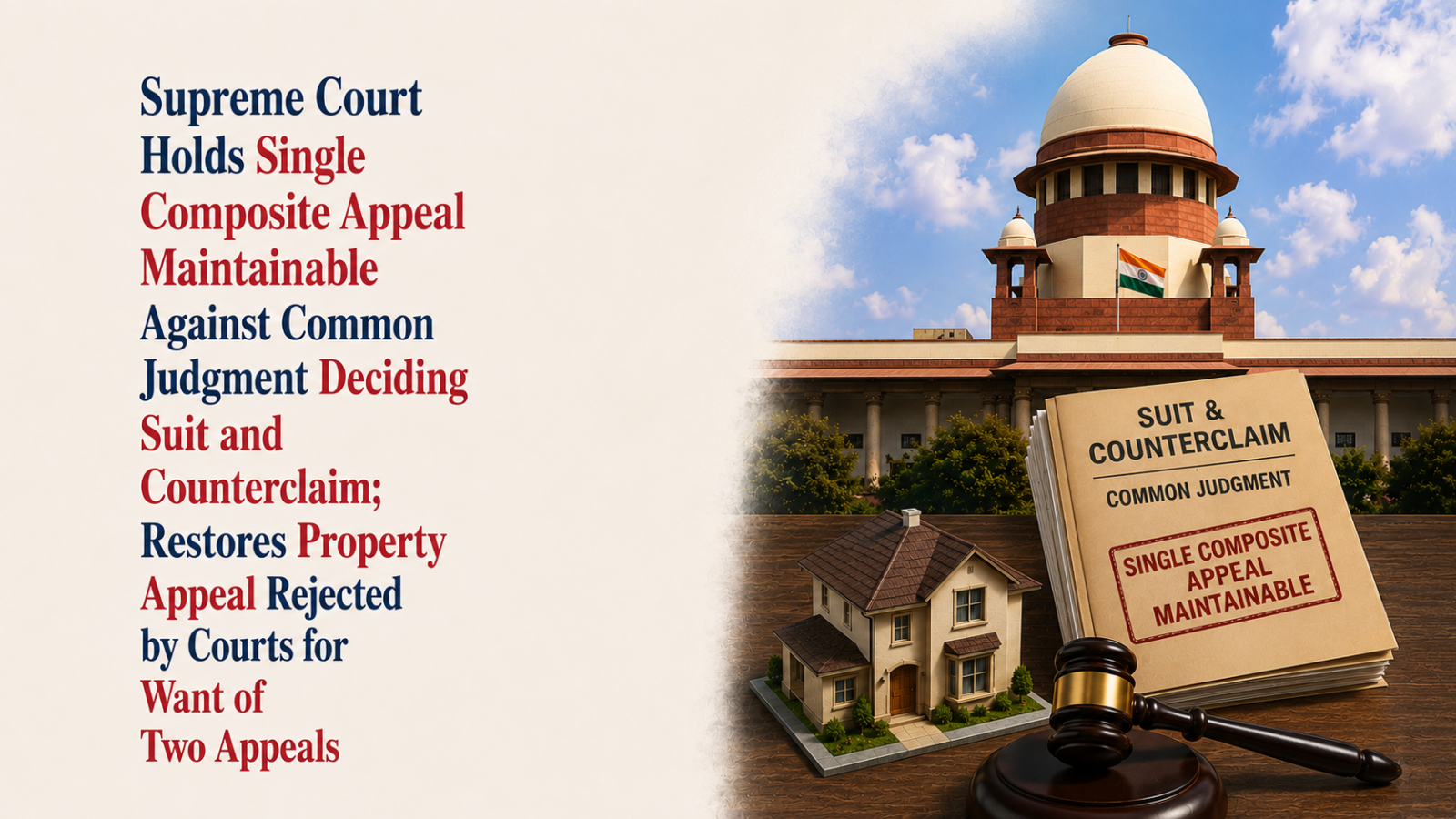
Supreme Court Holds Number of Decrees Does Not Decide Number of Appeals; Permits Composite Challenge to Common Judgment on Suit and Counterclaim
Facts
The dispute arose from a civil suit concerning rights over immovable property. The plaintiffs claimed a half share in the property and sought an injunction restraining interference, while the defendants raised a counterclaim asserting ownership over the entire property.
The Trial Court allowed the plaintiffs’ suit and dismissed the defendants’ counterclaim. The defendants challenged the decision by filing a single appeal. The First Appellate Court entertained that appeal, dismissed the plaintiffs’ suit and allowed the defendants’ counterclaim.
In second appeal, however, the High Court held that the defendants’ single first appeal was incompetent. Relying upon Ramesh Chand v. Om Raj and Others, it held that because the Trial Court had decreed the suit while rejecting the counterclaim, two separate appeals ought to have been filed.
The High Court consequently rejected the single appeal, invoking principles of waiver, estoppel and finality.
The defendants approached the Supreme Court.
The central question before the Court was therefore procedural but significant: where a suit and counterclaim are disposed of by a single common judgment, must two separate appeals be filed, or can both determinations be challenged through one composite appeal?
Issues
The Supreme Court considered:
- Whether two separate appeals are mandatory when a suit and counterclaim are adjudicated by a single common judgment.
- Whether the answer changes depending upon whether the Trial Court draws one composite decree or two separate decrees.
- Whether a counterclaim, although treated as a cross-suit under Order VIII Rule 6A CPC, requires an independent appeal.
- Whether failure to institute two separate appeals attracts the principles of res judicata, waiver or estoppel.
- What procedural requirements must be satisfied when a litigant files a single composite appeal challenging both the suit decree and the determination of the counterclaim.
Appellants’ Arguments
The appellants argued that the Trial Court had actually drawn up only one decree.
Therefore, when the Court itself had prepared a single decree from the common judgment, their appeal could not legitimately be dismissed merely because they had not filed two separate appeals.
They relied particularly upon Narhari v. Shanker and Charan Singh v. Ram Saroop.
Their essential contention was that the suit and counterclaim had been adjudicated together through one trial and one common judgment. Requiring multiple appeals in such circumstances would unnecessarily multiply proceedings and elevate procedural form over substantive justice.
Respondents’ Arguments
The respondents supported the High Court’s decision and relied upon Ramesh Chand v. Om Raj and Others and Premier Tyres Ltd. v. Kerala State Road Transport Corporation.
Their position was that even if only one decree was formally drawn up, the adjudication of the suit and counterclaim represented two distinct determinations.
Accordingly, two separate appeals were required to challenge them effectively.
The respondents also invoked the principles of res judicata and finality, contending that failure to independently challenge one of the determinations allowed it to attain finality.
Analysis of the Law
Nature of a Counterclaim Under Order VIII Rule 6A CPC
The Supreme Court extensively examined Rules 6A to 6D of Order VIII CPC.
Order VIII Rule 6A permits a defendant to raise a counterclaim against the plaintiff’s claim. Under Rule 6A(2), the counterclaim has the effect of a cross-suit, enabling the Court to pronounce a common final judgment covering both the original claim and counterclaim.
The counterclaim is deemed to be a plaint and the plaintiff is entitled to file a written statement in response.
The Court held that Rule 6C reinforces the integrated character of the proceedings. A counterclaim that ought properly to be adjudicated through an independent suit can be excluded; conversely, a counterclaim appropriately retained in the suit is ordinarily sufficiently connected to permit adjudication through the same trial and evidence.
Order XX Rule 19 CPC
The Supreme Court next examined Order XX Rule 19.
It held that Rule 19(2), which makes decrees in suits involving counterclaims subject to the same appellate provisions applicable to ordinary suits, does not require two appeals.
Equally, it does not prohibit the filing of a single composite appeal.
Section 96 and Order XLI Rule 1 CPC
The Court acknowledged the settled principle that an appeal under Section 96 CPC lies from a decree and not merely from a judgment.
However, it noted the significant legislative amendment to Order XLI Rule 1 with effect from 1 July 2002. The provision now requires the memorandum of appeal to be accompanied by the judgment, rather than mandatorily requiring the decree itself.
According to the Supreme Court, the legislative intention behind this amendment was clear: delays in drawing up decrees should not frustrate appellate remedies, and unnecessary multiplicity of proceedings should be avoided.
Precedent Analysis
Narhari v. Shanker
In Narhari, separate decrees arising from one suit and founded upon the same judgment were challenged. One appeal was dismissed as time-barred and the other was consequently dismissed on res judicata.
The Supreme Court had rejected that reasoning, holding in substance that where there was one suit and one judgment deciding the entire controversy, the decrees were effectively one for purposes of the dispute.
Charan Singh v. Ram Saroop
In Charan Singh, the Trial Court dismissed the suit and allowed the counterclaim, but only one appeal was filed.
The Supreme Court had recognised the requirement of two appeals in the circumstances of that case but, in furtherance of justice, permitted a separate memorandum of appeal to be filed without requiring another certified copy of the judgment.
The present Bench examined that decision while resolving the broader procedural controversy.
Shankar Masu Dokare v. Shobha Subhash Dokare
The Bombay High Court had taken the view that where there is one suit and a counterclaim, there is one trial, one finding and one decision, and consequently two appeals are not mandatory.
The Supreme Court noted this reasoning while examining the conflicting approaches adopted by different High Courts.
Abdul Nazer v. Lakshmana Das
The Kerala High Court ultimately held that a single appeal was maintainable against decrees passed respectively in the suit and counterclaim.
The decision emphasised the unified nature of suit-counterclaim proceedings and the legislative objective of avoiding multiplicity.
Rajni Rani v. Khairati Lal
The Supreme Court clarified that Rajni Rani had been misinterpreted by certain High Courts.
That judgment dealt with whether rejection of a counterclaim under Order VII Rule 11 should be challenged by appeal or revision. It did not hold that whenever a suit and counterclaim are ultimately decided together, two appeals must invariably be filed.
The Court stressed that Rajni Rani itself recognised that the purpose of the counterclaim mechanism is to avoid multiplicity and piecemeal adjudication.
Premier Tyres Ltd. v. Kerala State Road Transport Corporation
The respondents relied upon Premier Tyres for the proposition that where connected suits result in separate decrees and one decree is not appealed, the unchallenged determination may attain finality and operate as res judicata.
The Supreme Court distinguished this line of reasoning from the particular statutory scheme governing a suit and counterclaim adjudicated together as a unified proceeding.
Court’s Reasoning
The Supreme Court noted that High Courts across the country had adopted conflicting approaches on whether one or two appeals were required where a suit and counterclaim were decided through a common judgment.
It held that the counterclaim mechanism under Order VIII Rule 6A was introduced specifically to enable interconnected disputes between the plaintiff and defendant to be determined together.
The Court further observed that procedural rules are intended to facilitate justice rather than create unnecessary obstacles. It relied upon the established principle that procedure is the means of achieving justice and should not become an impediment where the essentials of the prescribed procedure have been satisfied.
The Court found that whether a particular State follows the practice of drawing one decree or two decrees after a common judgment is ultimately not decisive for determining the maintainability of the appeal.
Composite Appeal Permissible
The Supreme Court authoritatively held that where a suit and counterclaim are adjudicated by a single common judgment, the determination of both can be challenged through one composite appeal.
However, the Court prescribed two important procedural safeguards:
- the memorandum of the composite appeal must separately set out the grounds challenging the decree in the suit and the determination of the counterclaim; and
- the appeal must be valued as two separate appeals, with the requisite court fees paid accordingly.
This rule applies irrespective of whether the Trial Court has drawn up one decree or two decrees.
The Court held that this interpretation allows disputes to be adjudicated on merits and prevents purely procedural objections based on estoppel or res judicata arising merely because two separate appeals were not instituted.
Exception: Separate Adjudications at Different Stages
The Court nevertheless recognised that there may be circumstances requiring separate appeals.
For example, where a counterclaim is rejected independently while the original suit remains pending, an appeal may have to be filed against that rejection. If the original suit is subsequently decided, that later decree would independently require an appeal.
Thus, the composite-appeal principle specifically concerns situations where the suit and counterclaim are adjudicated together by a common judgment.
Conclusion
The Supreme Court held and declared that a common judgment adjudicating both a suit and counterclaim can henceforth be challenged through a single composite appeal.
Such an appeal must contain separate grounds challenging each determination and must be valued, with court fees paid, as though there were two appeals.
In the present case, considering the considerable uncertainty in the law that had existed until the judgment, the Supreme Court set aside the orders of the High Court and First Appellate Court and restored the first appeal.
The appellants were permitted to file a fresh memorandum containing separate grounds and to pay the additional court fees. The First Appellate Court was directed to consider the matter on merits as expeditiously as possible.
The Supreme Court clarified that although another appeal was being permitted in this particular case because one appeal already existed, henceforth a challenge to a common judgment deciding a suit and counterclaim may be brought through a composite appeal in accordance with the requirements laid down in the judgment.
The Court also directed its Registry to forward a copy of the judgment to all High Courts.
Case Details
Case: Basudev & Ors. v. Sanjay Kumar & Ors.
Court: Supreme Court of India
Citation: 2026 INSC 831
Case Number: Civil Appeal arising out of SLP (C) No. 4338 of 2025
Judges: Hon’ble Mr. Justice J. B. Pardiwala and Hon’ble Mr. Justice K. Vinod Chandran
Date: 11 August 2026
Result: Appeal allowed; High Court and First Appellate Court orders set aside; first appeal restored; Supreme Court holds that a single composite appeal can challenge a common judgment deciding both a suit and counterclaim, subject to separate grounds, appropriate valuation and court fees.