

Court’s decision
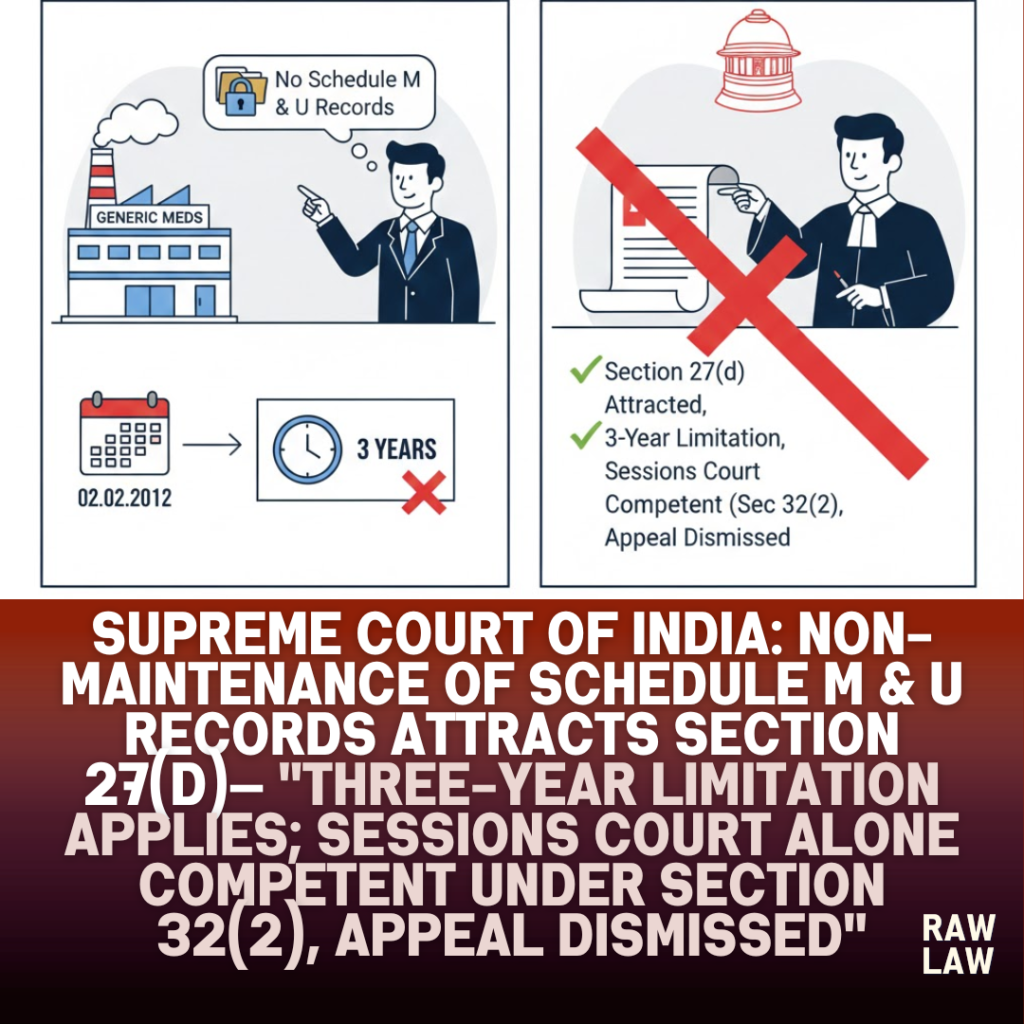
The Supreme Court of India dismissed a criminal appeal challenging the Himachal Pradesh High Court’s refusal to quash prosecution under the Drugs and Cosmetics Act, 1940. The Court held that failure to maintain statutory manufacturing and testing records under Schedule M and Schedule U constitutes contravention of Section 18(a)(vi), punishable under Section 27(d), and not merely an offence under Section 18-B read with Section 28-A.
It further ruled that limitation of three years under Section 468 CrPC applied, as Section 27(d) prescribes imprisonment up to two years. The committal to the Court of Sessions was upheld in view of Section 32(2).
Facts
The appellants, a pharmaceutical manufacturing firm and its responsible officers, were inspected on 22.07.2014 by a Drug Inspector. During inspection, serious discrepancies were allegedly found in records relating to manufacture, testing, and distribution of Pseudoephedrine Hydrochloride.
The firm was directed to produce complete purchase, sale, and consumption records under Sections 22(1)(cca) and 18-B of the Act. A re-inspection on 05.08.2014 allegedly revealed tampering, missing entries, and discrepancies in Batch Production Records.
The drug and documents were seized. After show cause proceedings and sanction dated 15.09.2016, a complaint was filed on 27.02.2017 alleging contravention of Sections 18(a)(vi), 18-B and Rule 74 read with Schedules M and U, punishable under Sections 27(d) and 28-A.
Cognizance was taken on 06.04.2017 and the matter committed to the Special Judge.
Issues
The Supreme Court considered:
- Whether non-maintenance of records under Schedule M and U amounts only to violation of Section 18-B punishable under Section 28-A (maximum one year), or also constitutes contravention under Section 18(a)(vi) punishable under Section 27(d).
- Whether the complaint was barred by limitation under Section 468 CrPC.
- Whether the case ought to have been tried summarily by a Magistrate under Section 36-A, or by the Court of Sessions in view of Section 32(2).
Appellants’ arguments
The appellants contended that the alleged violations related solely to record maintenance and non-furnishing of information, falling squarely within Section 18-B and punishable under Section 28-A.
Since Section 28-A carries a maximum punishment of one year, limitation under Section 468 CrPC would be one year. The complaint, filed more than two and a half years after inspection, was therefore time-barred.
It was further argued that the omission of Section 27(d) in the cognizance order was substantive and not clerical.
The appellants also invoked Section 36-A, arguing that offences punishable up to three years are triable summarily by a Magistrate.
Reliance was placed on Miteshbhai J. Patel v. Drug Inspector and Cheminova (India) Ltd. v. State of Punjab.
Respondent’s arguments
The State contended that the allegations were not confined to mere record keeping. The complaint alleged grave manipulations in batch production records, misuse of habit-forming drugs, and violations of manufacturing norms under Schedule M.
Such contravention falls under Section 18(a)(vi), which prohibits manufacture in violation of Chapter IV or Rules made thereunder, attracting punishment under Section 27(d).
Since Section 27(d) prescribes imprisonment up to two years, limitation under Section 468 CrPC would be three years. The complaint was filed within that period.
It was also argued that Section 32(2) mandates that offences under Chapter IV be tried by courts not inferior to a Court of Session.
Analysis of the law
The Court examined Sections 18(a)(vi), 18-B, 27(d), 28-A, 32(2), 36-A and 36-AB of the Act.
Section 18(a)(vi) prohibits manufacture or sale of any drug in contravention of Chapter IV or Rules made thereunder. Schedule M prescribes good manufacturing practices, and Schedule U mandates detailed batch manufacturing records.
The Court held that violation of mandatory manufacturing and documentation norms under Schedule M and U amounts to contravention under Section 18(a)(vi).
Section 27(d) prescribes punishment of one to two years for such contravention. Section 18-B addresses maintenance of records but does not exclude applicability of Section 18(a)(vi) where manufacturing violations are involved.
Precedent analysis
The Court distinguished Miteshbhai J. Patel, noting that in that case the complaint was filed beyond three years, whereas in the present case it was within three years.
Similarly, Cheminova (India) Ltd. was inapplicable because there the complaint was filed after expiry of limitation.
The Court clarified that where allegations disclose an offence under Section 27, limitation of three years applies.
Court’s reasoning
The Court observed that the complaint specifically alleged manipulation of batch production records, discrepancies in manufacturing and testing, and misuse of controlled drugs.
Such allegations are not confined to mere non-furnishing of records under Section 18-B but relate to contravention of manufacturing provisions.
Accordingly, punishment under Section 27(d) was attracted. Under Section 468 CrPC, offences punishable up to two years carry a limitation of three years. The complaint, filed within two years and six months, was within time.
On trial forum, the Court held that Section 32(2) expressly provides that no court inferior to a Court of Session shall try offences under Chapter IV. Section 36-A excludes offences triable by Sessions from summary trial.
Thus, committal to the Sessions Court was legally correct.
Conclusion
The Supreme Court held that:
• Violations of Schedule M and U fall under Section 18(a)(vi)
• Punishment under Section 27(d) applies
• Limitation of three years governs
• Committal to Sessions Court was proper
Finding no error in the High Court’s refusal to quash the complaint, the appeal was dismissed.
Implications
This judgment clarifies:
- Manufacturing record violations can attract Section 27(d), not merely Section 28-A.
- Limitation under Section 468 CrPC depends on maximum punishment attracted by the charged provision.
- Section 32(2) overrides summary trial provisions where Chapter IV offences are alleged.
- Technical omissions in cognizance orders may be treated as clerical where complaint clearly invokes penal provision.
The ruling strengthens regulatory enforcement under the Drugs and Cosmetics Act and narrows limitation-based quashing strategies.
Case law references
- Miteshbhai J. Patel v. Drug Inspector (2025 SCC OnLine SC 2203)
Held complaints under Section 27 must be filed within three years; distinguished as complaint there was beyond limitation. - Cheminova (India) Ltd. v. State of Punjab (2021) 8 SCC 818
Complaint quashed as barred by limitation; inapplicable where filed within three years. - Union of India v. Ashok Kumar Sharma (2021) 12 SCC 674
Discussed jurisdictional aspects under the Act; distinguished.
FAQs
1. Does failure to maintain manufacturing records attract Section 27(d)?
Yes, where it amounts to contravention of Schedule M or U during manufacture, it falls under Section 18(a)(vi) punishable under Section 27(d).
2. What is the limitation period for prosecution under Section 27(d)?
Three years under Section 468 CrPC, as maximum punishment extends to two years.
3. Are such offences triable summarily by a Magistrate?
No. Section 32(2) mandates trial by a Court not inferior to a Court of Session.


