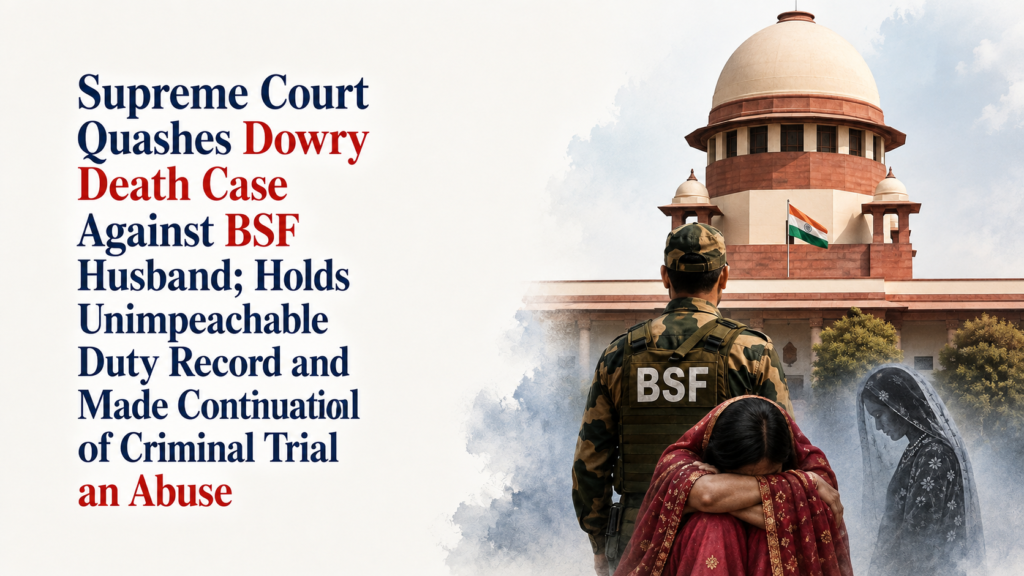
Supreme Court Quashes Dowry Death Case Against BSF Husband; Holds Unimpeachable Duty Record and Parents’ Acquittal Made Continuation of Criminal Trial an Abuse

Supreme Court Quashes Dowry Death Case Against Husband Alone; Holds Continuing Trial After Parents’ Acquittal on Same Evidence Would Serve No Justice
Facts
Rahul challenged the Allahabad High Court’s judgment dated 12 December 2025 refusing to quash the charge-sheet and criminal proceedings against him under Sections 498-A and 304-B IPC and Sections 3/4 of the Dowry Prohibition Act, 1961.
Rahul married Anshul @ Payal on 21 April 2014. On 13 June 2016, her father lodged an FIR alleging that Rahul and his family members had subjected her to cruelty and harassment for dowry, particularly demanding a Tata Safari, and that she had consequently been killed by hanging.
The contemporaneous inquest recorded that both the room in which the deceased was found hanging and the main entrance of the house were locked from inside and had to be broken open by the police. The post-mortem recorded the cause of death as asphyxia due to ante-mortem hanging.
Rahul was serving in the Border Security Force (“BSF”). An official certificate issued by the Commandant, 141 Battalion, BSF showed that during the relevant period he was on official Dak-runner duty connected with the Frontier Headquarters in Shillong and New Delhi. Crucially, the record showed that he remained in Shillong on the date of death, 13 June 2016, and left for Delhi only at 5:30 a.m. on 14 June 2016.
Meanwhile, Rahul’s parents were separately tried on charges arising from the same FIR. On 17 October 2025, the Sessions Court acquitted both parents after a full trial, finding that the prosecution had failed to establish cruelty, dowry demand or homicidal involvement beyond reasonable doubt.
Despite the acquittal and the BSF records, the Allahabad High Court refused to quash Rahul’s prosecution, holding that his plea of alibi was a disputed question requiring proof at trial. Rahul therefore approached the Supreme Court.
Issues
The Supreme Court formulated three principal questions:
- Whether the High Court was justified in refusing, at the quashing stage, to consider the effect of an official service certificate establishing Rahul’s absence from the place of occurrence.
- Whether the acquittal of Rahul’s parents on substantially the same allegations and evidence arising from the same FIR materially affected the sustainability of the prosecution against him.
- Whether, considering the entire record cumulatively, continuation of the criminal proceedings constituted an abuse of process warranting quashing.
Appellant’s Arguments
Rahul argued that his defence was not based upon a bare or self-serving plea of alibi but upon contemporaneous official BSF records whose authenticity was never disputed.
He relied upon the inquest report showing that both the main gate and room were locked from inside. According to him, this circumstance was prima facie inconsistent with the prosecution theory that family members had murdered the deceased and thereafter staged a hanging.
He further relied upon the post-mortem report, which showed death by ante-mortem hanging and contained no other injury indicative of homicidal violence, restraint or struggle.
Most importantly, the BSF certificate demonstrated that he was in Shillong during the relevant period and travelled to Delhi only one day after the incident.
Rahul also relied upon the acquittal of his parents, arguing that the trial court’s rejection of the allegations of cruelty and dowry harassment had substantially destroyed the very substratum of the prosecution.
He distinguished Rajendra Singh v. State of U.P., arguing that the alibi there was based upon private affidavits produced before the High Court, whereas his defence rested upon an official contemporaneous BSF service record whose authenticity was never challenged.
Respondents’ Arguments
The State of Uttar Pradesh argued that a plea of alibi is ordinarily a matter of evidence, with the burden resting upon the accused to establish it with sufficient certainty.
It contended that the BSF certificate, without supporting travel records, tickets, movement orders or other transportation details, could not conclusively establish that Rahul was incapable of reaching the place of occurrence. It relied upon Shaikh Sattar v. State of Maharashtra and Rajendra Singh v. State of U.P.
The complainant similarly argued that the charge-sheet cited 17 witnesses, whose credibility and evidentiary value could only be tested at trial.
According to the complainant, Rahul’s assertion of absence was essentially an alibi under Section 11 of the Evidence Act and could not be accepted merely on the basis of an untested movement or duty certificate at the quashing stage.
Analysis of the Law
The Supreme Court reiterated that powers under Section 482 Cr.P.C. must ordinarily be exercised sparingly and cannot be converted into a mini-trial.
However, this restriction does not require a court to ignore material demonstrating that continuation of a prosecution would itself constitute a manifest abuse of process.
The Court referred to the categories formulated in State of Haryana v. Bhajan Lal, particularly cases where allegations do not disclose an offence, where uncontroverted allegations and collected evidence fail to make out an offence, and where continuation of proceedings amounts to abuse of the criminal process.
More significantly, the Court applied the four-step test laid down in Rajiv Thapar v. Madan Lal Kapoor for considering defence material at the quashing stage:
- The material relied upon must be sound, reasonable and of sterling and impeccable quality.
- It must effectively rule out the factual assertions underlying the charges.
- It must be material which the prosecution has not refuted or cannot justifiably refute.
- Continuing the trial despite such material must amount to an abuse of process and fail to serve the ends of justice.
The Court held that all four requirements were satisfied.
Precedent Analysis
The Court relied principally upon State of Haryana v. Bhajan Lal for the established categories in which criminal proceedings may be quashed to prevent abuse of process.
Rajiv Thapar v. Madan Lal Kapoor supplied the governing four-step test for determining whether defence material can be considered before trial.
The Court relied upon Prashant Bharti v. State (NCT of Delhi) for the proposition that where defence material is of sterling and unimpeachable quality and completely demolishes the prosecution case, criminal proceedings can be quashed at the pre-trial stage rather than compelling an accused to undergo a futile trial.
It also relied upon Harshendra Kumar D. v. Rebatilata Koley, which permits a High Court exercising Section 482 jurisdiction to consider documents beyond suspicion or doubt where they bear directly upon whether continuation of proceedings would amount to abuse of process.
The Court referred to Mirza Iqbal @ Golu v. State of Uttar Pradesh, which concerned consideration of an accused’s official duty record showing absence from the place of occurrence.
The Supreme Court distinguished Rajendra Singh v. State of U.P. There, the alleged alibi depended upon private affidavits whose truth required testing through cross-examination. The Court held that Rajendra Singh does not establish an inflexible rule prohibiting courts from ever considering documentary material concerning an accused’s presence or absence at the quashing stage.
Court’s Reasoning
1. Medical and Inquest Evidence
The post-mortem unequivocally recorded death by asphyxia resulting from ante-mortem hanging. Apart from the ligature mark, there were no abrasions, contusions, nail marks, defensive injuries or other indications of resistance, restraint or physical assault.
Although medical evidence alone could not conclusively establish suicide rather than homicide, the complete absence of injuries ordinarily expected in a violent struggle was significant when the prosecution alleged homicidal conduct involving several persons.
The inquest report further showed that both the room and the main entrance were locked from inside. The prosecution had offered no satisfactory explanation for how the accused could have murdered the deceased, staged a hanging and nevertheless left both doors bolted from inside.
2. BSF Service Record Was Unimpeachable Material
The Supreme Court rejected the High Court’s treatment of Rahul’s defence as an ordinary plea of alibi.
The BSF certificate was an official record maintained by a wing of the Armed Forces in the ordinary course of duty. It had been produced from the earliest stage, its authenticity was never questioned, and even the Investigating Officer acknowledged that material had emerged showing Rahul was on duty at the relevant time.
The Court held that such material possessed the unimpeachable character contemplated in Prashant Bharti and Harshendra Kumar. Compelling an accused to undergo a full Sessions trial despite such admitted official proof would elevate procedural formalism over substantial justice.
3. Absence Alone Did Not Automatically Defeat Section 304-B
Importantly, the Supreme Court clarified that Rahul’s physical absence from Meerut at the precise time of death did not by itself exonerate him from Section 304-B IPC.
Cruelty or dowry harassment “soon before” death could theoretically occur even when the husband was elsewhere, including through telephonic threats or demands.
However, the prosecution had obtained no call-detail records to independently verify the solitary allegation of a telephonic dowry demand attributed specifically to Rahul.
4. Effect of Parents’ Acquittal
The Court clarified that acquittal of co-accused does not automatically exonerate another accused merely because the allegations arise from the same FIR.
The decisive factor here was that there was no distinguishing evidence against Rahul.
The evidence against him was essentially the same evidence which had already been found insufficient after a full trial to convict his parents. The only additional allegation—a telephonic demand—was substantially neutralised by the absence of call-detail records and the unimpeached proof of Rahul’s absence from the State.
Consequently, forcing Rahul alone to undergo a full Sessions trial after his parents had been acquitted on the self-same evidence would subject him to the ordeal and stigma of a prosecution whose substratum had already collapsed.
Conclusion
The Supreme Court held that the four-step test in Rajiv Thapar was fully satisfied.
Rahul’s BSF service certificate was undisputed, its issuing authority and contents were not questioned, and when considered alongside the result of the connected trial, the material demonstrated that continuation of the prosecution would be a futile exercise.
The Court emphasised that courts should not permit criminal proceedings to continue merely because a technical prima facie case can be extracted from the bare allegations in an FIR when unimpeached documentary material demonstrates that the prosecution has no realistic foundation.
Accordingly, the Supreme Court allowed the appeal, set aside the Allahabad High Court judgment dated 12 December 2025 and quashed FIR/Case Crime No. 227 of 2016, Charge-sheet No. 09A/16 dated 15 July 2017 and all consequential proceedings against Rahul alone.
Case Details
Case: Rahul v. State of Uttar Pradesh & Another
Court: Supreme Court of India
Citation: 2026 INSC 825
Case Number: Criminal Appeal arising out of SLP (Crl.) No. 2939 of 2026
Judges: Hon’ble Mr. Justice Sanjay Karol and Hon’ble Mr. Justice Augustine George Masih
Date: 11 August 2026
Result: Appeal allowed; Allahabad High Court order set aside; FIR, charge-sheet and all consequential criminal proceedings quashed insofar as they concerned the appellant.