Supreme Court Reinstates Technician Terminated for Not Disclosing NCR; Holds Unknown Criminal Case Cannot Constitute Suppression and Awards 50% Back Wages With Consequential Benefits

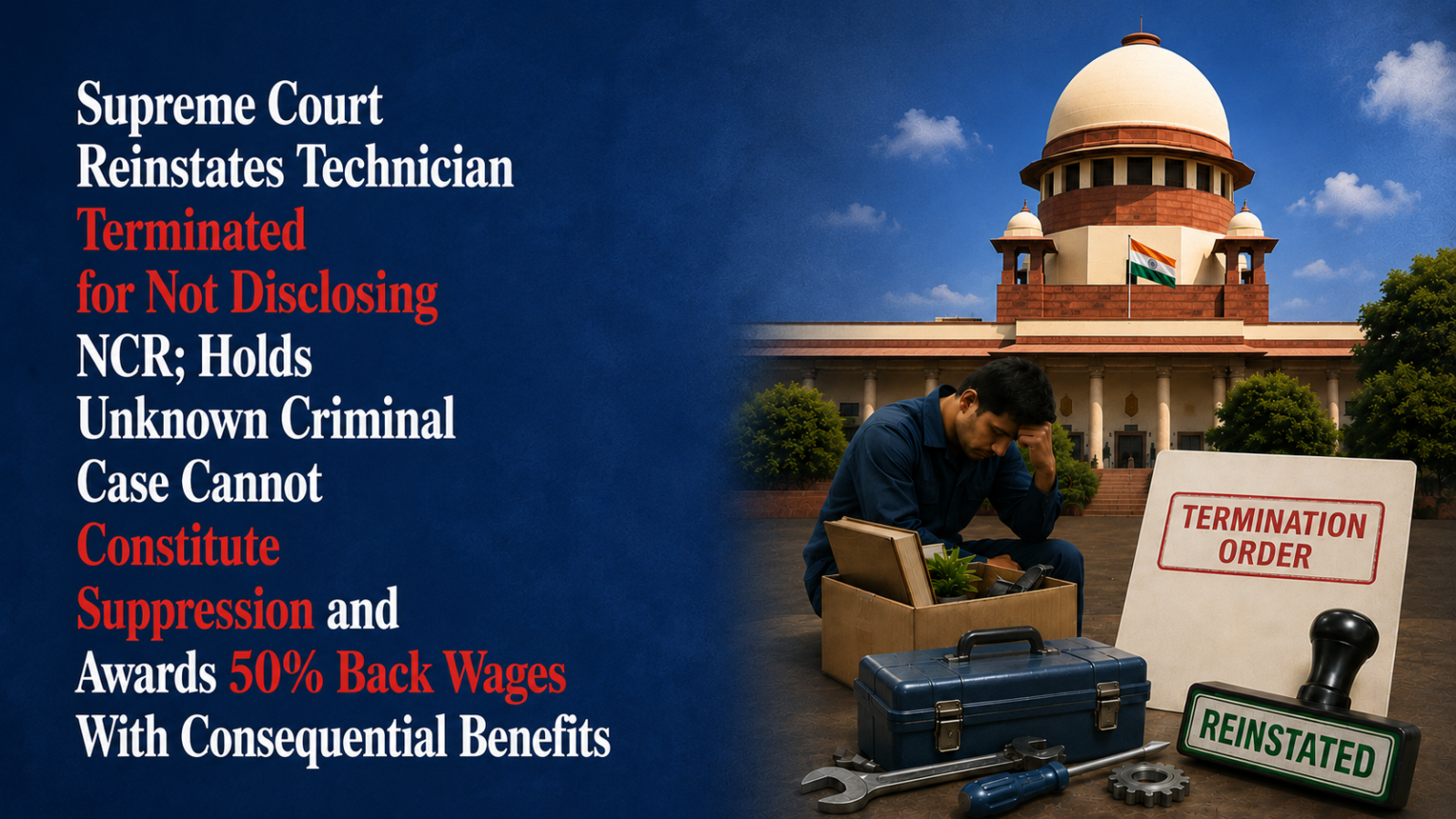
Supreme Court Holds Alternative Remedy No Absolute Bar to Writ Against Illegal Termination; Reinstates Employee Removed for Allegedly Concealing NCR
Facts
The appellant, Shatrughn Yadav, was appointed as a Technician (Process) by Fertilizers and Chemicals Travancore Ltd. (“FACT”) on 5 May 2021 on consolidated pay for an initial tenure of two years. In his attestation form, he declared that no criminal case was pending against him.
Approximately six months later, FACT sought verification of his criminal antecedents from the District Magistrate. By a letter dated 22 March 2022, the District Magistrate disclosed that a Non-Cognizable Report (“NCR”) dated 3 April 2019 under Sections 323 and 504 IPC had been registered against the appellant. FACT consequently issued a show-cause notice asking why his services should not be terminated for furnishing false information.
The appellant replied that he had no knowledge of the NCR. He had never received summons, been arrested, or otherwise been informed about it. He also produced a police character certificate dated 9 July 2020—which was issued after registration of the NCR—stating that there was no adverse entry against him according to the concerned police records.
The appellant subsequently produced the final report showing that the police had found no evidence against him and had deleted his name from the array of accused persons. Nevertheless, FACT cancelled his appointment by an order dated 5 August 2023.
The appellant challenged the termination before the Kerala High Court. The Single Judge declined interference, holding that whether he knew about the NCR involved a disputed question of fact. The Division Bench affirmed that decision. The appellant therefore approached the Supreme Court.
Issues
The Supreme Court considered:
- Whether failure to disclose a criminal case can constitute suppression or false information when the employee had no knowledge of its existence.
- Whether termination automatically follows whenever an undisclosed criminal antecedent is subsequently discovered.
- What inquiry an employer must undertake before terminating an employee for suppression of criminal antecedents.
- Whether the documentary material established the appellant’s claim that he genuinely did not know about the NCR.
- Whether the employer was required to consider the nature of the offence, nature of employment, employee’s role and eventual outcome of the criminal proceedings.
- Whether the availability of a remedy under the Industrial Disputes Act and the existence of disputed factual questions barred the High Court from exercising writ jurisdiction.
Appellant’s Arguments
The appellant relied principally upon Avtar Singh v. Union of India and Ravindra Kumar v. State of U.P.
He argued that the relevant question was not simply whether information concerning a criminal proceeding had been omitted from the verification form, but whether there had been deliberate suppression or furnishing of false information. Termination could not automatically follow merely because a criminal antecedent subsequently came to the employer’s notice.
He maintained that he genuinely had no knowledge of the NCR. He had never been summoned, arrested, called to the police station or associated with the investigation.
His bona fides were supported by the police character certificate dated 9 July 2020 and by the subsequent police certificate confirming that his name had been deleted from the case because no evidence was found against him.
He further argued that the High Court had erred in declining jurisdiction merely because his knowledge of the NCR was characterised as a disputed question of fact.
Respondents’ Arguments
FACT argued that disclosure of criminal antecedents was a condition attached to the appellant’s appointment and that his failure to disclose the NCR rendered him unsuitable for employment.
According to the respondents, the appellant was aware of the NCR but nevertheless declared that no criminal proceeding was pending against him. They also argued that his subsequent discharge from the NCR did not cure the falsity of the declaration made at the time of appointment.
FACT contended that it was improbable that the appellant did not know about the NCR because his parents were also named in it.
The respondents additionally raised a maintainability objection. According to them, the appellant ought to have pursued his remedy under the Industrial Disputes Act, 1947, particularly because the dispute allegedly involved contested factual questions.
Analysis of the Law
Alternative Remedy Does Not Absolutely Bar Writ Jurisdiction
The Supreme Court first rejected the respondents’ objection regarding maintainability.
It reiterated that the existence of an alternative statutory remedy does not constitute an absolute bar to writ jurisdiction, particularly where the legality of the termination order itself is under challenge.
Suppression Requires Knowledge
The most significant principle emerging from the judgment is that knowledge is a prerequisite to suppression.
A person cannot logically be said to have concealed or withheld a fact that was never within his knowledge.
The Supreme Court held that where the existence of the criminal antecedent itself is not shown to have been known to the candidate at the relevant time, the candidate cannot be treated as having suppressed or furnished false information concerning that antecedent.
However, the Court added an important qualification: a bare assertion of ignorance is insufficient.
The burden lies upon the candidate to establish lack of knowledge through cogent and reliable material. Otherwise, verification requirements could easily be defeated simply by pleading ignorance.
Two-Pronged Inquiry Before Termination
The Supreme Court formulated the employer’s inquiry into two distinct stages.
First, the employer must determine whether there was actually suppression or false information, having regard to:
- the employee’s knowledge at the relevant time; and
- the circumstances in which the declaration was made.
Second, even where suppression is established, the employer must examine the specific circumstances, including:
- nature and type of suppression;
- nature and gravity of the allegations;
- employee’s role in the alleged offence;
- nature of the post;
- duties attached to that post;
- effect of the antecedent upon suitability; and
- eventual outcome of the criminal proceedings, where concluded.
Only after both stages are properly undertaken can termination on the ground of suppression of criminal antecedents be legally sustained.
Precedent Analysis
Avtar Singh v. Union of India, (2016) 8 SCC 471
The Supreme Court treated Avtar Singh as the principal authority governing suppression of criminal antecedents in employment verification forms.
Avtar Singh establishes that information concerning conviction, acquittal, arrest or pending criminal proceedings must ordinarily be truthful. However, termination is not an automatic consequence of incorrect or undisclosed information.
The employer must consider the special circumstances of the case, applicable rules, nature of the criminal proceeding and other relevant considerations. Crucially, Avtar Singh expressly states that before a person can be held guilty of suppressio veri or suggestio falsi, knowledge of the relevant fact must be attributable to him.
Ravindra Kumar v. State of U.P., (2024) INSC 131
In Ravindra Kumar, relief was granted where a criminal case had not been disclosed in the verification form.
The Court considered the fact that no criminal case was pending on the relevant date because the candidate had already been acquitted. It also gave weight to a favourable character certificate and held that the candidate’s selection could not mechanically be treated as irregular merely because the affidavit contained incorrect information.
The employer was required to meaningfully assess suitability rather than mechanically punish incorrect disclosure.
Umesh Chandra Yadav v. Inspector General and Chief Security Commissioner, RPF, (2022) 14 SCC 244
The Supreme Court also relied upon Umesh Chandra Yadav, where the employee had not disclosed a criminal proceeding in which he had been dealt with as a juvenile.
The decision reiterated that even where material information is suppressed, the candidate has a right not to be dealt with arbitrarily.
The employer must objectively examine the nature of the post, nature of duties, effect of the suppression upon suitability and other circumstances instead of mechanically terminating employment.
Court’s Reasoning
1. Appellant Established That He Did Not Know About the NCR
The Court accepted the appellant’s consistent position that he had no knowledge of the NCR when he completed the verification form.
Of particular importance was the police character certificate dated 9 July 2020, issued more than a year after the NCR had been registered, which itself recorded that there were no adverse entries against him in the police records.
A subsequent police certificate further established that although the appellant had initially been named in the NCR, his name was removed after investigation because no evidence was found against him.
The certificate also confirmed that he had neither been called to the police station nor arrested.
The Supreme Court therefore concluded that, in the absence of summons, arrest, questioning or any other communication, the appellant had no means of knowing about the NCR.
2. Parents Being Named in NCR Did Not Establish His Knowledge
The respondents argued that the appellant must have known about the NCR because his parents were also named.
The Supreme Court rejected this as mere surmise.
There was no evidence that his parents had informed him about the NCR or that he had otherwise been put on notice of its existence. Such speculation could not displace the documentary material supporting his claim of ignorance.
3. No Suppression Without Awareness
The Court stated the principle in categorical terms: suppression necessarily presupposes awareness.
It would be both “illogical and unjust” to hold an employee responsible for concealing information which was never within his knowledge.
Accordingly, the first stage of the required inquiry itself failed because deliberate suppression or false disclosure had not been established.
4. Employer Failed to Assess Suitability
The termination also failed the second stage.
Although FACT had given the appellant opportunities to explain himself, the authorities had not actually assessed:
- the specific nature of the offence;
- its relevance to the post of Technician;
- the appellant’s alleged role;
- the gravity of the allegations; or
- the fact that the police ultimately found no evidence against him and deleted his name from the case.
Instead, the authorities proceeded on the assumption that the mere existence of a criminal antecedent automatically rendered him ineligible.
The Supreme Court held that this approach was impermissible.
5. Termination Was Illegal and Without Application of Mind
The Court ultimately found that the termination failed both prongs of the legal test.
There was no established suppression because the appellant did not know about the NCR, and the employer had failed to conduct the individualized assessment necessary before deciding whether the antecedent justified termination.
The termination order was consequently held to be illegal and without application of mind.
Conclusion
The Supreme Court allowed the appeal and set aside the appellant’s termination.
Finding nothing on record suggesting that he was otherwise unqualified for the post or that his work had been unsatisfactory, the Court directed FACT to reinstate him forthwith with all consequential benefits.
The Court, however, restricted his back wages to 50%, directing payment within eight weeks. If the amount was not paid within that period, it would carry interest at 6% per annum from the date it became due until actual disbursement.
The judgment therefore establishes that an employee cannot be terminated merely because an undisclosed criminal antecedent subsequently surfaces. Knowledge must first be established before non-disclosure can constitute suppression, and even thereafter the employer must independently examine the seriousness of the antecedent and its bearing upon the employee’s suitability.
Case Details
Case: Shatrughn Yadav v. The Fertilizers and Chemicals Travancore Ltd. (F.A.C.T.) & Ors.
Court: Supreme Court of India
Citation: 2026 INSC 829
Case Number: Civil Appeal arising out of SLP (Civil) No. 7197 of 2026
Judges: Hon’ble Mr. Justice Sanjay Karol and Hon’ble Mr. Justice Augustine George Masih
Date: 11 August 2026
Result: Appeal allowed; termination set aside; appellant directed to be reinstated forthwith with consequential benefits and 50% back wages, with 6% interest on delayed payment.