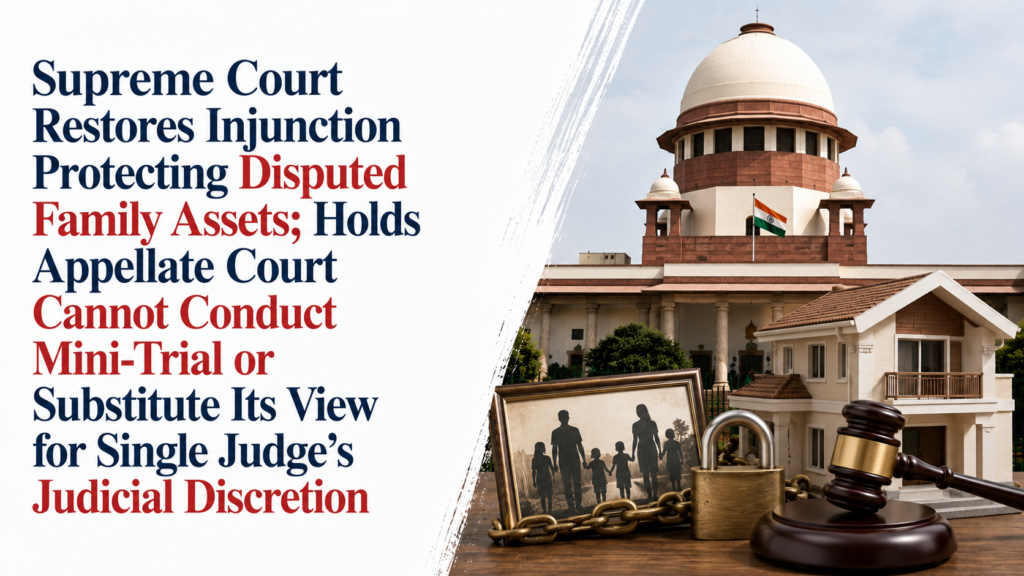
Supreme Court Restores Injunction Protecting Disputed Family Assets; Holds Appellate Court Cannot Conduct Mini-Trial or Substitute Its View for Single Judge’s Judicial Discretion

Supreme Court Limits Appellate Interference With Temporary Injunctions; Restores Restraint on Family Assets and Leaves Will, Fraud and Ownership Questions for Trial
Facts
The dispute concerned the family estate of Devinder Singh Chaudhary, who had established several companies, partnerships and trusts principally owned by him and his wife, Sita Chaudhary. He died on 5 December 2009. Competing succession claims arose: Sita Chaudhary relied upon a Will dated 26 March 2004, one son asserted a subsequent Will dated 4 October 2008, while another son claimed that the deceased had died intestate.
After the testator’s death, his granddaughter Sunanina Singh and her family began residing with Sita Chaudhary. Between December 2018 and June 2019, Sita executed several gift deeds and LLP transfer agreements transferring substantial shareholding and capital interests in family entities.
As detailed in the table on page 4 of the judgment, these transactions included 6,000 shares of Amba Promoters & Developers Pvt. Ltd.; 18,012 shares of P.E. Manning (Consultants) Pvt. Ltd.; 62% capital in Ruchi Towers LLP; 47% capital in Rama Packing & Wires Industries LLP; and 21,21,240 shares of Industrial Cables (India) Ltd.
It was further alleged that a farmhouse at Rajokri, New Delhi, was sold for ₹4.72 crore, and approximately ₹50 crore was obtained by way of loans and advances. Those funds were allegedly used by Sunanina Singh and Ajay Kadyan to purchase flats at DLF Magnolias and Magnum Towers, a factory in Uttarakhand and luxury and sports cars.
Sita Chaudhary subsequently instituted a suit in 2021 alleging that, taking advantage of her old age and health, certain family members had fraudulently procured transfers of her shareholding and LLP interests and were disposing of family properties.
She sought declarations that the transfers were null and void, restoration of the shareholding and LLP interests, and injunctions preventing further alienation of the disputed assets.
The Single Judge granted interim protection, finding prima facie material concerning undue influence, disputed testamentary rights and diversion of family assets. The defendants were restrained from creating third-party interests in properties owned by the concerned companies and LLPs and from alienating specified properties.
The Delhi High Court Division Bench, however, reversed that order on 20 March 2026. The legal representatives of the original plaintiff therefore approached the Supreme Court.
Issues
The principal issues before the Supreme Court were:
- Whether the Division Bench, while exercising appellate jurisdiction under Order XLIII Rule 1(r) CPC, could substitute its own assessment for the discretion exercised by the Single Judge in granting a temporary injunction;
- What constitutes a prima facie case for purposes of an interim injunction;
- Whether the balance of convenience and irreparable injury justified preservation of the disputed shareholding, LLP interests and immovable properties;
- Whether disputed questions concerning the Wills, undue influence, ownership, Section 14 of the Hindu Succession Act and Section 89 of the Companies Act could be conclusively examined at the interlocutory stage; and
- Whether an injunction proceeding or appeal therefrom can effectively become a mini-trial on the merits.
The Supreme Court expressly framed the controversy around the nature of interlocutory jurisdiction and the limits of appellate interference with judicial discretion in granting temporary injunctions.
Petitioner’s Arguments
The appellants contended that the Division Bench had improperly interfered with a reasoned discretionary order of the Single Judge contrary to the principle laid down in Wander Ltd. v. Antox India P. Ltd.
They alleged that Sunanina Singh, by exercising undue influence over her elderly grandmother, had effectively obtained control over almost the entire family estate.
It was specifically argued that, following the disputed transfers, Sunanina Singh controlled assets worth approximately ₹1,035 crore, compared with approximately ₹40 crore remaining with the rest of the family. Defendant Nos. 4 and 9 were alleged to have appropriated approximately 96.3% of the estate, leaving less than 4% for the remaining family members.
The appellants further argued that the Division Bench had wrongly interpreted the 2004 Will and had undertaken a detailed examination of questions that ought to have been reserved for trial.
Respondent’s Arguments
The respondents argued that Sita Chaudhary had herself approved and participated in the transactions subsequently challenged as fraudulent.
They contended that the Single Judge’s findings were themselves perverse and that the threshold permitting appellate interference under Wander Ltd. was therefore satisfied.
Accordingly, they defended the Division Bench’s decision vacating the injunction and submitted that no interference by the Supreme Court was warranted.
Analysis of the Law
Temporary Injunction Is Discretionary but Judicial
The Supreme Court explained that jurisdiction to grant temporary injunctions is statutory in form but equitable in substance.
Section 36 of the Specific Relief Act recognises preventive relief as discretionary; Section 37(1) deals with temporary injunctions; Order XXXIX Rule 1(a) CPC addresses property in danger of being wasted, damaged or alienated; and Section 94(c) CPC enables injunctions where necessary to prevent the ends of justice from being defeated. Section 151 CPC supplements these provisions through the Court’s inherent jurisdiction.
The discretion, however, is judicial rather than subjective. It must be exercised according to settled legal and equitable principles.
Object of Interim Injunction — Preserve the Subject Matter
The Court described the central purpose of an interlocutory injunction as preservation rather than adjudication.
An interim injunction decides nothing finally. It operates as a “holding operation” ensuring that the eventual trial does not become meaningless because the disputed property has disappeared or third-party interests have intervened.
Applying this principle, the Court found that the disputed shareholding, LLP interests and immovable properties constituted the very subject matter of the litigation.
If they were permitted to be alienated or encumbered during the suit, even a decree ultimately obtained by the plaintiff could become practically ineffective.
Prima Facie Case Means a Serious Question to Be Tried
The Supreme Court clarified that the threshold for establishing a prima facie case is modest.
A plaintiff is not required to establish final title or prove the entire case at the interlocutory stage. The Court must determine whether the claim is bona fide, not frivolous or vexatious, and presents a substantial or serious question requiring adjudication at trial.
Here, substantial questions existed concerning:
- the nature of Sita Chaudhary’s interest under the 2004 Will;
- whether that interest became absolute under Section 14 of the Hindu Succession Act;
- the effect and validity of the subsequently propounded 2008 Will;
- the alleged exercise of undue influence over an elderly widow; and
- the validity of the transfers through which substantial family assets allegedly passed to defendant Nos. 4 and 9.
These questions plainly required trial.
The Division Bench had therefore applied an excessively demanding standard by insisting upon a “clear prima facie nexus” and conducting detailed analysis of the Wills, the parties’ conduct and Section 89 of the Companies Act.
Balance of Convenience
The Court held that the balance of convenience clearly favoured preservation.
The injunction did not dispossess defendant Nos. 4 and 9 or prevent them from enjoying the properties. It principally prevented further alienation of assets whose ownership and provenance were disputed.
By contrast, permitting alienation could irreversibly deprive the appellants of control over family companies and permit the assets to pass into the hands of strangers.
Irreparable Injury
The Court found that alienation of controlling shareholding and creation of third-party interests in the disputed properties constituted irreparable injury.
This was not merely a monetary loss capable of being quantified and compensated through damages. Once specific family shareholding or properties passed to third parties, a subsequent monetary decree might not restore the appellants to their original position.
The Court also rejected, for interim purposes, the argument that certain properties were self-acquired. The appellants had specifically alleged that those assets were purchased from loans, advances and proceeds traceable to the family companies and disputed transfers. Whether the traceability claim was ultimately correct was a matter for trial.
Accordingly, the Court found that all three elements—prima facie case, balance of convenience and irreparable injury—coexisted.
Precedent Analysis
Wander Ltd. v. Antox India P. Ltd., 1990 Supp SCC 727
This was the central precedent governing appellate interference.
An appellate court should not ordinarily substitute its discretion for that of the court of first instance merely because it would have reached another conclusion. Interference is justified where discretion was exercised arbitrarily, capriciously, perversely or contrary to settled legal principles.
The Supreme Court found that the Single Judge’s order satisfied the established injunction principles and was neither arbitrary nor perverse. The Division Bench therefore exceeded the permissible limits of appellate review.
Dalpat Kumar v. Prahlad Singh, (1992) 1 SCC 719
The Court relied upon Dalpat Kumar to distinguish a prima facie case from prima facie title. At the interim stage, the applicant need only establish a substantial bona fide question requiring investigation and adjudication on merits.
Gujarat Bottling Co. Ltd. v. Coca Cola Co., (1995) 5 SCC 545
This decision was relied upon both for the meaning of a prima facie case and for the equitable nature of temporary injunctions. It also supported the requirement that apprehended injury must be incapable of adequate compensation through damages.
Zenit Mataplast Pvt. Ltd. v. State of Maharashtra, (2009) 10 SCC 388
The Court relied upon this authority for the proposition that interim orders exist to protect the subject matter of litigation until final adjudication so that ultimate relief is not rendered meaningless.
Shyam Sel and Power Ltd. v. Shyam Steel Industries Ltd., (2023) 1 SCC 634 and Ramakant Ambalal Choksi v. Harish Ambalal Choksi, (2024) 11 SCC 351
These decisions reinforced the Wander principle governing the limited scope of appellate interference with discretionary interlocutory orders.
American Cyanamid Co. v. Ethicon Ltd.
The Court relied upon the established principle that interlocutory proceedings are not the proper stage for resolving conflicting evidence or difficult questions of law that require mature consideration after evidence is led.
Court’s Reasoning
The Supreme Court found that the Single Judge had identified a genuine and substantial dispute concerning the family estate, alleged undue influence, disputed testamentary rights and the transfer and subsequent utilisation of family assets.
The Single Judge’s order was grounded in the three established requirements for temporary injunction—prima facie case, balance of convenience and irreparable injury—and therefore could not be characterised as arbitrary, capricious or perverse.
The Division Bench, despite correctly reciting the restrictive Wander standard, effectively reconsidered the merits itself. It interpreted clauses of the 2004 Will, assessed alleged admissions and delay, applied Section 89 of the Companies Act and examined the evidentiary nexus between particular assets and particular proceeds.
According to the Supreme Court, these were matters properly reserved for trial.
Supreme Court’s Warning Against “Mini-Trials”
An important feature of the judgment is the Court’s express disapproval of increasingly lengthy and merits-heavy interim injunction orders.
The Court observed that both trial and appellate courts were increasingly conducting what amounted to “mini-trials” on affidavits and documents at the interlocutory stage, prematurely assessing title, fraud, undue influence and the probable outcome of litigation.
The Supreme Court held that this approach is impermissible.
Orders under Order XXXIX CPC should ordinarily confine themselves to reasoned findings concerning:
- prima facie case;
- balance of convenience; and
- irreparable injury.
Courts should not examine final merits or predict the ultimate outcome of issues reserved for trial.
Conclusion
The Supreme Court allowed the appeals, set aside the Delhi High Court Division Bench judgment dated 20 March 2026 and restored the Single Judge’s order dated 29 July 2022 granting the interim injunction.
The injunction restraining further alienation and creation of third-party interests in the disputed family assets will continue until further orders of the Single Judge.
Importantly, the Supreme Court clarified that none of its observations amounted to a final determination concerning the 2004 Will, the alleged 2008 Will, intestacy, Section 14 of the Hindu Succession Act, Section 89 of the Companies Act, undue influence, fraud or whether particular properties were genuinely self-acquired. All those questions remain open for determination at trial on evidence.
The Supreme Court also directed the Single Judge to dispose of the underlying civil suit as expeditiously as possible, preferably within eight months.
Case Details
Case: Shruti Manav Sharma & Anr. v. Sunanina Singh & Ors.
Court: Supreme Court of India
Case Number: Civil Appeals arising out of SLP (C) Nos. 12592–12597 of 2026; 2026 INSC 843
Judge: Justice Pamidighantam Sri Narasimha and Justice Alok Aradhe
Date: 12 August 2026
Result: Appeals allowed; Delhi High Court Division Bench judgment set aside; Single Judge’s interim injunction restored; underlying suit directed to be decided preferably within eight months.