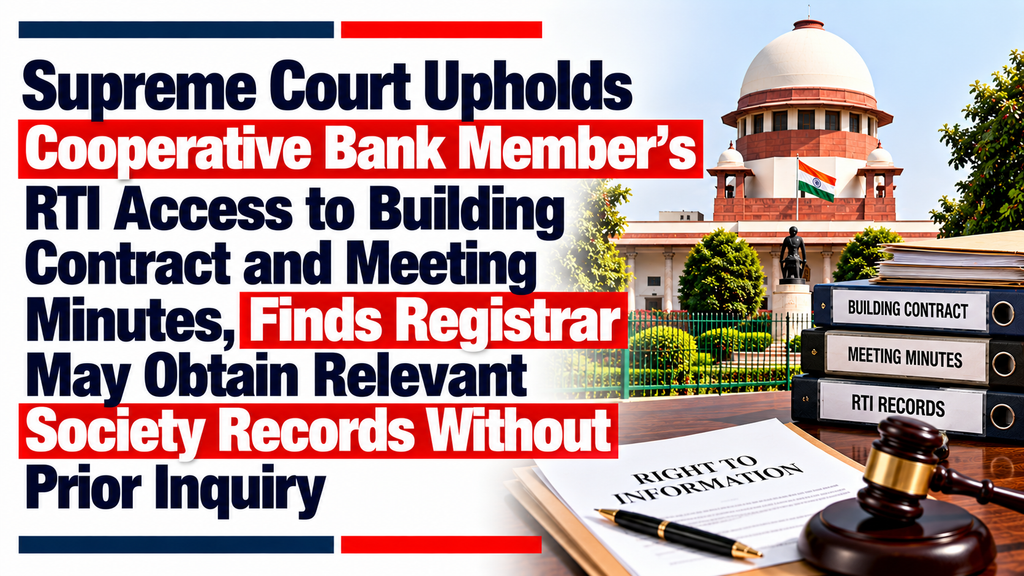
Supreme Court Upholds Cooperative Bank Member’s RTI Access to Building Contract and Meeting Minutes, Finds Registrar May Obtain Relevant Society Records Without Prior Inquiry

Supreme Court Dismisses Cooperative Bank Appeals, Orders Disclosure of Construction Contract and General Body Minutes, Clarifies Private Society Records Accessible Through Registrar’s Existing Statutory Powers
Facts
A member of Muppathadam Service Co-operative Bank Ltd. sought two documents under the Right to Information Act, 2005: the agreement engaging a labour co-operative society to construct the Bank’s building and the minutes of its last General Body Meeting. The member approached the Joint Registrar of Co-operative Societies. An initial refusal led to a High Court direction for reconsideration; on the second round, the Information Commissioner and the Kerala High Court upheld disclosure. The Bank appealed, maintaining that it was not a public authority under the RTI Act.
Issues
Whether documents belonging to a co-operative bank that is not itself a public authority fall within ‘information’ under Section 2(f) when the Registrar can access them by statute; whether access under Sections 65 and 66 of the Kerala Co-operative Societies Act, 1969 requires an already-initiated inquiry; and whether the contract and General Body minutes are exempt under Sections 8(1)(d) or 8(1)(j) of the RTI Act.
Petitioner’s Arguments
The appellant-Bank invoked Thalappalam Service Cooperative Bank to contend that it is a private entity for RTI purposes. It argued that the Registrar’s access under Sections 65–66 is conditional on a prior decision to conduct an inquiry, which had not occurred. Relying on CPIO, Supreme Court of India v. Subhash Chandra Agarwal, it asserted that such preconditions restrict what a public authority can access on an RTI request. It also raised the commercial-confidence and personal-information exemptions in Section 8(1)(d) and (j).
Respondent’s Arguments
The State Information Commissioner submitted that statutory access through the Registrar was sufficient even without characterising the Bank itself as a public authority. The Registrar’s power to inspect and supervise records exists apart from actual custody or any pending inquiry. The requesting member pointed to supervisory provisions in Section 66 and the statutory meaning of information under Section 2(f), arguing that a member was entitled to the specified contract and meeting minutes.
Analysis of the Law
Section 2(f) of the RTI Act includes material relating to a private body that a public authority can access under another law; prior physical possession is unnecessary. Section 65(2) of the Kerala Co-operative Societies Act authorises access to society records, while Section 66 confers continuing inspection and supervisory powers. A prior satisfaction may be required to initiate a formal inquiry, but inspection of records cannot depend on such satisfaction when the records may be needed to form it. RTI access remains subject to statutory exemptions and the requester’s relationship to the private body.
Precedent Analysis
In Thalappalam Service Cooperative Bank Ltd. v. State of Kerala, (2013) 16 SCC 82, co-operative societies were distinguished from public authorities, while the Registrar’s legally authorised access was preserved; confidential deposit information was separately protected. CPIO, Supreme Court of India v. Subhash Chandra Agarwal, (2020) 5 SCC 481, explained that information ‘under the control’ of an authority includes records obtainable from private bodies through statutory power, subject to applicable restrictions. CBSE v. Aditya Bandopadhyay, (2011) 8 SCC 497, was cited for the RTI Act’s disclosure framework and express exemptions.
Court’s Reasoning
The Court held that the Bank’s non-public-authority status did not defeat an application to the competent Registrar. Statutory authority to obtain records exists before a formal inquiry begins; otherwise the Registrar could not determine whether inquiry is warranted. A completed building contract was not shown to disclose trade secrets or competitive-sensitive material under Section 8(1)(d). As the applicant was a Bank member seeking the Bank’s construction contract and General Body minutes, Section 8(1)(j) did not bar disclosure. The Court expressly distinguished a request made by an unconnected third party, whose entitlement may be different.
Conclusion
On 26 October 2026, the Supreme Court dismissed both appeals and affirmed the Kerala High Court’s direction permitting disclosure. The Joint Registrar was directed to call for the construction agreement and last General Body Meeting minutes immediately, in any event within two weeks, and supply them to the requesting member. The decision does not make every co-operative society a public authority or create unrestricted third-party access; it recognises disclosure through records legally accessible to a public authority, subject to RTI exemptions.
Case: The Muppathadam Service Co-Operative Bank Ltd. v. State Chief Information Commissioner & Ors.
Court: Supreme Court of India, Civil Appellate Jurisdiction
Case Number: Civil Appeals Nos. 13906 and 13907 of 2026 (arising from SLP(C) Nos. 12283 and 12846 of 2025); 2026 INSC 1153
Judge: Hon’ble Justices J. B. Pardiwala and K. Vinod Chandran (judgment by K. Vinod Chandran, J.)
Date: 26 October 2026
Result: Both appeals dismissed; Joint Registrar directed to procure and supply the two requested documents within two weeks.