Supreme Court Upholds Registered Sale Despite Unpaid Balance Consideration; Holds Seller’s Remedy Is Recovery of Money, Not Cancellation of Completed Sale Deed

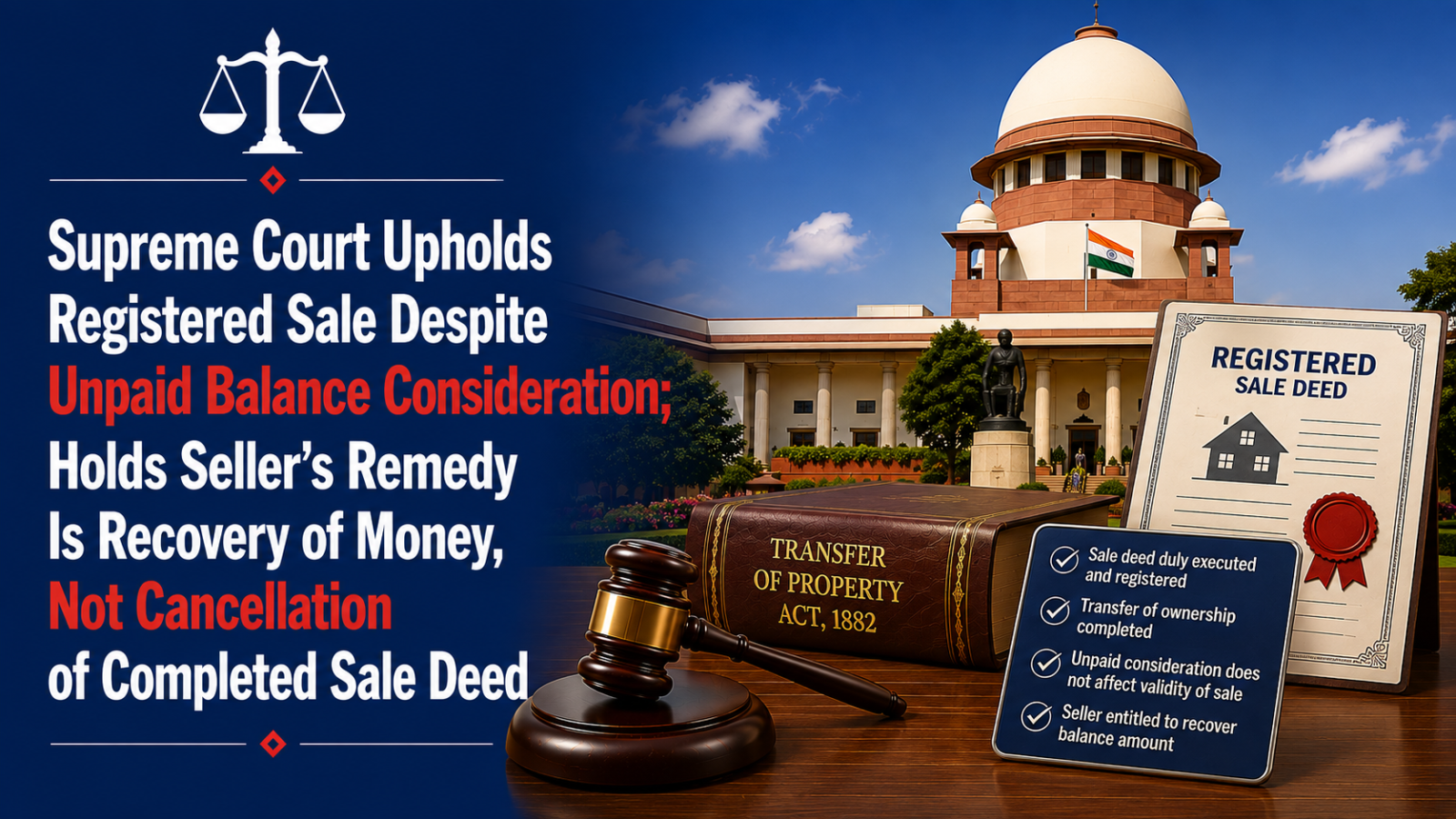
Supreme Court Holds Non-Payment of Balance Sale Price Does Not Void Registered Sale; Seller Must Sue for Recovery
Facts
The dispute concerned two registered sale deeds dated 10 March 1975. The original plaintiffs, a son and his mother, sought a declaration that both sale deeds were void and inoperative, their cancellation, declaration of their absolute ownership over the properties and a permanent injunction against the purchaser.
According to the plaintiffs, they had outstanding debts with financial institutions and government departments. The defendant initially agreed to find a purchaser for their properties but eventually agreed to purchase the lands himself. The consideration for each property was Rs. 7,000, of which only Rs. 2,500 was paid upfront. The remaining Rs. 4,500 for each property was retained by the defendant on the understanding that he would use it to discharge the plaintiffs’ outstanding liabilities.
When the defendant allegedly failed to discharge those liabilities, subsequent agreements were executed under which he undertook to pay the balance amount and repay the loans. The Trial Court nevertheless held that the sale transactions were concluded sales and that neither sale deed provided that failure to pay the balance consideration would result in cancellation. The suit was therefore dismissed, and the First Appellate Court affirmed that decision.
In second appeal, the High Court reversed the concurrent findings and declared the plaintiffs owners of the properties, holding the sale deeds inoperative because the purchaser had failed to establish payment of the balance consideration or discharge of the debts.
The purchaser’s legal heirs thereafter approached the Supreme Court.
Issues
- Whether a registered sale deed becomes void or inoperative merely because the entire sale consideration has not been paid.
- Whether non-payment of the balance consideration entitled the sellers to seek cancellation of the sale deeds and declaration of ownership.
- Whether the High Court was justified in reversing the concurrent decisions of the Trial Court and First Appellate Court in second appeal.
- What remedy was available to the sellers where the purchaser failed to pay the promised balance consideration.
Appellants’ Arguments
The appellants, being the legal heirs of the original purchaser, relied principally upon Vidhyadhar v. Manikrao & Anr. and Dahiben v. Arvindbhai Kalyanji Bhanusali.
They contended that under Section 54 of the Transfer of Property Act, 1882, payment of the entire consideration at the time of execution is not a prerequisite for completion of a sale. A sale can validly be completed where the price is paid, promised, or partly paid and partly promised. Consequently, failure to subsequently pay the balance consideration could not invalidate the registered conveyances.
Respondents’ Arguments
The respondents, representing the original sellers, defended the High Court’s judgment by arguing that it had not disturbed the Trial Court’s factual findings or reappreciated the evidence.
According to them, the High Court merely applied the correct legal consequences to the established facts—particularly the purchaser’s failure to pay the remaining consideration and discharge the plaintiffs’ liabilities. They therefore contended that the High Court had acted within its jurisdiction under Section 100 CPC.
Analysis of the Law
The Supreme Court applied Section 54 of the Transfer of Property Act, 1882, which recognises a sale as transfer of ownership for a price that may be paid, promised, or part-paid and part-promised.
The Court emphasised that actual payment of the entire purchase price at the time of execution of a registered sale deed is not a sine qua non for completion of the sale. Where the parties intended ownership to pass and a registered conveyance was executed, subsequent failure to pay a portion of the consideration does not, by itself, undo the transfer of title.
The real test is the intention of the parties, gathered from the recitals in the sale deed, their conduct and the evidence. Here, the deeds themselves expressly recorded that Rs. 4,500 from the consideration for each property had been retained by the purchaser for clearing the sellers’ debts. Thus, the deeds were executed with full knowledge that only part of the consideration had immediately passed.
Precedent Analysis
The Supreme Court principally relied upon two decisions:
Vidhyadhar v. Manikrao & Anr., (1999) 3 SCC 573: The Court reiterated that Section 54 expressly contemplates a price that may be paid or promised, or part-paid and part-promised. Therefore, even if the whole price has not been paid when a registered sale deed is executed, the sale may nevertheless be complete and title may pass.
Dahiben v. Arvindbhai Kalyanji Bhanusali, (2020) 7 SCC 366: The Court reiterated that non-payment of a portion of the sale price does not invalidate a registered sale deed. The seller’s remedy is to seek recovery of the unpaid consideration rather than cancellation of the conveyance.
These precedents directly undermined the High Court’s conclusion that the sale deeds could be treated as inoperative merely because the purchaser failed to pay the promised balance consideration.
Court’s Reasoning
The Supreme Court found that the sale deeds expressly recorded that the defendant had retained Rs. 4,500 from the consideration for each property to discharge the plaintiffs’ liabilities. The subsequent agreements merely reaffirmed his obligation to pay the balance consideration and government loans; they did not convert the completed sales into conditional transfers.
The Court held that a sale deed executed with full knowledge that only part consideration had been paid cannot be rendered void or inoperative merely because the promise to pay the remaining consideration was subsequently breached.
The sellers’ legal remedy was therefore to institute proceedings for recovery of the balance sale consideration, not to seek a declaration that the registered sale deeds were null and void. The Court also noted that the agreements were executed in 1975 and 1976 while the suit was instituted only in 1984, giving rise to an issue of limitation regarding the monetary claim.
However, the Supreme Court did not disturb the plaintiffs’ possession. It observed that the purchaser’s legal heirs would have to pay the balance consideration with interest from 10 March 1975 at the rate charged to the plaintiffs by their creditors and thereafter seek possession, if they so desired.
Conclusion
The Supreme Court allowed the appeal, reversed the High Court’s judgment and restored the Trial Court’s decree as affirmed by the First Appellate Court.
It held that non-payment of the balance consideration does not invalidate a completed registered sale. The sellers’ remedy was recovery of the unpaid consideration rather than cancellation of the sale deeds or declaration that they remained owners. At the same time, the Supreme Court declined to disturb the plaintiffs’ existing possession of the properties.
Case Details
Case: Raziya Begum & Ors. v. Nafisa Begum Abdul Hamid & Ors.
Court: Supreme Court of India
Case Number: Civil Appeal No. 7225 of 2011
Judges: Hon’ble Mr. Justice J.B. Pardiwala and Hon’ble Mr. Justice K. Vinod Chandran
Date: 07 August 2026
Result: Appeal allowed; High Court judgment reversed and concurrent judgments of the Trial Court and First Appellate Court dismissing the sellers’ suit restored; plaintiffs’ possession left undisturbed.