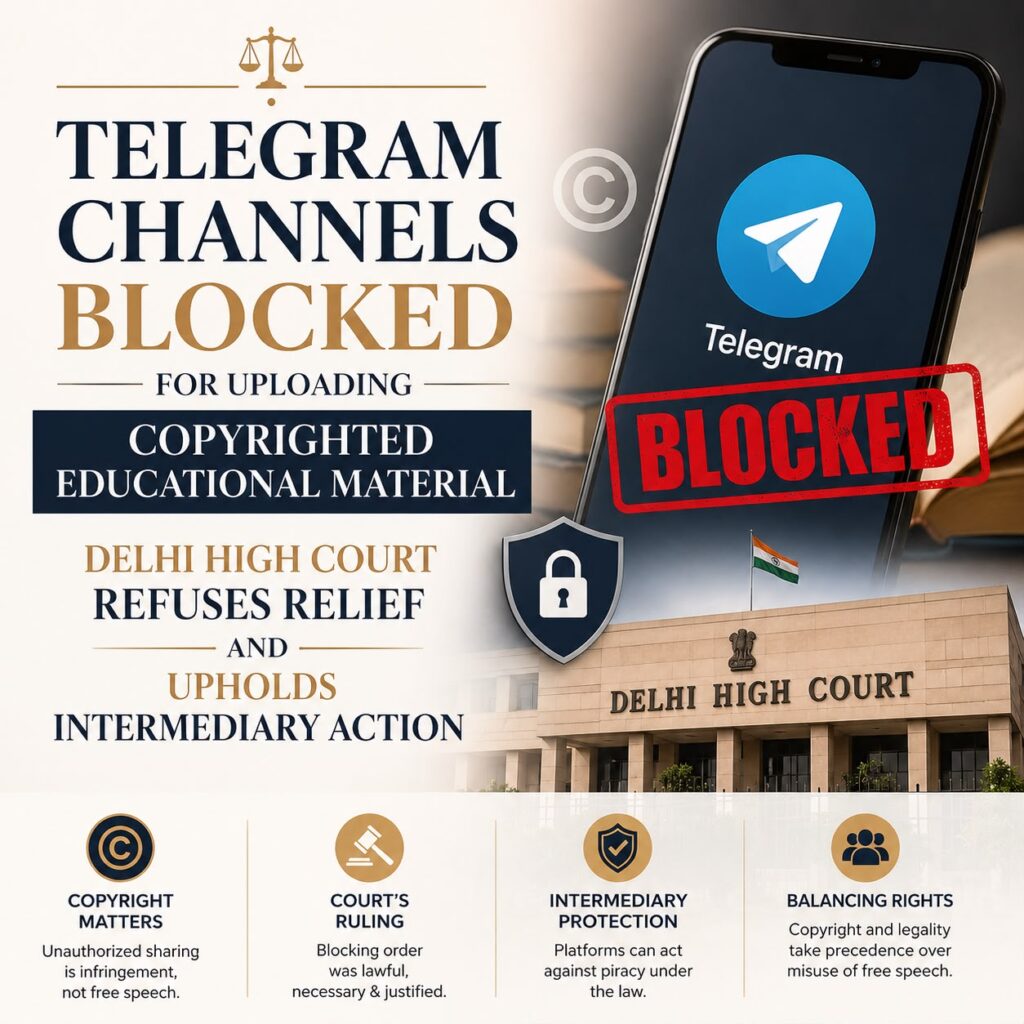
Telegram Channels Blocked for Uploading Copyrighted Educational Material: Delhi High Court Refuses Relief and Upholds Intermediary Action

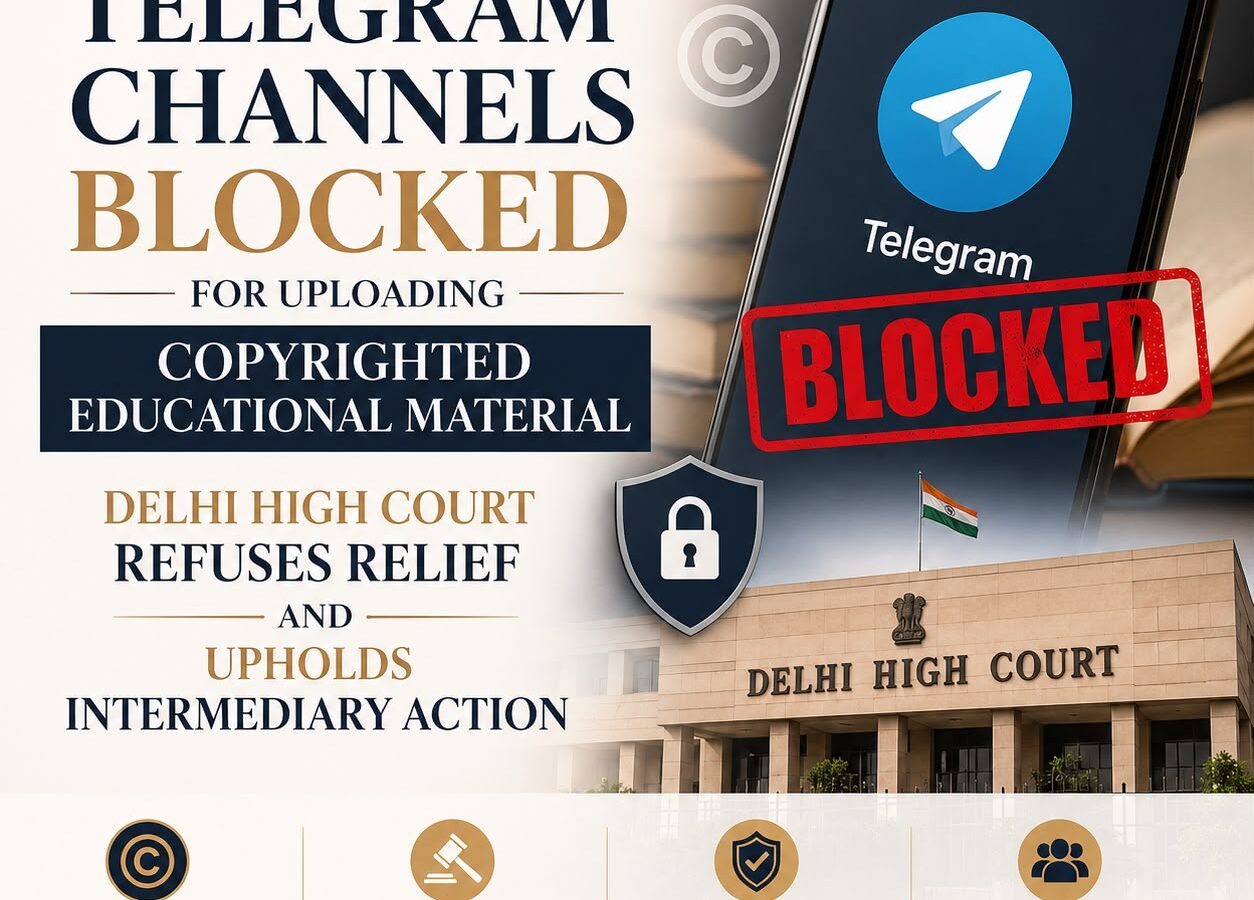
Court Finds Platform-Wide Restriction Necessary and Proportionate After Individual Takedowns Failed to Stop Mirror Channels, Bots and Examination Fraud Networks
The Delhi High Court has upheld the Central Government’s decision to temporarily block access to Telegram across India in the immediate run-up to the NEET UG 2026 re-examination, holding that the power under Section 69A of the Information Technology Act, 2000, is not necessarily confined to individual posts, accounts or URLs and may, in appropriate circumstances, extend to an entire digital platform.
Justice Tejas Karia dismissed the writ petition filed by Telegram FZ LLC and its authorised representative challenging the interim and final orders passed by the Ministry of Electronics and Information Technology.
The Court found that the temporary restriction was supported by relevant material, pursued a legitimate objective, had a rational connection with the protection of the examination process and was limited to the period considered necessary to prevent fraud, misinformation and a potential public-order situation.
The judgment assumes significance because it recognises that an entire application or platform may fall within the broad statutory definition of “information” under the Information Technology Act. However, the ruling also makes it clear that such platform-wide blocking must be justified by exceptional circumstances, supported by recorded reasons and tested against the constitutional requirement of proportionality.
Background of the Case
The dispute arose from reports concerning the misuse of Telegram in connection with the NEET UG 2026 examination.
The National Testing Agency informed MeitY that several Telegram channels, accounts and automated bots were allegedly being used to circulate fake examination papers, make false claims concerning examination leaks, collect money from students and spread misleading information about the examination.
According to the authorities, certain Telegram channels openly advertised purported access to leaked examination material and demanded amounts ranging from a few thousand rupees to several lakhs from candidates and their families.
The Government’s concern was not limited to the circulation of false examination papers. The alleged operators were also accused of obtaining candidates’ previous admit cards, active mobile numbers and other personal information under the pretext of supplying proof of access to leaked papers.
MeitY convened a meeting with Telegram and the NTA to discuss the nature and scale of the alleged misuse. Telegram submitted that it maintained an extensive content-moderation system consisting of artificial intelligence and machine-learning tools, human moderators, hash-based detection mechanisms, user-reporting systems and enforcement measures such as account restrictions and permanent bans.
Telegram also acted upon a list of offending URLs supplied by the authorities and disabled several identified channels and accounts.
However, the authorities maintained that individual takedowns had not solved the problem. Whenever a particular channel or account was removed, the operators allegedly created mirror channels, reserve channels, backup groups, burner accounts and rotated handles. Existing subscribers could then be redirected to the replacement channels, enabling the alleged fraudulent activity to resume almost immediately.
Government Orders Temporary Blocking of Telegram
On 16 June 2026, MeitY passed an interim order under Section 69A of the Information Technology Act and the Information Technology Blocking Rules, 2009.
The order directed that:
- Telegram and its associated URLs be blocked across India within one hour until 22 June 2026;
- Telegram disable its message-editing feature until 30 June 2026;
- Internet service providers and application stores prevent public access to Telegram during the specified period; and
- The matter be placed before the Committee constituted under Rule 7 of the 2009 Blocking Rules for consideration and recommendation.
The NEET UG 2026 re-examination was scheduled for 21 June 2026. The Government stated that the restriction was therefore linked to the critical period immediately preceding and following the examination.
After Telegram approached the Delhi High Court, the Committee under the Blocking Rules heard the parties and passed a final order on 18 June 2026 confirming the interim directions.
Telegram’s Challenge Before the High Court
Telegram argued that the Government’s action was unlawful, excessive and disproportionate.
Its principal submission was that Section 69A authorises the Government to block access to specific “information” generated, transmitted, received, stored or hosted through a computer resource. According to Telegram, the provision did not empower the Government to block an entire intermediary platform.
Telegram further argued that a platform-wide restriction affected approximately 150 million users in India, including millions of students, teachers and other persons who used the application for lawful purposes.
It submitted that the restriction resulted in the blocking of legitimate and constitutionally protected communication along with the allegedly unlawful content.
Telegram also contended that it had consistently cooperated with the authorities and had taken down identified channels, accounts and URLs. Therefore, less restrictive alternatives remained available, including the blocking of specific posts, channels, accounts, bots or URLs.
Reliance was placed on the Supreme Court’s decision in Anuradha Bhasin v. Union of India, in which it was held that restrictions affecting fundamental rights must satisfy the doctrine of proportionality and that the State must adopt the least restrictive effective measure available.
Telegram also questioned the decision-making process. It alleged that the interim order did not contain sufficient reasons and reflected a mechanical acceptance of the allegations made by the requesting agencies.
According to Telegram, the subsequent final order could not be used to supply or supplement reasons that were absent from the original emergency direction.
Government Defends Platform-Wide Restriction
The Union Government defended the action by pointing to the scale, persistence and technical characteristics of the alleged misuse.
It argued that approximately 22 lakh candidates were appearing for the NEET UG 2026 examination and that fraudulent claims concerning paper leaks had the potential to undermine public confidence in the examination process, defraud students and their families and create a serious public-order situation.
The authorities submitted that they had initially adopted narrower measures by identifying and seeking the removal of specific channels and accounts. These measures were allegedly rendered ineffective because of Telegram’s capacity to facilitate rapid creation of mirror channels, audience migration, automated bots and large-scale dissemination of information.
The Government also relied upon Telegram’s message-editing functionality. It was alleged that a message or file posted before an examination could subsequently be edited after the examination while retaining an earlier timestamp.
This could enable fraudulent actors to replace an earlier attachment with the actual examination paper after the examination and falsely claim that the paper had been leaked beforehand.
The Government maintained that the temporary disabling of the editing feature was therefore an examination-specific precaution intended to prevent “backdating scams.”
It further argued that the statutory definition of “information” under Section 2(1)(v) of the Information Technology Act expressly includes codes, computer programmes, software and databases.
Since a digital platform is made up of software, source code, databases, communication protocols and computer programmes, the Government contended that an entire application could fall within the meaning of “information” for the purpose of Section 69A.
Questions Considered by the Court
The High Court considered two principal questions:
First, whether the interim and final orders were vitiated by non-application of mind or failure to record sufficient reasons.
Second, whether temporarily blocking access to the entire Telegram platform was legally permissible and proportionate.
Emergency Order Contained Sufficient Reasons
The Court rejected Telegram’s contention that the interim order lacked sufficient reasons.
It observed that the order referred to the circulation of purported examination papers, misleading information, fraudulent activities, repeated creation of replacement channels and the possible effect of such activities on the integrity of the examination and public order.
The order also recorded that channel-by-channel takedowns had failed to prevent the re-emergence of the alleged fraudulent ecosystem.
The Court held that reasons are an essential component of administrative decision-making because they demonstrate a connection between the material considered and the conclusion reached.
In the present case, however, the emergency order disclosed a direct and substantial nexus between the identified threat and the temporary directions issued by the Government.
The Court also noted that the statutory scheme permits an emergency interim direction to be issued before a full hearing, provided that the affected intermediary is subsequently granted an opportunity to present its case before the Committee.
Telegram had been heard after the interim order, and its submissions were considered before the final order was passed.
The final order was based on communications received from the NTA, reports of the Indian Cybercrime Coordination Centre, Telegram’s written submissions, the minutes of meetings and oral arguments advanced before the Committee.
The Court therefore found no procedural illegality or non-application of mind.
Section 69A Can Extend to an Entire Application or Platform
The Court then addressed Telegram’s central legal argument that Section 69A permits only the blocking of particular information and not an entire intermediary platform.
Section 69A empowers the Central Government to block public access to any information generated, transmitted, received, stored or hosted in a computer resource where such action is necessary or expedient on specified grounds, including public order and the prevention of incitement to cognizable offences relating to public order.
The Court examined the definition of “information” under Section 2(1)(v), which includes data, messages, text, images, sound, voice, codes, computer programmes, software and databases.
It observed that the definition is broad and technologically neutral. Restricting it only to individual posts, files, messages, accounts or channels would unduly narrow the operation of Section 69A.
An application or online platform is a computer programme or software designed to perform specific functions for users. It comprises code, databases, software infrastructure and communication facilities.
Since computer programmes and software are expressly included within the definition of “information,” the Court held that there was no legal basis to exclude an application or platform from the scope of the provision.
Accordingly, the Court concluded that MeitY possessed the legal authority under Section 69A to direct the blocking of public access to Telegram.
Individual Takedowns Were Found Ineffective
The Court distinguished between Telegram’s compliance with individual takedown directions and the broader justification for the temporary platform-wide restriction.
It observed that the removal of specific channels or accounts was not decisive because the Government’s action was based on the overall architecture of the platform and the ability of unlawful operators to evade targeted enforcement.
Telegram permits the creation of large public channels, automated bots, extensive file sharing and username-based communication. Its cloud-based architecture enables content to be stored and retrieved across devices and allows information to be disseminated to a large audience within a short time.
The Court noted that disabling a particular channel did not necessarily eliminate the network of subscribers connected with it. Operators could create replacement channels and redirect users to them, allowing the alleged activity to continue despite repeated takedowns.
The Government orders had expressly recorded that reporting and removing individual channels, groups, accounts and bots had repeatedly proved inadequate.
The Court accepted that the rapid creation of backup and mirror channels made real-time segregation of legitimate content from fraudulent material impracticable during the limited period immediately preceding the examination.
Temporary Blocking Satisfied the Proportionality Test
Applying the principles laid down in Anuradha Bhasin, the Court examined whether the restriction pursued a legitimate objective, had a rational connection with that objective, was necessary and represented the least restrictive effective measure available.
The Court identified the protection of the integrity of a national-level medical entrance examination, prevention of fraud and preservation of public order as legitimate objectives.
It found a rational connection between those objectives and the restriction imposed, since the alleged fraudulent activities were being conducted through Telegram channels, bots and associated infrastructure.
On necessity, the Court placed considerable emphasis on the failure of targeted takedowns. Mirror channels, backup accounts and audience migration enabled the alleged operators to continue their activities despite earlier interventions.
The Court also considered the limited duration of the measure. Access to Telegram was blocked only until 22 June 2026, one day after the examination, while the message-editing feature was to remain disabled until 30 June 2026.
According to the Court, the limited temporal operation demonstrated that the action was narrowly tailored to the examination window rather than being an indefinite or unrestricted prohibition.
The Court acknowledged that the restriction affected lawful users of Telegram. However, it held that the measure was justified by the exceptional circumstances, the interests of approximately 22 lakh examination candidates and the inability of narrower measures to effectively address the identified risk within the available time.
The platform-wide restriction was consequently held to be the least restrictive effective measure available in the prevailing circumstances.
Decision
The Delhi High Court held that the interim and final orders did not suffer from non-application of mind, procedural irregularity or lack of reasons.
It further held that Section 69A of the Information Technology Act empowers the Central Government, in appropriate cases, to block access to an entire application or digital platform because the statutory definition of “information” includes software, codes, computer programmes and databases.
The temporary restriction on Telegram was found to be necessary, proportionate, event-specific and limited in duration.
Accordingly, the Court dismissed Telegram’s writ petition and upheld the Government’s directions temporarily blocking access to the platform and disabling its message-editing functionality.
Why the Judgment Matters
The judgment significantly expands the practical understanding of the Government’s blocking powers under Section 69A.
It confirms that the power is not invariably restricted to particular posts, URLs or user accounts. Where the technological architecture of a platform enables persistent and systematic evasion of targeted takedowns, the Government may direct temporary blocking of the entire platform, provided that statutory safeguards are followed.
At the same time, the ruling does not grant an unrestricted power to impose platform-wide bans.
The legality of such action would continue to depend upon the existence of relevant material, recorded reasons, compliance with the Blocking Rules, a legitimate statutory ground and satisfaction of the proportionality test.
The nature of the threat, effectiveness of alternative measures, duration of the restriction and impact on lawful users would remain central to judicial review.
In the present case, the proximity of the NEET UG 2026 re-examination, repeated failure of individual takedowns, rapid creation of mirror channels and the time-bound character of the restriction persuaded the Court that exceptional intervention was justified.
Key Takeaway
An entire online platform may be temporarily blocked under Section 69A of the Information Technology Act where the platform itself falls within the broad definition of “information,” targeted content-removal measures have proved ineffective and the restriction is supported by reasons, limited in duration and proportionate to a legitimate public-order objective.
Case: Telegram FZ LLC & Another v. Union of India & Others
Court: High Court of Delhi
Case Number: W.P.(C) 8259/2026
Judge: Justice Tejas Karia
Date of Judgment: 19 June 2026
Result: Writ petition dismissed; temporary blocking directions upheld
Also Read:
Can an Employee Be Fired for Insulting Women at Work? Bombay High Court Upholds Dismissal